
 joyce@taisenfurniture.com
 0086 15356090777


- Hard headboards generally simplify cleaning, inspection, and phased replacement across a large hotel portfolio.
- Upholstered headboards create a softer visual identity and may improve perceived comfort, but fabric selection and maintenance planning are critical.
- Chain hotels should evaluate the complete hotel headboard assembly rather than choosing a surface finish alone.
- A prototype room, written acceptance criteria, and a replacement plan reduce rollout risk across multiple properties.
Choosing between an upholstered headboard and a hard hotel headboard is a portfolio decision, not only a design decision. For example, the U.S. Access Board’s 2010 ADA Standards specify a 30-by-48-inch clear floor space for many accessible approaches, showing why headboard depth and adjacent furniture must be coordinated early. This guide compares both options for chain hotels and explains how to select, specify, test, and maintain them.
Hotel Headboard Selection Starts with the Operating Model
The strongest selection is the one that matches how the hotel will clean, inspect, repair, and refresh rooms over time.
A hotel headboard is part of the room’s visual identity, but it also affects housekeeping labor, wall protection, guest safety, installation sequencing, and future renovation work. A chain hotel may need the same appearance in hundreds of rooms while adapting dimensions to different room types, wall conditions, electrical layouts, and local codes.
Upholstered and hard constructions can both perform well when engineered correctly. The difference is that upholstery adds a replaceable textile layer that introduces additional variables, including abrasion, staining, seam durability, color consistency, cleaning chemistry, and flammability documentation.
Upholstered Headboard vs. Hard Headboard
Upholstered headboards usually provide the strongest design impact, while hard headboards usually provide the simplest operating model.
| Evaluation factor | Upholstered headboard | Hard headboard | Planning implication |
|---|---|---|---|
| Visual softness | High | Low to medium | Upholstery suits lifestyle, boutique, and premium room concepts. |
| Routine cleaning | Requires fabric-specific procedures | Usually simpler wipe-down care | Hard finishes are often easier for standardized housekeeping. |
| Stain visibility | Depends on textile and color | Depends on laminate, veneer, paint, or finish | Sample testing should use the hotel’s actual cleaning products. |
| Component replacement | May allow textile re-covering | May allow panel replacement or refinishing | Both can support repair if components are designed for access. |
| Acoustic contribution | Potentially higher | Usually limited | Do not treat a headboard as a substitute for a tested acoustic system. |
| Brand standardization | Depends heavily on textile supply | Often easier across properties | Specify approved finishes, colors, edge details, and tolerances. |
When Upholstered Headboards Make Sense
Upholstered headboards are most suitable when guest perception and room atmosphere justify the additional maintenance controls.
They can create visual warmth, introduce color or pattern, and conceal a broad wall area without making the room feel overly rigid. In a premium chain, a tailored headboard with durable contract fabric may support the brand story more effectively than a plain wood panel.
However, procurement teams should distinguish decorative upholstery from tested commercial upholstery. Ask for the fabric construction, cleaning instructions, abrasion information where available, colorfastness data, seam design, backing method, and applicable fire-performance documentation. In the United States, requirements can vary by product type, jurisdiction, and use case; the U.S. flammability standard in 16 CFR Part 1633 is relevant to certain mattress and foundation products, but it should not be assumed to certify every upholstered headboard assembly.
For housekeeping, the key question is not whether fabric can be cleaned. The key question is whether the approved cleaning process can be repeated without damaging color, texture, seams, or backing.
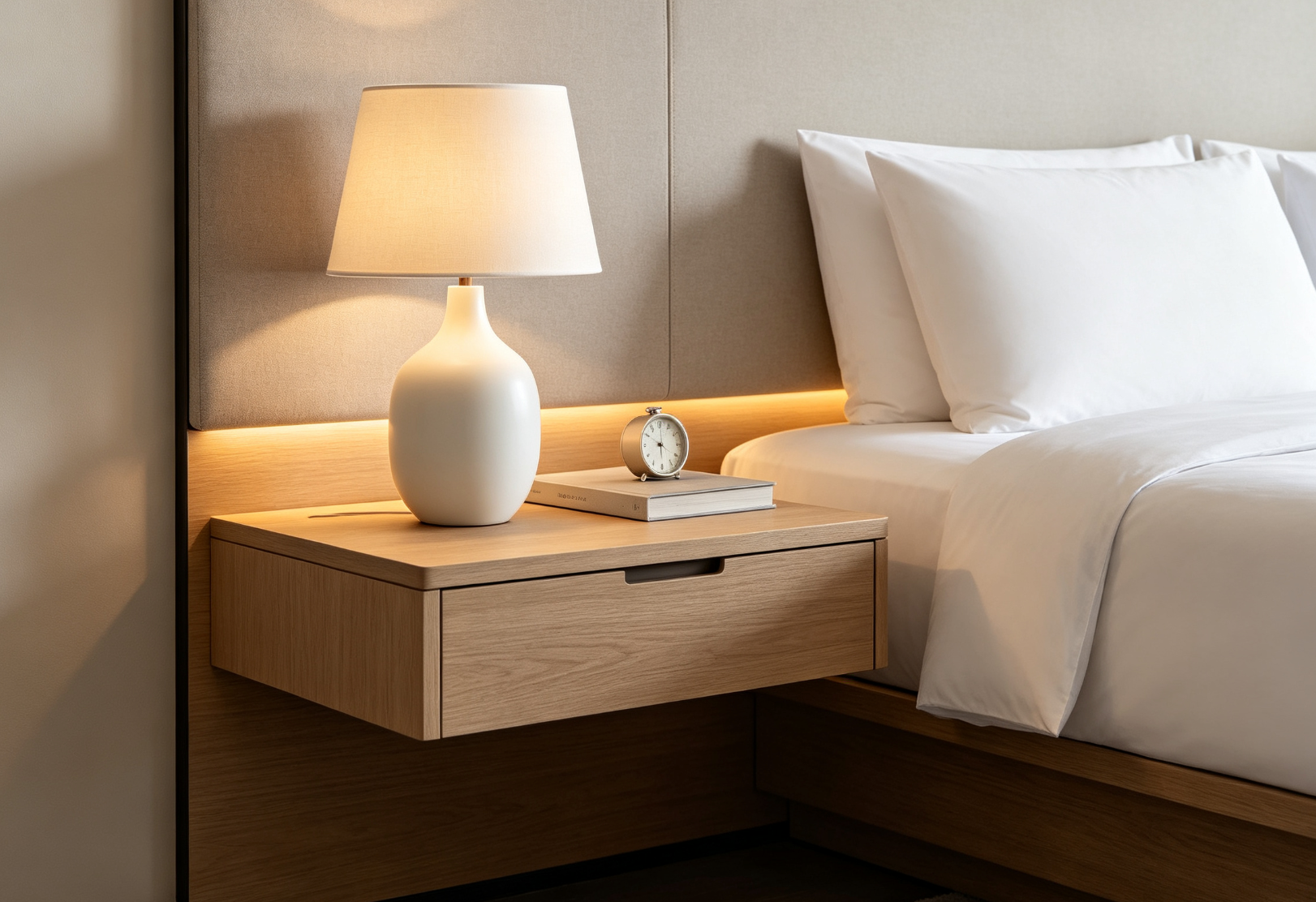
When Hard Headboards Make Sense
Hard headboards are usually the more predictable choice for high-turnover rooms, limited-service properties, and portfolios that prioritize low-touch maintenance.
Hard surfaces may use veneer, high-pressure laminate, decorative panels, painted finishes, engineered wood, or other specified materials. Their main advantage is process consistency: housekeeping teams can inspect the surface quickly, maintenance teams can identify damage easily, and replacement panels can be standardized by room type.
Hard does not mean indestructible. Poorly sealed edges can absorb moisture, thin decorative layers can chip, and unsupported panels can move or crack. The specification should therefore cover substrate, edge treatment, mounting method, wall protection, hardware access, and repairability.
Hard headboards also work well when the design uses layered materials. A wood or laminate panel can be combined with a removable upholstered insert, an integrated reading-light zone, or a replaceable accent panel. This hybrid approach can preserve a chain hotel’s maintenance discipline while adding warmth where guests see and touch the furniture most often.
How Chain Hotels Should Compare the Options
Chain hotels should use a weighted decision matrix rather than relying on a showroom impression.
| Decision criterion | Suggested weight | Upholstered score | Hard score | Reason for review |
|---|---|---|---|---|
| Cleaning simplicity | 1-5 | 2-4 | 4-5 | Score depends on fabric performance and approved chemicals. |
| Design expression | 1-5 | 4-5 | 3-5 | Consider room tier and brand positioning. |
| Repair strategy | 1-5 | 3-5 | 3-5 | Score depends on removable and replaceable components. |
| Supply consistency | 1-5 | 2-4 | 4-5 | Textile availability can affect multi-property rollout. |
| Guest contact comfort | 1-5 | 4-5 | 2-4 | Relevant when guests sit up in bed regularly. |
| Renovation flexibility | 1-5 | 3-5 | 3-5 | Review access to walls, wiring, and replacement parts. |
The scores in this table are an editorial planning framework, not laboratory results. Each hotel group should set its own weights after reviewing housekeeping procedures, room economics, brand requirements, and local compliance obligations.
Material and Construction Questions to Put in the Specification
A durable hotel headboard is defined by its complete assembly, not by the visible finish alone.
- Define the substrate, moisture resistance, edge treatment, finish system, and cleaning compatibility.
- State whether the headboard is wall-mounted, bed-mounted, floor-supported, or installed as a combination system.
- Provide access requirements for electrical outlets, USB ports, reading lights, switches, and maintenance panels.
- Specify visible joints, reveals, corner conditions, fasteners, and alignment requirements.
- Identify replacement parts, spare-finish rules, packaging protection, and labeling for multi-property distribution.
- Require a full-size or representative prototype before mass production.
Accessibility coordination should happen before drawings are frozen. Headboard width, bedside clearance, outlet location, lighting controls, and bed position can affect room usability. The federal accessibility reference should be reviewed with the project’s architect and local authority rather than treated as a furniture-only checklist.
Maintenance, Fire Documentation, and Quality Control
The most reliable chain-hotel program connects material approval with cleaning trials, production inspection, and installation verification.
For upholstered options, create a cleaning test using the actual or proposed housekeeping chemicals. Record visible change, seam behavior, color transfer, odor, and drying requirements. For hard options, test edge impact, scratch visibility, moisture exposure, hardware loosening, and repair appearance.
Fire documentation must be specific to the relevant assembly and jurisdiction. Do not use a general material statement as a substitute for project compliance review. The U.S. Environmental Protection Agency’s formaldehyde resources explain why composite wood products and emissions documentation may matter in procurement, especially when engineered wood panels are used.
Factory quality control should cover incoming materials, first-article approval, dimensional checks, finish matching, hardware operation, packaging, and final inspection. A chain hotel should also approve a control sample that remains available for future comparison. This reduces disputes when a later production batch appears visually different from the original installation.
Budget and Total Cost of Ownership
The lowest purchase price is not necessarily the lowest hotel headboard cost over the property’s operating life.
| Cost category | Upholstered option | Hard option | What procurement should measure |
|---|---|---|---|
| Initial fabrication | Fabric, padding, sewing, and panel work | Substrate, finish, edge, and panel work | Compare complete installed assemblies. |
| Housekeeping labor | Spot treatment and inspection may vary | Routine wipe-down may be more standardized | Use a room trial instead of assumptions. |
| Damage response | Re-covering may be possible | Panel replacement or refinishing may be possible | Price critical spare parts and labor. |
| Replacement risk | Can increase if fabric is discontinued | Can increase if finish or substrate is discontinued | Require a documented continuity plan. |
| Installation risk | Protect textile from site damage | Protect edges and finished faces | Review packaging, staging, and access conditions. |
A practical comparison should include purchase price, freight, installation, cleaning time, repair frequency, spare inventory, and the effect of a partial renovation. For a chain, the ability to reproduce an approved appearance several years later can be more valuable than a small initial saving.
A Practical Recommendation for Chain Hotels
For most standardized chain-hotel rooms, choose a hard or hybrid headboard unless the design brief clearly requires full upholstery.
Hard construction is generally the better baseline for economy, limited-service, extended-stay, and high-occupancy environments where fast inspection and repeatable maintenance are priorities. Upholstered construction is more compelling for upscale, resort, lifestyle, and boutique applications where tactile comfort and visual differentiation contribute directly to the guest experience.
The most balanced specification often uses a robust hard outer frame with a removable upholstered insert. That arrangement can separate high-wear surfaces from decorative elements and make future refurbishment more manageable. It still requires engineering review, representative testing, and clear documentation.
When comparing suppliers, evaluate their ability to translate brand standards into shop drawings, prototypes, approved samples, production controls, coordinated packaging, and site-ready documentation. A project-level hotel furniture partner should be assessed on execution across the room package, not only on the appearance of one headboard.
FAQ
Are upholstered headboards better for luxury hotels?
They can be, especially when the design depends on softness, texture, color, or a more residential guest-room atmosphere. The decision should still include fabric durability, cleaning procedures, fire documentation, replacement availability, and long-term color control.
Are hard hotel headboards easier to maintain?
They are often easier to inspect and clean because the surface can be standardized. Performance still depends on the finish, edge sealing, mounting system, and the chemicals used by housekeeping.
Can a hotel combine upholstered and hard materials?
Yes. A hybrid headboard can use a hard structural frame with a removable upholstered panel or insert. This can provide design flexibility while making high-wear or damaged components easier to replace.
What should a chain hotel request from a headboard supplier?
Request shop drawings, material samples, finish samples, a prototype, cleaning guidance, fire-related documentation where applicable, installation details, packaging specifications, spare-part recommendations, and a defined approval process.
How should hotels test an upholstered headboard?
Test the proposed fabric and assembly with realistic contact, staining, cleaning, inspection, and installation conditions. Review seams, corners, backing, color change, odor, and the appearance after approved cleaning.
How should hotels test a hard headboard?
Review edge durability, finish consistency, scratch visibility, moisture exposure, hardware access, panel alignment, wall attachment, and the visual quality of local repairs or replacement panels.
Should the headboard be selected before the bed and bedside tables?
No. The headboard should be coordinated with the bed, bedside tables, lighting, outlets, controls, wall protection, accessibility clearances, and the overall casegoods package before final approval.
About the Supplier
Taisen Furniture is a project-oriented hotel furniture supplier serving global hospitality programs with integrated design, manufacturing, sales, and delivery capabilities. Its scope includes guest-room casegoods, hotel headboards, lobby furniture, chairs, bathroom vanities, lighting, curtains, and decorative packages. The team supports custom hotel furniture programs that require brand coordination, sampling, production control, and multi-property delivery. Explore the hotel furniture portfolio to review available project solutions and begin a supplier discussion.

Post time: Sep-17-2026