
 joyce@taisenfurniture.com
 0086 15356090777


- Material selection, moisture resistance, edge treatment, and finish durability strongly influence the vanity cabinet price.
- Custom dimensions, concealed services, lighting, plumbing access, and unusual detailing increase design and manufacturing complexity.
- Volume, repeatability, packaging, shipping terms, and delivery schedule can materially change the project quotation.
- A useful comparison separates product cost from design, sampling, inspection, freight, installation, and after-sales responsibilities.
Custom hotel bathroom furniture pricing depends on the complete project specification rather than the cabinet alone. Accessibility can also affect design: the 2010 ADA Standards specify a minimum clear floor space of 30 by 48 inches for a forward approach, making space planning part of the commercial decision. This guide explains how hotel buyers can compare vanity cabinet quotations, control lifecycle cost, and protect brand consistency.
What determines custom hotel bathroom furniture pricing?
The most important pricing principle is that a quotation reflects the complete bill of materials and delivery responsibility, not simply the visible face of the furniture.
For a hotel bathroom package, the supplier may be pricing vanity cabinets, mirrors, open shelves, tall storage, wall panels, countertops, drawer systems, hardware, lighting integration, plumbing cutouts, protective packaging, and installation support. Two quotations that appear to cover the same vanity may therefore contain very different scopes.
Before requesting prices, the procurement team should define room type, quantity, room dimensions, drawings, finish schedule, service locations, brand standards, delivery destination, required samples, and acceptance criteria. Clear inputs reduce the allowance that a manufacturer must add for uncertainty.
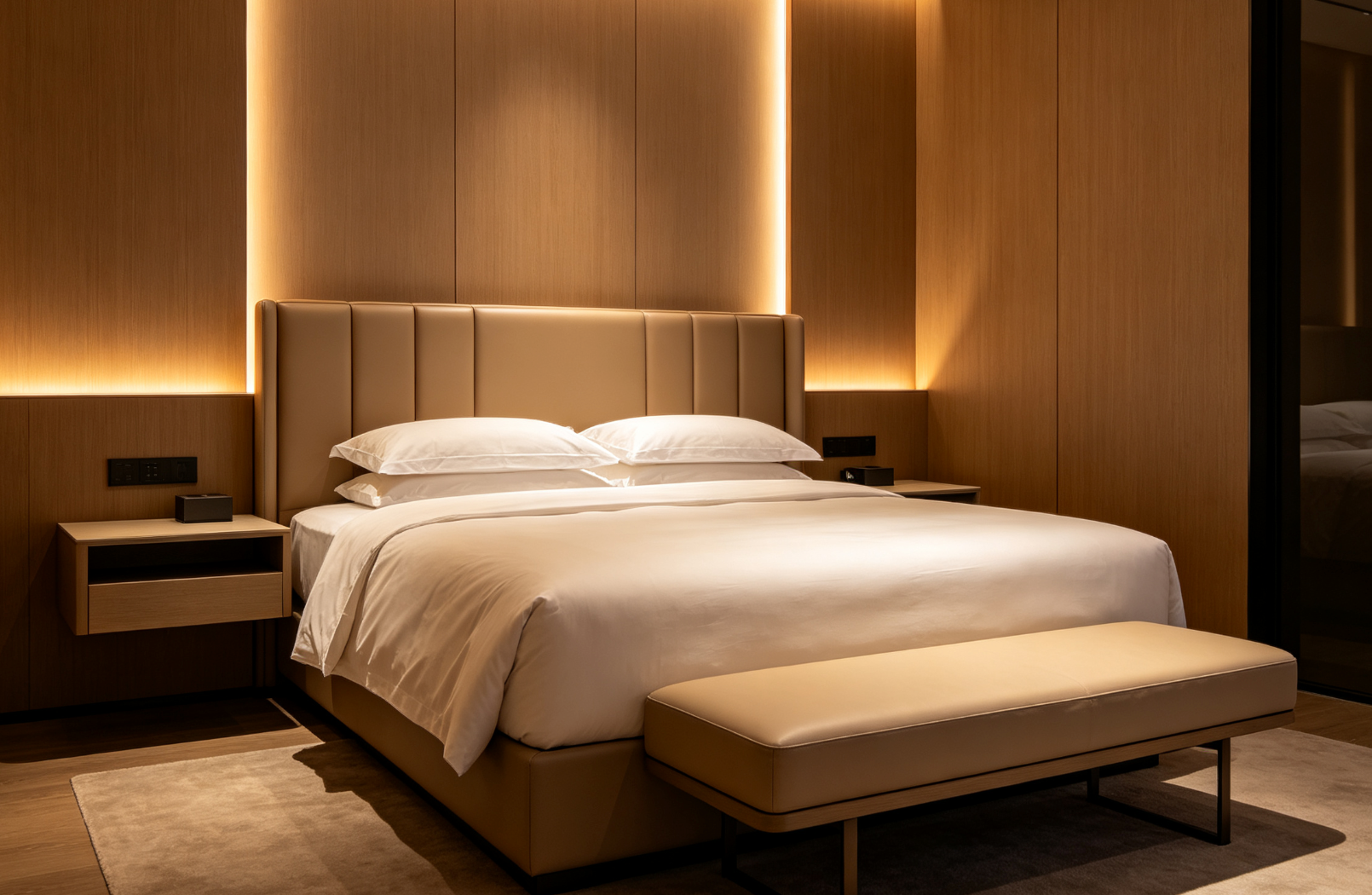
Material and construction choices for a vanity cabinet
Material selection affects both the purchase price and the bathroom furniture’s expected maintenance burden.
Common construction options include moisture-resistant engineered wood, plywood-based panels, solid timber components, compact laminate, metal frames, solid-surface elements, stone tops, and mixed-material assemblies. The right choice depends on humidity exposure, cleaning chemicals, design intent, local sourcing, and the hotel’s operating model.
Bathroom conditions make edge protection especially important because water can enter through exposed cut edges, joints, drillings, and poorly sealed countertop interfaces. A lower-priced panel can become an expensive choice if swelling, delamination, staining, or hardware failure causes room repairs.
Finish specification also changes cost. High-pressure laminate, textured laminate, veneer, lacquer, painted surfaces, decorative foil, and specialty metal finishes differ in material cost, preparation time, color consistency, and repairability. A hotel buyer should ask for a physical finish sample and define whether visible variation is acceptable.
| Pricing element | Buyer decision | Illustrative impact score | Verification question |
|---|---|---|---|
| Panel material | Moisture resistance and appearance | 1 to 5 | What panel, core, and test documentation are included? |
| Edge treatment | Sealed, lipped, profiled, or exposed edges | 1 to 5 | How are sink, countertop, and service cut edges protected? |
| Surface finish | Standard, textured, painted, veneer, or specialty finish | 1 to 5 | Is the quoted finish based on an approved production sample? |
| Countertop | Laminate, solid surface, stone, or another specified material | 1 to 5 | Are cutouts, backsplashes, joints, and sealing included? |
| Hardware | Standard or specified hinges, runners, pulls, and accessories | 1 to 5 | What warranty and replacement process apply to the hardware? |
The impact score in this table is a planning tool, not a market price index. Buyers should use it to identify items requiring a detailed technical comparison.
How design complexity changes the quotation
Customization increases cost when it adds engineering work, special tooling, slower production, additional inspection, or a higher risk of installation errors.
A standard cabinet module is generally easier to manufacture than a vanity designed around irregular walls, offset plumbing, concealed waste pipes, integrated lighting, curved panels, floating supports, or several finish transitions. Repeated room layouts can reduce engineering effort, while many unique room types increase it.
Design complexity also includes coordination with other trades. A vanity cabinet may need exact relationships with tile thickness, wall backing, mirror position, electrical outlets, plumbing traps, accessibility clearances, and floor levels. If these interfaces are unresolved, the supplier may price contingencies or later variation work.
For a renovation, site conditions are another cost driver. Existing walls may not be square, old fixtures may require removal, and delivery routes may be restricted. A new-build project usually provides more predictable installation conditions, but it may demand stricter coordination with the general contractor and interior designer.
Questions that reveal hidden design cost
- Are all room types based on approved shop drawings?
- Are left-hand and right-hand versions treated as separate models?
- Who confirms plumbing, electrical, and wall reinforcement locations?
- Are mock-up revisions included in the quoted engineering scope?
- Does the price include templates for countertop and service openings?
Volume, standardization, and hotel project economics
Order volume affects unit pricing because design, sampling, setup, purchasing, and inspection activities can be distributed across more units.
Large projects benefit most when the buyer standardizes dimensions, finishes, hardware, and packaging across room types. However, a large quantity does not automatically guarantee a lower total cost. Frequent design changes, split deliveries, low release quantities, and long storage periods can offset volume advantages.
For a hotel group, repeat orders can create additional value when the supplier retains approved drawings, finish references, and quality checkpoints. The commercial benefit comes from repeatability, not merely from placing a large first order.
| Project condition | Typical commercial effect | Risk level for budget control | Recommended action |
|---|---|---|---|
| One approved module repeated across rooms | Lower engineering repetition | Low | Lock the approved module and finish schedule |
| Several room types with minor variations | Moderate setup and inspection work | Medium | Create a controlled room-type matrix |
| Many unique layouts | Higher drawing and coordination effort | High | Price engineering and mock-up revisions separately |
| Phased releases | Potentially higher purchasing and logistics complexity | Medium | Define release dates, minimum batches, and storage terms |
| Urgent replacement or renovation order | Expedited production and freight exposure | High | Confirm a realistic critical-path schedule before purchase |
The table compares planning conditions rather than guaranteed supplier outcomes. The contract should identify which assumptions control the final price.
Hardware, durability, and maintenance cost
Hardware selection influences the user experience, service life, and replacement process of a vanity cabinet.
Important components include hinges, drawer runners, adjustable legs, wall brackets, handles, locks, soft-close mechanisms, and removable access panels. A hospitality buyer should compare load requirements, corrosion resistance, adjustment range, spare-part availability, and the ease of replacing a component without damaging surrounding finishes.
Durability is not only a product attribute; it is also a maintenance strategy. A removable plumbing access panel may reduce service time. A replaceable drawer front may avoid replacing the entire cabinet. Standardized hardware can simplify spare-parts purchasing across multiple properties.
Cleaning chemicals should be considered during finish approval. The United States Environmental Protection Agency formaldehyde resource explains the regulatory context surrounding composite wood products, which is relevant when a project specifies engineered wood panels for hotel interiors. Buyers should request the documentation applicable to the destination market and the exact panel products used.
Brand standards, compliance, and project documentation
Brand compliance adds value when it converts design requirements into repeatable production controls.
International hotel projects may require approved finishes, specific dimensions, accessibility provisions, flame or smoke documentation for relevant components, sustainability declarations, packaging rules, and inspection procedures. The cost depends on which requirements apply to the product and how much documentation the supplier must prepare.
Accessibility should be coordinated at the room-design stage rather than corrected after production. The ADA standard is one reference for projects in the United States, but local building codes, jurisdictional requirements, and brand standards may also apply. The supplier should not be expected to infer legal requirements from a product image.
Environmental claims also require careful wording. The Federal Trade Commission Green Guides provide guidance on environmental marketing claims in the United States. A buyer should request precise evidence for any claim about recycled content, responsible sourcing, emissions, or environmental preference instead of accepting broad labels.
Freight, packaging, installation, and total delivered cost
Logistics can change the real cost more than a small difference in factory unit price.
Bathroom furniture often requires corner protection, moisture-resistant wrapping, carton identification, palletization, and room-by-room labeling. Strong packaging may increase packaging cost while reducing damage, rework, and site delays. The best packaging specification depends on transport mode, handling points, storage conditions, and whether the project uses consolidated or direct delivery.
Commercial terms should state whether the quotation includes export packing, inland transport, port charges, ocean freight, insurance, customs responsibilities, last-mile delivery, unloading, installation, and disposal of packaging. A low ex-works price cannot be compared directly with a delivered-and-installed quotation.
Installation responsibility is equally important. If the supplier provides only cabinets, the contractor may need to complete leveling, wall fixing, countertop fitting, sealing, mirror coordination, and final adjustment. If the supplier provides installation support, the price may include drawings, site supervision, or a commissioning procedure.
A practical process for comparing quotations
The safest procurement process compares like-for-like scope before comparing unit prices.
- Issue one controlled specification containing drawings, dimensions, finishes, hardware, quantities, room types, and delivery requirements.
- Request a line-item quotation that separates cabinet bodies, fronts, tops, hardware, accessories, packaging, freight, installation, and documentation.
- Approve a representative sample or mock-up before mass production, including finish, edge details, joints, doors, drawers, and service access.
- Define inspection points for incoming materials, first article approval, in-process production, final inspection, packing, and loading.
- Record exclusions, assumptions, variation rates, lead-time triggers, warranty scope, spare parts, and replacement procedures in the purchase contract.
A procurement team should also evaluate communication quality. Accurate drawings, prompt clarification of contradictions, and transparent change control are practical indicators of project maturity.
How to reduce price without reducing performance
The most reliable savings come from simplifying the system rather than removing essential quality controls.
Standardize cabinet widths where the room plan allows it, reduce unnecessary finish changes, use one approved hardware family, coordinate plumbing openings before production, and combine compatible shipments. Consider value engineering at the mock-up stage, when design changes are less disruptive.
Do not remove moisture protection, service access, packaging, or inspection merely to reach a lower unit price. These items can prevent higher costs caused by damaged goods, site modifications, room downtime, and inconsistent guest-room appearance.
For a coordinated hotel package, buyers can review hotel bedroom furniture, hotel lobby furniture, and related project inquiry support as separate scopes when developing a broader FF&E procurement plan. Each category should still be evaluated against its own specification, delivery schedule, and acceptance criteria.
FAQ
What is usually included in a custom hotel bathroom furniture quotation?
It may include cabinet bodies, fronts, shelves, hardware, countertops, cutouts, finishes, packaging, drawings, inspection, delivery, and installation. The exact scope must be confirmed line by line.
Is a custom vanity cabinet more expensive than a standard cabinet?
It can be, because custom work may require additional engineering, sampling, special finishes, unique dimensions, and coordination. Repeated custom modules can reduce the effect of those setup activities.
Which material is best for hotel bathroom furniture?
There is no universal best material. The selection should balance moisture exposure, design requirements, cleaning practices, local code, repairability, availability, and lifecycle cost.
How can hotel buyers compare two vanity cabinet prices fairly?
Use the same drawings, material descriptions, finish samples, hardware schedule, quantities, packaging standard, delivery term, warranty, and installation scope for every bidder.
Does order volume always reduce the unit price?
No. Volume may distribute setup and engineering work, but split releases, many variations, storage, urgent delivery, or frequent revisions can increase the total project cost.
Why is a physical sample important?
A sample allows the team to check color, sheen, edge treatment, gaps, hardware action, countertop joints, service access, and coordination with adjacent finishes before mass production.
What should be checked during final acceptance?
Check quantities, dimensions, finish consistency, visible damage, door and drawer operation, hardware installation, labeling, accessories, packaging condition, and compliance with the approved drawings.
About the supplier
Taisen Furniture serves hotel projects with integrated design, manufacturing, sales, and delivery coordination. Its portfolio covers guest-room casegoods, lobby furniture, seating, cabinetry, bathroom furniture, lighting, curtains, and decorative accessories for hospitality environments. The project-oriented approach is suited to brand-standard conversion, repeatable room modules, renovation programs, and batch procurement. Review the relevant product scope or submit an inquiry to align drawings, samples, quantities, quality checkpoints, and delivery responsibilities.
Post time: Sep-19-2026