
 joyce@taisenfurniture.com
 0086 15356090777


- The core bedroom modules are the bed, headboard, nightstands, desk, luggage bench, wardrobe, and media cabinet.
- Hotel casegoods should be designed as a coordinated system rather than purchased as unrelated pieces.
- Accessibility, cable management, housekeeping access, material emissions, and replacement planning affect the specification.
- A project supplier should coordinate design, samples, production, packaging, delivery, and installation documentation.
Understanding the core modules in a hotel guest room furniture set helps owners and procurement teams control scope before requesting quotations. Accessibility standards provide measurable planning criteria, including a thirty-inch by forty-eight-inch clear floor space and a sixty-inch turning space in relevant applications, as described by the U.S. Department of Justice ADA Standards. This guide explains how each hotel casegoods module works, how the pieces should be coordinated, and what to confirm before approving a custom hotel furniture package.
What Is Included in a Hotel Guest Room Furniture Set?
The basic hotel guest room furniture set combines fixed and movable furniture around the guest journey. A typical specification begins with the sleeping zone, continues through work and storage functions, and then connects the bedroom to the bathroom and entry area.
| Module | Primary function | Typical quantity in one room | Specification focus |
|---|---|---|---|
| Bed base and headboard | Sleeping support and visual focal point | One bed assembly per sleeping position | Mattress compatibility, anchoring, cleanability, acoustic contact points |
| Nightstand | Bedside storage, lighting, charging | One per accessible bedside position | Drawer operation, outlet access, edge safety |
| Desk or work console | Work, dining, and device use | One work surface | Leg clearance, cable routing, surface durability |
| Luggage bench | Luggage placement and unpacking | One luggage station | Load stability, cleanable upholstery, wall protection |
| Wardrobe or closet cabinet | Hanging and folded storage | One storage zone | Hanging clearance, door swing, shelf adjustment |
| Media or television cabinet | Entertainment equipment and storage | One media zone | Ventilation, cable concealment, service access |
| Bathroom vanity cabinet | Sink support and personal-care storage | One vanity assembly | Moisture resistance, plumbing access, countertop coordination |
The quantities in this table are planning references, not universal hotel requirements. A property with twin beds may need additional nightstands, while a suite may divide the functions between a bedroom, living room, kitchenette, and entry zone.
Core Hotel Casegoods Modules Explained
Bed, Headboard, and Bedside Units
The bed wall is the functional and visual anchor of the room. A headboard can conceal wall protection, integrate reading lights, provide a finished background for the brand design, and help coordinate the nightstands with the room’s electrical layout. The specification should identify mattress dimensions, bed base construction, wall fixing, removable panels, and access for maintenance.
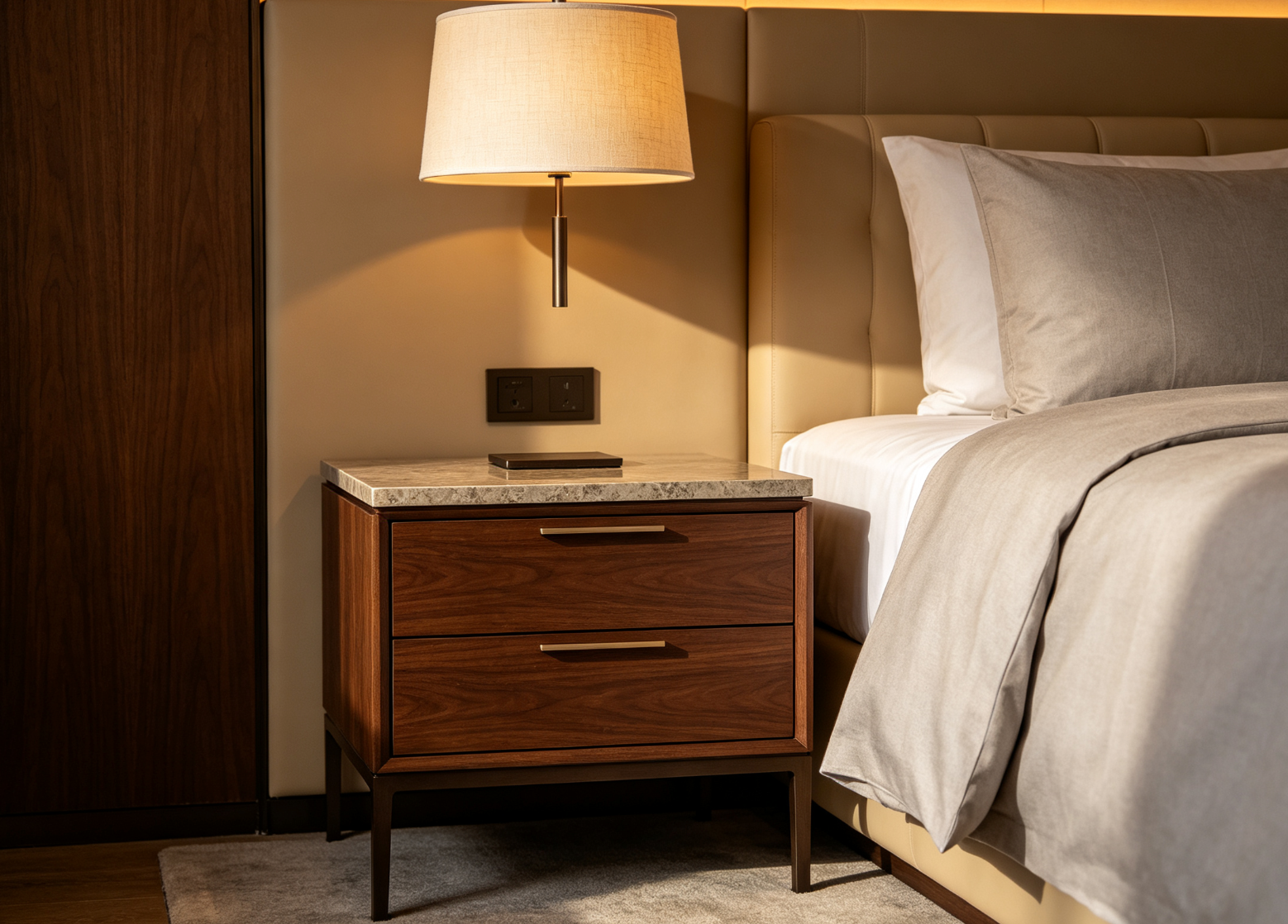
Nightstands should be designed around actual guest behavior rather than appearance alone. Guests need a stable surface for a phone, water, glasses, and room controls. Procurement teams should also confirm whether the unit requires drawers, open shelving, USB or power integration, task lighting, and a removable back panel for maintenance.
Desk, Work Console, and Luggage Bench
The work console must support both business use and flexible guest use. A desk may serve as a workstation, dining surface, vanity, or writing table, so its top finish, leg clearance, lighting, and power access should be reviewed together.
The luggage bench protects the bed from suitcase handling and creates a dedicated unpacking point. Its frame should resist repeated loading, while the upholstery or laminate surface should tolerate housekeeping chemicals and frequent contact. In compact rooms, a luggage bench may be combined with a drawer, open shelf, or low cabinet, but the combined design must remain easy to clean.
Wardrobe, Closet, and Entry Storage
Storage modules should be evaluated by how quickly guests can understand and use them. A wardrobe may include hanging rails, shelves, a safe compartment, a luggage shelf, a mirror, and a door or curtain system. The interior layout should be checked against housekeeping access, door swing, sprinkler clearance, room circulation, and the location of electrical and data services.
Accessible rooms require particular attention to reach ranges and maneuvering space. The ADA Standards specify a forward or side reach range of fifteen to forty-eight inches in the applicable conditions and define clear floor space criteria for accessible elements. Designers should verify the complete room layout with the governing code and project authority instead of applying isolated dimensions.
| Accessibility planning metric | Published value | Design implication | Reference |
|---|---|---|---|
| Clear floor or ground space | Thirty inches by forty-eight inches | Reserve usable space at applicable accessible elements | 2010 ADA Standards, Section 305 |
| Wheelchair turning space | Sixty-inch diameter circle or compliant T-shaped space | Coordinate furniture footprints and circulation paths | 2010 ADA Standards, Section 304 |
| Forward or side reach range | Fifteen to forty-eight inches | Place controls, switches, and usable storage within reach where required | 2010 ADA Standards, Section 308 |
Television Cabinet and Technology Integration
The media cabinet is no longer only a television stand. It may contain a refrigerator, drawers, luggage storage, sound equipment, network hardware, and concealed power. The specification should define ventilation, cable routes, service panels, equipment loads, and the relationship between the screen height and the viewing position.
Technology access is a common source of late changes. The furniture supplier, electrical engineer, low-voltage contractor, and hotel operator should review outlet locations and access panels before the production drawing is approved.
Bathroom Vanity Cabinet
A bathroom vanity cabinet extends the hotel casegoods package into a high-moisture environment. The supplier should coordinate the cabinet with the basin, countertop, backsplash, mirror, plumbing trap, access doors, and cleaning requirements.
Moisture-resistant construction does not eliminate the need for correct installation. Exposed edges, unsealed cutouts, standing water, and poorly ventilated compartments can reduce service life. A durable vanity specification therefore includes edge treatment, substrate selection, hardware protection, and a clear maintenance method.
How to Specify a Custom Hotel Furniture Set
The most reliable specification process starts with room functions and operating constraints, not a product catalogue. A project team should document the following before comparing supplier quotations:
- Room type, bed arrangement, accessible room variations, and total room count.
- Brand design standards, approved finishes, hardware expectations, and sample requirements.
- Electrical, lighting, television, internet, plumbing, and wall-fixing interfaces.
- Fire, accessibility, indoor-air-quality, sustainability, and local building requirements.
- Delivery sequence, packaging rules, installation responsibility, spare parts, and warranty procedure.
Material compliance should be treated as a documented requirement rather than a marketing statement. For composite wood used in regulated products in the United States, the U.S. Environmental Protection Agency formaldehyde standards list emission limits of 0.05 parts per million for hardwood plywood, 0.09 parts per million for particleboard, 0.11 parts per million for medium-density fiberboard, and 0.13 parts per million for thin medium-density fiberboard. The applicable product scope and test documentation should be confirmed for the project location and material type.
| Material category | EPA emission limit | Where it may appear | Procurement document to request |
|---|---|---|---|
| Hardwood plywood | 0.05 ppm | Veneered panels, headboards, cabinet components | Material declaration and applicable compliance documentation |
| Particleboard | 0.09 ppm | Carcass panels, shelves, drawer components | Panel classification and emissions documentation |
| Medium-density fiberboard | 0.11 ppm | Painted fronts, shaped panels, decorative details | Panel classification and emissions documentation |
| Thin medium-density fiberboard | 0.13 ppm | Thin backs, skins, and selected interior panels | Thickness category and compliance documentation |
Why Modular Coordination Matters in Hotel Projects
Modular coordination reduces installation risk because each furniture component is developed against a shared room schedule. The headboard, nightstand, desk, wardrobe, media cabinet, and vanity should use compatible finishes, reveals, hardware language, and maintenance logic.
A coordinated package also improves replacement planning. If a drawer front, hinge, leg, or shelf can be replaced without dismantling the entire cabinet, the hotel can reduce room downtime during maintenance. This is especially important for renovation work, where furniture may need to be installed in phases while the property remains partially operational.
For international hotel groups, the supplier’s value is not limited to manufacturing capacity. The supplier must interpret brand standards, issue shop drawings, manage approved samples, control finish consistency, protect components during shipment, and provide installation information that local contractors can use.
Common Purchasing Mistakes to Avoid
- Comparing prices before freezing the bill of materials and room-type variations.
- Approving a finish sample without checking its cleanability, scratch visibility, and replacement availability.
- Leaving cable access, plumbing openings, and wall fixing until after furniture production begins.
- Specifying a visually attractive wardrobe without reviewing door swing, reach range, and housekeeping access.
- Ordering casegoods without a documented packaging, inspection, spare-parts, and claims process.
A useful quotation should separate product cost from packaging, mock-up samples, delivery, installation, and optional accessories. It should also show the approved drawing revision, finish code, hardware schedule, carton identification, and inspection responsibility. These details make supplier comparisons more accurate and reduce disputes during delivery.
How to Evaluate a Hotel Furniture Supplier
The best supplier evaluation combines product capability with project execution evidence. Ask for comparable guest room references, production samples, finish boards, quality-control records, packaging photographs, and a proposed approval schedule.
For a project-level custom hotel furniture supplier, the review should cover design support, engineering, procurement of boards and hardware, production planning, export packaging, delivery coordination, and after-sales replacement. A supplier that can coordinate casegoods with seating, lighting, curtains, artwork, and bathroom furniture may reduce interface problems, but the purchaser should still require clear responsibility boundaries for every trade.
Taisen Furniture presents itself as an integrated supplier for hotel projects, with guest room furniture, public-area furniture, seating, cabinets, bathroom furniture, and related FF&E coordination. Its suitability should be assessed against the specific brand manual, room schedule, target market regulations, sample approval process, and delivery plan.
FAQ
What are the essential modules in a hotel guest room furniture set?
The essential modules are usually the bed and headboard, nightstands, desk or work console, luggage bench, wardrobe, and television or media cabinet. A bathroom vanity is commonly included when the supplier’s scope covers bathroom furniture.
What does hotel casegoods mean?
Hotel casegoods generally means hard, cabinet-based furniture made from wood, wood composites, veneers, laminates, or related panel materials. In a guest room, the term commonly covers headboards, nightstands, desks, wardrobes, media cabinets, luggage benches, and other storage units.
Should hotel furniture be custom-made?
Custom production is useful when the room has a distinctive layout, a strict brand standard, unusual service interfaces, or a coordinated finish package. Standardized modules may be more efficient when the project needs rapid replacement or multiple properties with similar room types.
How can buyers control the cost of hotel casegoods?
Cost control starts with a frozen bill of materials, repeatable room types, rationalized finishes, standard hardware where acceptable, and early coordination of electrical and plumbing interfaces. Buyers should compare total delivered scope rather than only the unit price.
What materials are suitable for hotel room cabinets?
Common choices include plywood, particleboard, medium-density fiberboard, laminate, veneer, paint, solid-surface components, and metal hardware. The correct selection depends on moisture exposure, wear, appearance, emissions requirements, cleanability, and local availability.
How do hotel furniture suppliers support renovation projects?
Renovation support may include site measurement, phased production, mock-up rooms, protective packaging, replacement of selected modules, and delivery scheduled around room releases. The project team should confirm whether demolition, installation, and disposal are included or assigned to another contractor.
What should be inspected before accepting hotel furniture?
Inspect dimensions, finish consistency, edge quality, hardware operation, drawer alignment, cable openings, wall-fixing provisions, carton labels, damage protection, and conformity with the approved drawing and sample. Record defects by room type and module so corrective action can be tracked.
About the Supplier
Taisen Furniture is a project-oriented hotel furniture supplier serving hospitality procurement teams with custom guest room furniture, hotel casegoods, public-area seating, cabinets, bathroom vanities, and coordinated FF&E support. Its integrated design and manufacturing approach is intended for brand-standard projects, bulk production, renovation programs, and international delivery. Review the supplier’s current scope, request project drawings, and submit an inquiry for a room-specific quotation.

Post time: Sep-16-2026