
 joyce@taisenfurniture.com
 0086 15356090777


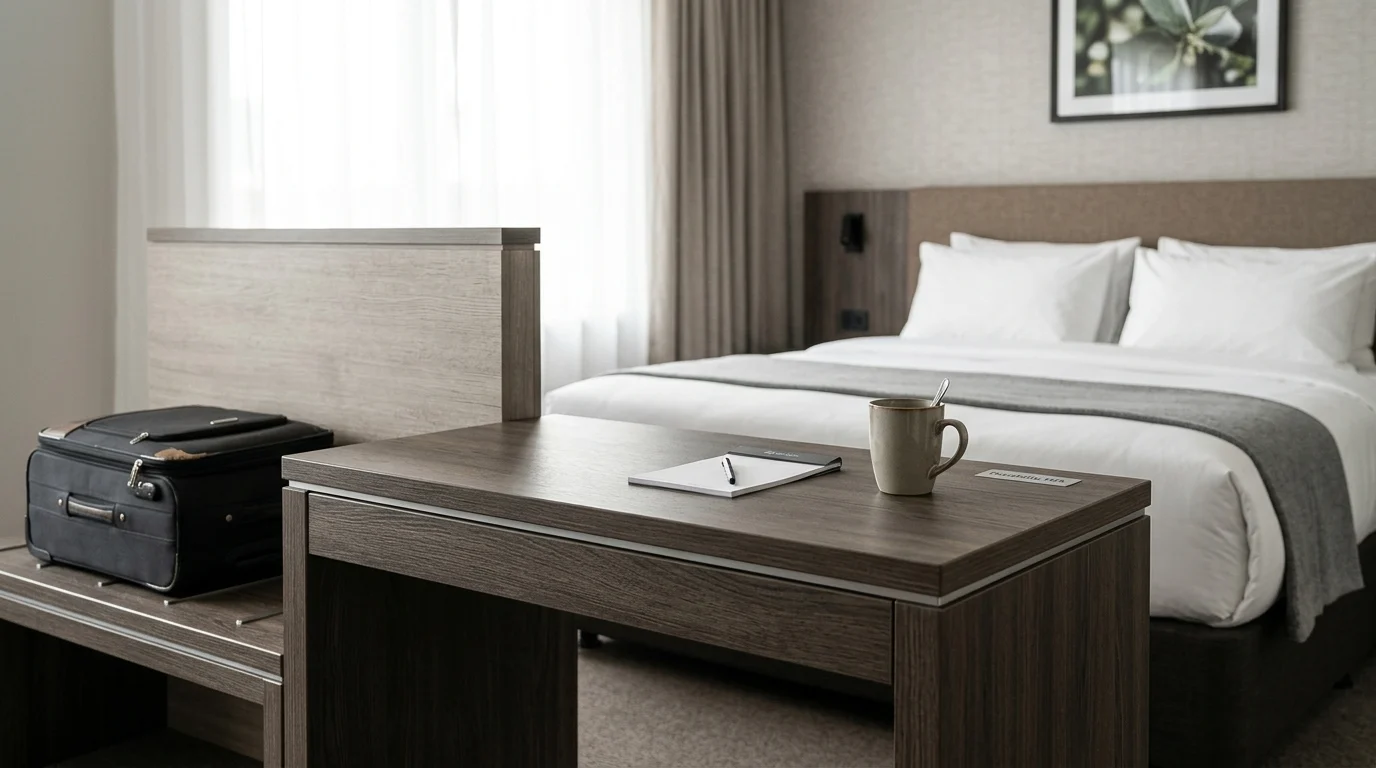
Why HPL Laminate Works for Hotel Furniture
The hospitality industry operates under uniquely demanding conditions. Casegoods and fixtures must withstand relentless daily use, fluctuating temperatures, and frequent chemical cleaning. In this rigorous environment, High-Pressure Laminate (HPL) has emerged as a highly effective surface material for modern hotel interiors. Unlike residential furnishings, which experience predictable and localized wear, hospitality assets must maintain a flawless aesthetic across a typical 7- to 10-year property renovation cycle without accumulating prohibitive maintenance costs.
The engineering behind HPL provides a critical intersection of structural resilience and design versatility. Advanced manufacturing techniques fuse synthetic resins with structural kraft paper, delivering a surface that resists common causes of furniture wear like abrasion, moisture, and temperature changes. This material evolution has fundamentally shifted how procurement teams and interior designers approach the specification of commercial casegoods.
What HPL laminate is
High-Pressure Laminate is a composite material engineered through a highly controlled thermo-setting process. Its structural integrity relies on a multi-layered composition: a core of phenolic resin-impregnated kraft paper, topped with a decorative printed layer, and sealed with a transparent melamine resin overlay. These layers are consolidated under controlled parameters, typically subjected to pressures between 1,000 and 1,500 pounds per square inch (PSI) and temperatures ranging from 280°F to 320°F (140°C to 160°C), according to standard manufacturer datasheets.
This high-pressure curing process causes the resins to flow and cross-link, creating a unified, non-porous sheet. The resulting material conforms to strict industry standards, such as the National Electrical Manufacturers Association (NEMA) LD 3 specifications. Because the melamine topcoat is inherently impervious to most common solvents and physical impacts, the final sheet achieves a density and hardness that significantly outperforms standard painted surfaces or low-pressure laminates.
It is important to distinguish HPL from Thermally Fused Laminate (TFL, or melamine board). While TFL consists of a single resin-soaked decorative paper pressed directly onto a substrate, HPL’s multi-layered kraft paper core gives it vastly superior impact resistance.
Where HPL performs best in hotels
Within a hospitality setting, HPL is strategically deployed in high-impact zones where traditional materials would quickly fail. The most critical applications include horizontal surfaces subjected to constant friction and blunt force, such as luggage racks, nightstands, and work desks. Luggage racks, for instance, frequently bear the impact of heavy suitcases equipped with abrasive metal hardware. HPL surfaces specified with a high NEMA impact resistance rating prevent the gouging that would instantly ruin a wood finish.
Beyond horizontal work surfaces, HPL is highly effective for flat vertical applications such as headboards, wardrobe doors, and bathroom vanity bases. For instance, when sourcing comprehensive Hotel Furniture packages, specifying HPL for these components ensures visual uniformity across hundreds of rooms. However, due to its rigidity, standard HPL has limited suitability for tightly curved or post-formed applications compared to more flexible veneers or thermofoils. In food and beverage areas or in-room kitchenettes, HPL’s moisture resistance prevents absorption from spills and condensation, mitigating the risk of water rings or bacterial growth that can affect natural wood.
HPL Laminate vs Veneer Performance
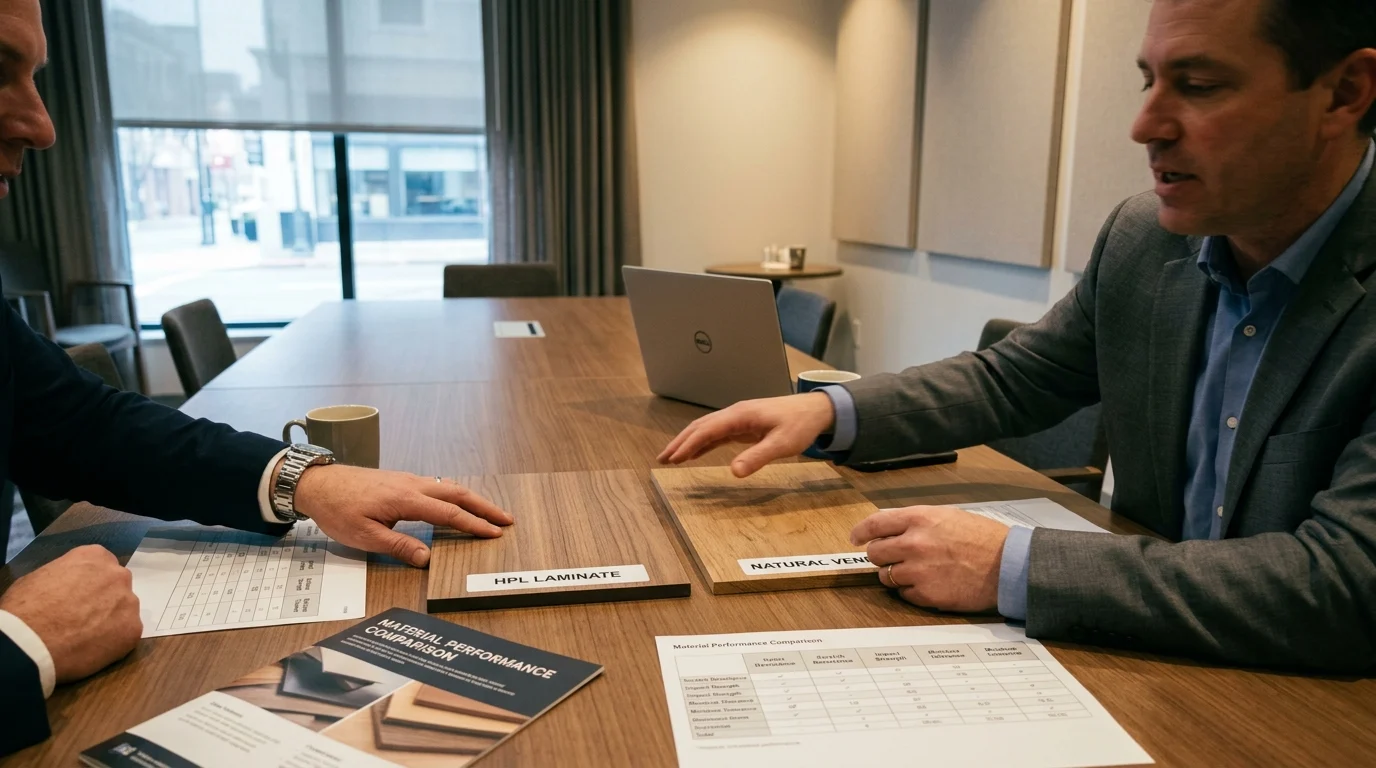
To make informed capital expenditure decisions, hoteliers must look beyond initial aesthetic appeal. They must evaluate how each material responds to the specific micro-abrasions, chemical exposures, and ambient humidity fluctuations endemic to hotel operations.
Key durability metrics to compare
Standardized testing protocols reveal a stark contrast in the physical resilience of HPL compared to natural veneer. Under the Taber abrasion test (a standard metric for surface wear), commercial-grade HPL typically withstands upwards of 400 wear cycles per NEMA LD 3 testing before the decorative layer shows degradation. In contrast, standard wood veneer finished with commercial polyurethane typically exhibits visible wear in fewer than 100 cycles. Scratch resistance also heavily favors HPL, which generally requires a force exceeding 2.0 Newtons to cause visible marring during standard manufacturer testing, whereas veneer can be scratched by forces as low as 0.5 Newtons. These illustrative ranges highlight HPL’s baseline resilience across the industry.
| Performance Metric | High-Pressure Laminate (HPL) | Natural Wood Veneer (Polyurethane Finish) |
|---|---|---|
| Taber Abrasion Resistance | > 400 cycles | < 100 cycles |
| Scratch Resistance (Hoffman) | 2.0 – 3.0 Newtons | 0.5 – 1.0 Newtons |
| Boiling Water Resistance | No effect (NEMA standard) | Whitening / Blistering |
| UV Color Fastness (Xenon Arc) | High resistance to fading | Moderate (Noticeable ambering/fading) |
| Stain Resistance (Reagents) | Unaffected by 1-10% reagents | Susceptible to acetone and alcohol |
Furthermore, color fastness is a critical metric for rooms exposed to direct sunlight. HPL features UV-stabilized decorative layers that show excellent resistance to color shift over time. Veneer, being an organic material, is highly susceptible to photo-oxidation, leading to uneven fading or ambering that complicates future partial replacements.
Despite these advantages, HPL is not without limitations. It is susceptible to edge chipping under severe blunt impact. While minor scratches can sometimes be mitigated with color-matched repair compounds, seamless refinishing is not possible. Additionally, at the end of its lifecycle, the synthetic resins and cross-linked structure present recyclability concerns. Procurement teams focused on circularity must weigh these end-of-life challenges—along with potential formaldehyde emissions from the core substrate—against green-building frameworks like LEED.
Design and finish trade-offs
From a design perspective, HPL offers absolute consistency, which is a major logistical advantage for large-scale hotel rollouts. When manufacturing casegoods for a 500-room property, HPL ensures that room 101 matches room 500 perfectly. Achieving this with wood veneer requires expensive “flitch matching”—slicing veneer from the same log to maintain grain continuity. This process not only drives up material costs but also results in a 10% to 15% material waste factor due to natural defects and color variations in the wood.
However, the trade-off lies in tactile authenticity and repairability. It is worth noting that lower-grade or poorly specified HPL can deliver a synthetic, “plastic-like” aesthetic that may undercut a property’s brand perception. While premium modern HPL incorporates advanced synchronized texture (EIR – Embossed in Register) technology to mimic the grain patterns of natural wood, it remains a synthetic surface.
Natural wood veneer offers genuine advantages beyond tactile luxury, including superior acoustic and thermal properties, the ability to be refinished, and the capacity for localized field repairs. For ultra-luxury or boutique properties where guests expect the unique properties of real timber, veneer may still be required. Yet, for mid-scale to upper-upscale properties, the visual fidelity of premium HPL closely mimics wood at a glance, making the durability trade-off highly favorable.
Edges, substrates, and adhesives
The ultimate performance of an HPL or veneer surface is heavily dependent on the underlying substrate, the edge treatment, and the adhesive systems utilized. HPL is typically bonded to high-density substrates such as Medium Density Fiberboard (MDF) with a density of 700 to 850 kg/m³, or premium particleboard. These substrates provide the necessary dimensional stability to prevent warping under the extreme tension of the laminate. Additionally, manufacturers must account for thermal expansion mismatches between the rigid HPL and the core substrate to prevent bowing over time.
Edge banding is the most vulnerable failure point in commercial furniture, and edge-band failure remains the most common field issue for HPL installations. Modern HPL casegoods utilize 1mm to 2mm thick PVC or ABS edge banding, applied via automated edge-banders. Crucially, the use of Polyurethane Reactive (PUR) hot-melt adhesives creates an impermeable, waterproof bond, ensuring the edge banding resists delamination even in high-humidity environments. However, if the edge banding is physically breached by a severe impact, moisture can penetrate the core substrate, leading to irreversible swelling and delamination of the HPL surface. Unlike natural wood, which can often be sanded and refinished, a compromised HPL edge is notoriously difficult to repair in situ.
Cost Benefits of HPL Hotel Furniture
Procuring hotel furniture represents a significant portion of a property’s initial Capital Expenditure (CapEx), but the financial impact of material selection extends far into the Operating Expenditure (OpEx) phase. The cost benefits of High-Pressure Laminate are realized not only at the point of purchase but also through a drastically altered lifecycle cost profile.
By mitigating the need for premature replacements, specialized cleaning agents, and labor-intensive repairs, HPL transforms casegoods from a depreciating liability into a stable, long-term operational asset. Understanding this economic model requires a comprehensive look at the total cost of ownership, manufacturing price drivers, and daily maintenance reductions.
Total cost of ownership
The Total Cost of Ownership (TCO) for hospitality casegoods calculates the initial purchase price, installation, maintenance, repair, and eventual replacement costs over the property’s renovation cycle. Initially, HPL casegoods are generally more cost-effective to manufacture than equivalent wood veneer pieces. This is primarily due to reduced labor hours in the finishing department, as HPL eliminates the need for sanding, staining, and multi-coat lacquering.
Over a standard 10-year lifecycle, the TCO divergence becomes even more pronounced. Veneer casegoods frequently require professional touch-ups by year 4 or 5, incurring ongoing costs for skilled maintenance labor. HPL largely eliminates the need for this mid-cycle refinishing, though extreme scenarios involving deep gouging, edge chipping, or chemical staining may still require component replacement.
When factoring in the extended lifespan—where HPL often remains structurally and aesthetically viable for well over a decade—the annualized cost of HPL furniture is substantially lower than its veneer counterparts. However, TCO calculations must also account for HPL’s limited field repairability; while routine maintenance is minimal, severe damage typically necessitates replacing the entire component rather than refinishing it.
Main pricing factors
Several key variables dictate the unit pricing of HPL hotel furniture during the procurement phase. The primary driver is the grade and thickness of the laminate itself. Standard vertical-grade HPL (typically 0.6mm to 0.7mm thick) is less expensive than horizontal-grade HPL (0.8mm to 1.2mm thick), which contains more kraft paper layers for enhanced impact resistance. Substrate thickness also plays a role, with 25mm structural tops costing marginally more than standard 18mm panels but offering superior load-bearing capacity.
The following table provides illustrative estimates of the cost-component breakdown for typical room sets. Note that because veneer requires significantly more labor and expensive surface materials, the core substrate represents a smaller percentage of the total cost for veneer than for HPL, even if the absolute cost of the core board remains identical:
| Cost Component | HPL Room Set (Est. % of Total Cost) | Veneer Room Set (Est. % of Total Cost) |
|---|---|---|
| Core Substrate (MDF/PB) | 25% | 15% |
| Surface Material | 15% | 25% (Includes waste factor) |
| Adhesives & Edge Banding | 10% | 5% |
| Labor (Fabrication & Finish) | 30% | 40% (Sanding, staining, lacquering) |
| Hardware & Logistics | 20% | 15% |
Minimum Order Quantities (MOQs) significantly influence pricing structures. Most commercial furniture manufacturers require an MOQ of 50 to 100 room sets to optimize the yield of HPL sheets (which are typically produced in 4×8 foot or 5×12 foot dimensions) and to amortize the setup costs of automated CNC machinery. Orders falling below these thresholds may incur premium surcharges.
Long-term maintenance savings
The operational savings generated by HPL furniture are most visible in the daily routines of the housekeeping department. Because HPL does not require specialized wood polishes or oil-based cleaners, properties can standardize their chemical inventory. Staff can utilize standard multi-surface disinfectants without fear of degrading the finish.
This chemical resilience reduces the time spent cleaning horizontal surfaces. Eliminating the need for careful polishing and spot-treatment streamlines housekeeping routines, yielding substantial labor savings annually across a fully operational property. Furthermore, if a piece of HPL furniture is catastrophically damaged, exact match replacements are easily sourced via the original laminate manufacturer’s code. This avoids the costly necessity of replacing entire room sets just to maintain visual harmony.
How to Specify and Source HPL Furniture
Transitioning from interior design concepts to the actual procurement of HPL furniture requires a rigorous specification process. Ambiguity in purchase orders or architectural specifications often leads to material substitutions that compromise durability. To secure the intended performance and cost benefits, buyers must define precise technical parameters for every layer of the furniture’s construction.
Successful sourcing relies on detailing the laminate grades, substrate emissions standards, adhesive technologies, and logistical packaging requirements. By establishing strict compliance and quality control benchmarks, hoteliers can mitigate supply chain risks and ensure a seamless installation process.
Specification steps for buyers
The specification process must begin with explicit references to industry standards. Buyers should mandate specific NEMA LD 3 grades based on the furniture’s application. For instance, horizontal surfaces such as desks and nightstands must be specified as High-Pressure Grade Surface (HGS) or equivalent, denoting a thickness of at least 1.0mm to 1.2mm. Vertical surfaces, like wardrobe doors and headboards, can be specified as Vertical Grade Surface (VGS) at 0.7mm to 0.9mm to optimize costs without sacrificing necessary durability.
Beyond the laminate, the specification must clearly define the substrate density and the edge-banding methodology. Procurement documents should explicitly state the requirement for Polyurethane Reactive (PUR) hot-melt adhesives for all edge banding. Buyers should expressly prohibit the use of standard Ethylene Vinyl Acetate (EVA) glues, which are prone to thermal reactivation and delamination in warm climates. Substrate density should be specified at a minimum of 700 kg/m³ for MDF to ensure adequate screw-holding capacity for hinges and drawer slides.
Compliance and safety requirements
Hotel furniture must adhere to stringent regional and international safety regulations, particularly concerning fire safety and indoor air quality. Crucially, fire safety ratings such as ASTM E84 Class A or B apply to the complete composite assembly—the laminate, the substrate, and the adhesive combined—not to the HPL as a standalone surface material. Specifying only fire-rated HPL without a fire-rated core can lead to non-compliant and dangerous installations.
Equally critical are the regulations governing Volatile Organic Compounds (VOCs) and formaldehyde emissions from the composite wood substrates. Buyers must ensure that all MDF and particleboard cores comply with stringent emission standards, such as the California Air Resources Board (CARB) Phase 2 or the EPA TSCA Title VI. These standards mandate formaldehyde emissions to remain below 0.11 parts per million (ppm) for MDF, ensuring a safe, non-toxic environment for guests and compliance with green building certifications like LEED or BREEAM.
Logistics, packaging, and installation
The logistical strategy for sourcing HPL furniture significantly impacts the final landed cost. Buyers must decide between sourcing fully assembled casegoods or flat-packed (Ready-to-Assemble) units. Fully assembled units reduce on-site installation labor and ensure factory-level structural integrity (often utilizing dowel and cam-lock construction reinforced with structural adhesives). However, they consume substantial freight volume. Physical container capacity is dictated by the volume and complexity of the furniture designs, while freight costs are heavily influenced by the dense weight of HPL panels. As an illustrative baseline, a standard 40-foot High Cube (40HQ) shipping container typically holds 40 to 50 fully assembled room sets.
Conversely, flat-packed furniture can double the container capacity to 80-100 room sets, drastically reducing per-unit freight costs, but requires skilled on-site carpentry teams for assembly. Regardless of the assembly state, packaging must be specified to withstand the rigors of global transit. Buyers should mandate compliance with International Safe Transit Association (ISTA) 3A drop-test standards. This ensures that the dense, heavy HPL panels are protected by adequate edge protectors and high-density EPS foam, preventing crushed corners that frequently occur during multi-modal shipping.
How to Decide If HPL Is the Right Choice
Determining whether High-Pressure Laminate is the optimal choice for a specific hospitality project requires a strategic evaluation of the property’s market positioning, target demographic, and operational budget. While HPL is undeniably robust, it is not a monolithic solution for every tier of the hospitality industry.
A successful FF&E strategy often involves a hybrid approach. Procurement teams can strategically deploy HPL where its physical properties yield the highest return on investment, while reserving more delicate or expensive materials for low-impact, high-visibility accent areas.
Matching HPL grades to hotel areas
Value engineering a hotel’s interior involves matching the appropriate grade of laminate to the specific stress profile of each zone. High-traffic transient areas, such as lobby business centers, breakfast buffets, and guestroom luggage drops, demand the highest grade of HPL (HGS) to resist continuous abrasion and impact. In these zones, the material’s ability to maintain a pristine appearance under heavy use directly protects the property’s brand standard.
For less demanding applications, such as the interior carcasses of wardrobes or the insides of desk drawers, specifying premium HPL is an unnecessary expenditure. In these concealed or low-impact areas, Thermally Fused Laminate (TFL) provides an extremely cost-effective alternative. TFL offers sufficient durability for vertical, interior applications at a fraction of the cost of HPL, allowing procurement teams to optimize the overall room budget without compromising the durability of the exterior, guest-facing surfaces.
Balancing durability, cost, and aesthetics
The final decision rests on balancing three core pillars of commercial design: durability, cost, and aesthetics. For economy, mid-scale, and upper-upscale properties (typically 2-star to 4-star categories), HPL represents a highly practical choice. The material’s ability to simulate high-end wood grains, combined with a TCO that is significantly lower than natural wood, aligns perfectly with the aggressive ROI targets and heavy guest turnover typical of these segments.
Conversely, in the ultra-luxury or 5-star boutique segments, guest expectations regarding authenticity and tactile luxury may necessitate the use of natural materials, despite their higher maintenance costs and shorter lifecycles.
Key Takeaways
- Specify HPL for high-impact hotel surfaces such as luggage racks, desks, and nightstands to reduce gouging, abrasion, and premature finish failure.
- Use HPL when furniture must retain a consistent appearance across a 7- to 10-year property renovation cycle.
- Choose HPL over TFL for demanding hospitality casegoods because its multi-layer kraft paper core provides superior impact resistance.
- Confirm that selected HPL meets relevant performance standards such as NEMA LD 3 before approving large-scale hotel furniture packages.
- Reserve standard HPL primarily for flat horizontal and vertical applications, and evaluate alternative materials for tight curves or post-formed profiles.
Frequently Asked Questions
What makes HPL laminate suitable for hotel furniture?
HPL is engineered under high pressure and heat to create a dense, non-porous surface that resists abrasion, moisture, impacts, temperature changes, and frequent chemical cleaning.
How long should HPL hotel furniture perform in a renovation cycle?
When properly specified, HPL surfaces can help furniture maintain appearance and function through a typical 7- to 10-year hotel renovation cycle.
Where is HPL most useful in hotel guest rooms?
HPL performs best on high-wear surfaces such as luggage racks, desks, nightstands, headboards, wardrobe doors, and bathroom vanity bases.
Is HPL better than TFL or melamine board?
For hospitality use, HPL generally offers stronger impact resistance because it has a multi-layer kraft paper core, while TFL uses a single decorative paper fused directly to a substrate.
Does HPL reduce hotel furniture maintenance costs?
Yes. Its resistance to scratches, moisture, stains, and cleaning chemicals can reduce repairs, replacements, and room downtime over the furniture lifecycle.
Post time: Aug-18-2026