
 joyce@taisenfurniture.com
 0086 15356090777


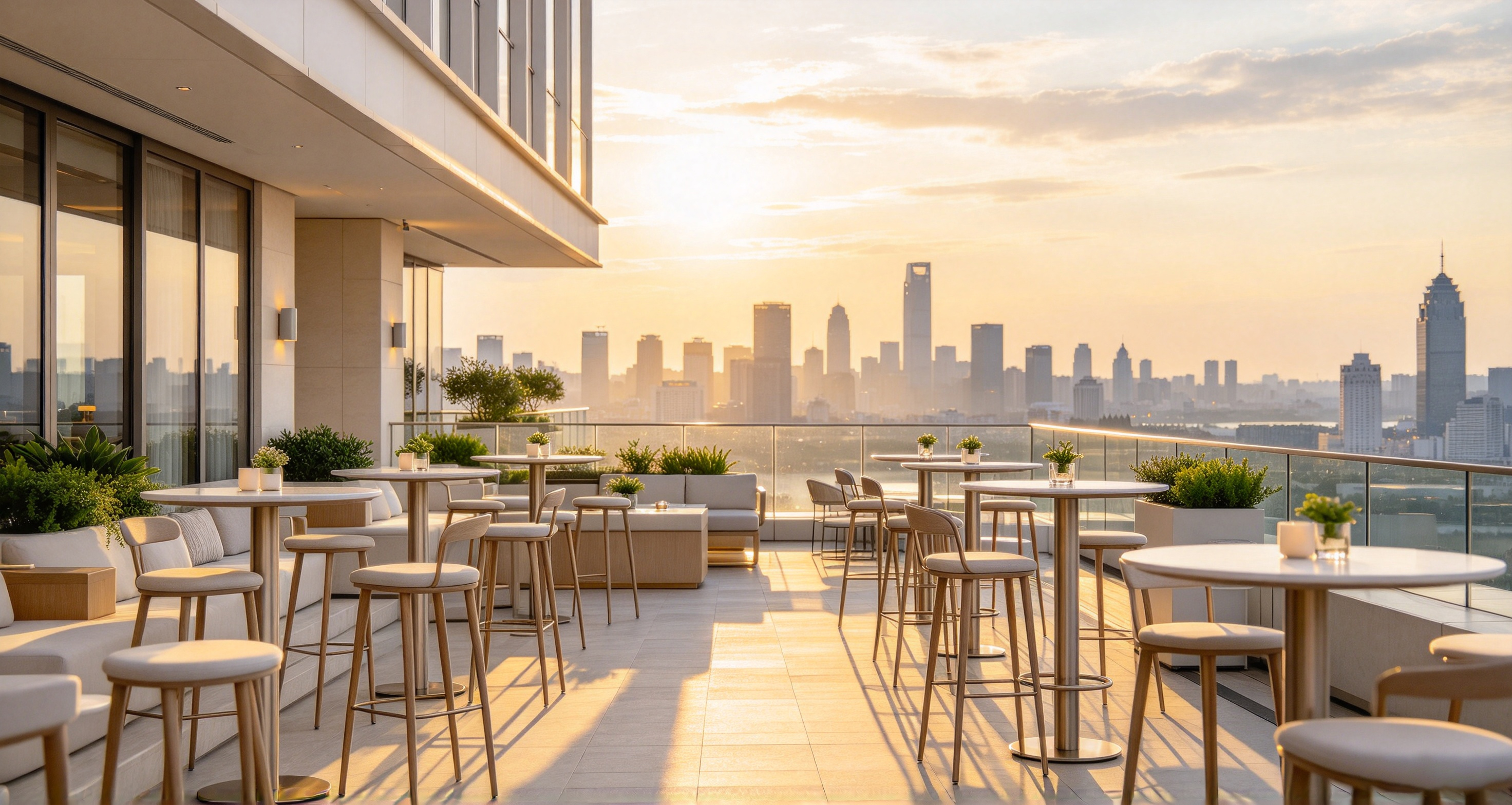
A rooftop lounge is one of the most profitable guest zones in a modern hotel. It drives premium beverage sales, attracts social media content, and creates signature moments that set one property apart from competing venues. Yet rooftop environments carry unique engineering risks that rarely appear on ground-level patios. Elevated above surrounding buildings, these spaces encounter accelerated wind speeds, sudden gusts, and turbulent airflow that can tip, slide, or lift poorly designed high-top bar table furniture. Unlike standard dining tables, high-top bar table furniture sits at 105 cm to 110 cm, with a higher centre of gravity, making it inherently more vulnerable to overturning force.
For hotel procurement teams, designers and FF&E contractors, wind stability is not an optional upgrade. It is a core safety specification, a liability control measure, and a long-term operational cost driver. A table that blows over can injure guests, break glassware, damage rooftop waterproofing membranes, trigger insurance claims, and force the hotel to close its rooftop lounge during windy weather. Even near-miss incidents erode guest confidence and create extra labour work for staff who repeatedly reset scattered furniture. This article breaks down the physics of rooftop wind load, critical design parameters, material selection standards, anchoring and weighting systems, testing protocols, and procurement checklists for high-top bar table furniture built for exposed rooftop hospitality spaces.
Why Rooftop Wind Is Different from Patio Wind
Many buyers mistakenly assume that outdoor-rated furniture for pool decks or garden patios will perform equally well on rooftops. This assumption creates the most common failure point in rooftop FF&E projects. Wind speed increases with elevation, and rooftops often sit above the local boundary layer where wind is slowed by trees, walls and neighbouring buildings. Turbulence also becomes far more unpredictable. Corner zones along rooftop parapets, edges beside stairwells and gaps between mechanical penthouses create gust channels that amplify wind force far beyond the site’s average wind rating.
The aerodynamic challenge for high-top bar table furniture comes from two separate forces: lateral sliding force and uplift overturning moment. The tabletop acts like a sail. A solid, flat, non-perforated top catches wind and pushes horizontally. If the wind force exceeds the friction between the base and rooftop finish, the table slides. When the wind hits at an upward angle, it creates uplift. Combined with the high centre of gravity of a tall bar table, uplift can rotate the table around its front edge and tip it over. This risk grows dramatically when the tabletop is large, solid, and lightweight.
Another hidden factor is wind gust duration. Steady wind pressure is easier to calculate, but short, sharp gusts deliver dynamic shock loads. A table that remains stable in constant 40 km/h wind may fail under brief gusts of 60 km/h or higher. Hotel rooftop lounges also face variable occupancy conditions. Empty tables are less stable than tables weighted down by guests and drinks. The correct stability rating must assume the worst-case empty state, not the loaded condition.
Table 1: Typical Wind Speed Exposure for Hospitality Rooftop Locations
| Exposure Zone | Sustained Wind Speed | Peak Gust Speed | Recommended Minimum Table Base Weight |
|---|---|---|---|
| Sheltered rooftop (inner courtyard, surrounded by taller buildings) | 30–40 km/h | 45–55 km/h | 35 kg |
| Moderate exposure (mid-rise rooftop, partial wind breaks) | 40–50 km/h | 55–70 km/h | 45–60 kg |
| Fully exposed rooftop (high-rise, coastal, no surrounding wind blocks) | 50–65 km/h | 70–95 km/h | 70–110 kg |
| Extreme exposure (island, open coastal, hurricane-prone regions) | 65 km/h+ | 95 km/h+ | Engineered anchoring mandatory |
This table offers practical baseline guidance for buyers, though local building codes and site wind surveys always override general benchmarks. Many coastal and high-rise hotel projects require a site-specific wind tunnel report or ASCE 7 wind load calculation before FF&E approval.
Core Design Principles for Wind-Stable High-Top Bar Table Furniture
When evaluating high-top bar table furniture, buyers should assess four interconnected design features: centre of gravity, base footprint, sail area reduction, and structural rigidity. These four features work together to resist overturning, sliding and material fatigue.
First, centre of gravity must sit as low as possible. The natural weakness of high-top bar table furniture is its tall frame. Designers counteract this by concentrating mass inside the base, not the top. Heavy tops such as solid stone or thick porcelain slab raise the centre of gravity and make tipping easier. Lightweight tabletops paired with weighted, low-profile bases are almost always the safer choice for windy rooftops. Many commercial-grade models integrate cast concrete, weighted metal inserts or removable steel weights sealed inside the base housing. This keeps the bulk of the mass close to the rooftop surface.
Second, base footprint width directly controls overturning resistance. A narrow, single-pedestal base with a small floor contact area is elegant but unstable. The wider the stance of the base legs or the wider the diameter of a round pedestal base, the larger the tipping threshold. For a standard 70 cm round high-top bar table, the base spread should measure no less than 60 cm across. Rectangular tabletops require asymmetric base support, with the longer base dimension aligned parallel to the prevailing wind direction on the site. Narrow footprints can be used only if permanent anchoring hardware is included.
Third, sail effect must be reduced. Solid, unbroken tabletops are the largest aerodynamic liability. Manufacturers use several strategies: slatted tops, perforated metal panels, mesh composite surfaces, cutout patterns and gaps between surface tiles. These openings let wind pass through instead of building pressure against the table. The trade-off is design aesthetics. Many hotel brands prefer seamless stone or sintered stone tops for a luxury look. In these cases, the designer must compensate by increasing base weight, adding friction pads and installing anchoring points.
Fourth, the frame structure must resist wind-induced fatigue. Repeated gusts create cyclic side loading that loosens welds, stretches bolts and weakens joints over months and years. Cheap thin-wall aluminium tubing flexes under repeated wind load. Wind-rated high-top bar table furniture uses thicker gauge tubing, reinforced gusset plates, box-section frames and fully welded joints rather than bolt-only assemblies. Every connection point is a potential failure point in long-term rooftop exposure.
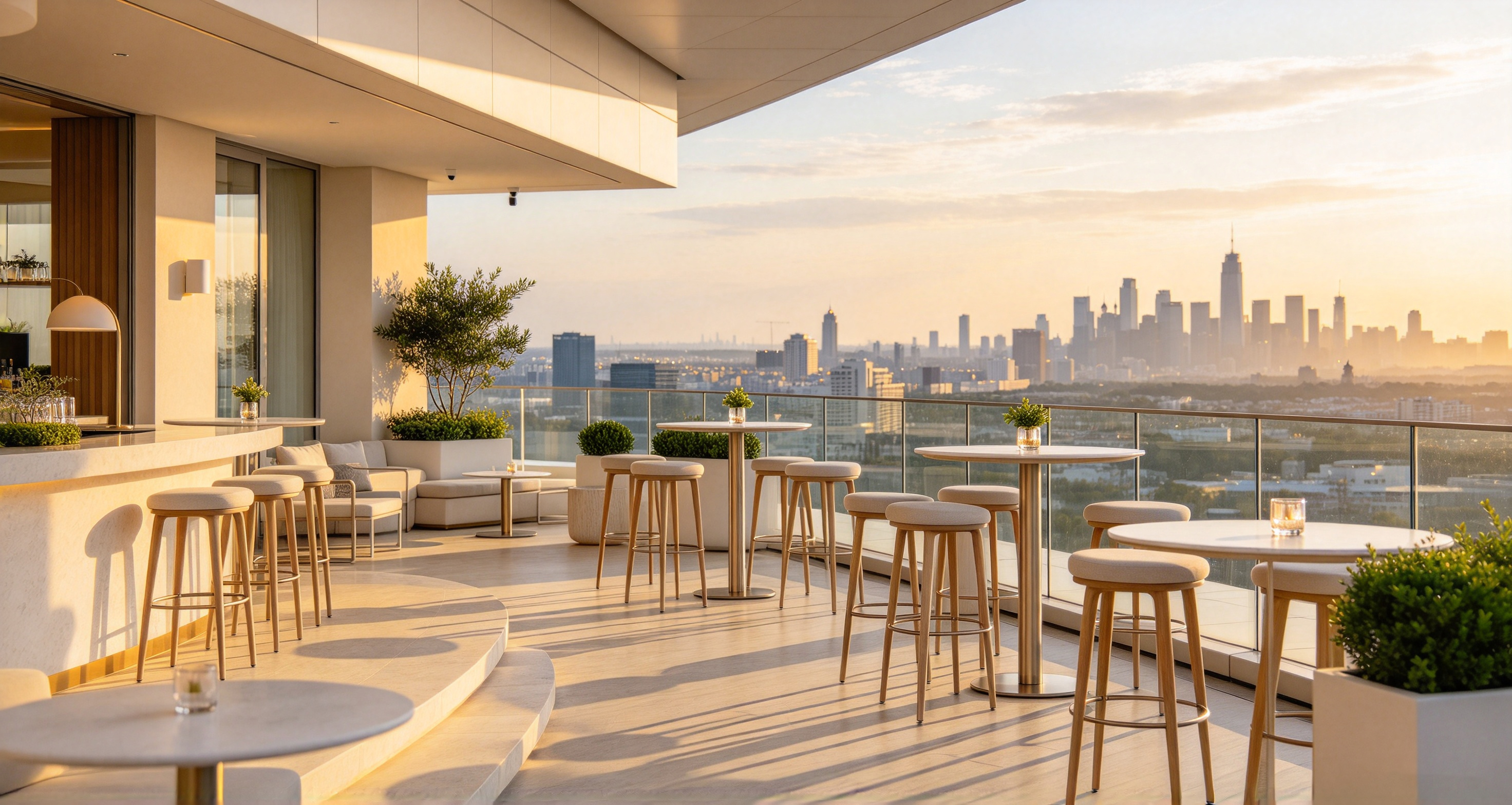
Material Selection: Trade-Offs Between Weight, Aerodynamics and Weather Resistance
Material choice is one of the most complex decisions for rooftop high-top bar table furniture. Each material brings a different balance of weight, sail profile, corrosion resistance, UV stability and maintenance demand. Buyers should avoid judging material suitability based only on appearance or initial price.
Aluminium is the most popular outdoor frame material for hospitality. It is lightweight, rustproof and easy to powder coat to match brand palettes. However, bare aluminium frames are too light for exposed rooftops unless paired with integrated weight inserts or anchor points. Powder coating is essential, and buyers should specify a commercial-grade polyester or fluoropolymer powder coat with UV inhibitors. Thin aluminium frames without internal weighting are suitable only for sheltered zones.
Cast iron and heavy gauge steel deliver excellent stability because of their inherent mass. A cast iron base naturally lowers the centre of gravity and resists sliding. The main downside is corrosion risk. All steel and cast iron components must receive multi-stage pretreatment, e-coat and top-grade powder coating. Drains must be built into hollow base cavities to stop standing water from accelerating rust. Without proper drainage, sealed hollow steel bases can trap rainwater and develop hidden corrosion.
Concrete and composite mineral bases provide outstanding stability and are widely used in high-wind rooftop projects. Precast concrete bases are dense, low-profile and UV stable. Modern formulations include fibre reinforcement to reduce cracking. The drawback is shipping cost and on-site handling. Heavy concrete bases increase container weight and installation labour. Some suppliers offer split modular concrete weights that fit inside decorative outer shells, allowing easier transport and assembly.
Tabletop materials create their own aerodynamic and maintenance trade-offs. Sintered stone and porcelain slab tops are non-porous, stain-resistant and luxury in appearance, but they are solid sail surfaces. Teak and thermally modified wood slatted tops reduce sail area and offer warm design appeal, but they require regular oiling and inspection for splinters. Perforated aluminium and HDPE slatted tops are the most wind-friendly options, with minimal sail loading and low maintenance. Woven resin tabletops are lightweight and attractive but rarely rigid enough for fully exposed rooftop high-top applications.
Table 2: Material Comparison for Wind-Rated High-Top Bar Table Furniture
| Material | Wind Stability Advantage | Key Limitations | Best Use Case |
|---|---|---|---|
| Powder-coated aluminium frame | Light transport, corrosion resistance | Low inherent mass, needs added weights | Sheltered rooftops, paired with anchor kits |
| Cast iron / heavy steel base | Excellent natural stability | Corrosion risk, heavy shipping | Moderate wind exposure, fixed locations |
| Fibre reinforced concrete base | Highest stability, low centre of gravity | Heavy, higher freight cost | Fully exposed high-rise and coastal rooftops |
| Slatted HDPE / perforated aluminium top | Low sail effect, wind passes through | Less premium visual finish | High-gust, high-traffic rooftop lounges |
| Sintered stone solid top | Premium stain resistance | Large sail area, higher tipping risk | Sheltered rooftop zones, with weighted base |
Weighting, Friction and Anchoring Systems
Three layers of stability control work together: friction between base and rooftop surface, removable ballast weights, and permanent mechanical anchoring. Responsible suppliers design high-top bar table furniture with compatibility for one or more of these systems, and procurement teams should clarify which system is required before ordering.
Friction pads are the baseline layer. Non-slip elastomer pads fixed to the bottom of the base increase sliding resistance. They also protect rooftop waterproofing membranes from scratching and abrasion. Friction pads alone cannot stop overturning in strong gusts, but they prevent slow creep and sliding during moderate wind. Buyers should specify UV-stable EPDM or silicone pads, not cheap rubber that degrades and leaves stains on waterproof surfaces.
Removable ballast weights are the most common solution for hotels that need flexible layouts. Many rooftop lounges rearrange furniture for private events, weddings and seasonal layouts. Permanent bolt-down anchoring limits layout flexibility. Ballast systems include hollow base shells that accept concrete inserts, stackable steel weight plates, lockable sand or water-filled weight pods, and decorative weight blocks hidden inside the base plinth. The best ballast designs lock weights securely so guests cannot lift or remove them. Loose sandbags are not suitable for commercial hospitality; they tear, leak, look unprofessional and create trip hazards.
Permanent mechanical anchoring is required for extreme wind zones. This system uses expansion bolts, threaded inserts or surface-mounted anchor plates fixed into the rooftop structural slab. The table base connects to anchors via heavy-duty stainless steel brackets or safety cables. Anchors must be installed by a qualified contractor who understands rooftop waterproofing. Poorly drilled anchor points are a major source of roof leaks. The FF&E supplier and waterproofing contractor must coordinate the anchor layout before installation.
Many projects use a hybrid strategy: weighted bases for everyday stability, plus hidden safety cables connected to fixed anchor points as a backup restraint. The cable restrains the table if an extreme gust overcomes the base weight, preventing the table from blowing across the rooftop or falling over the parapet edge. This hybrid approach balances layout flexibility and safety, and it is increasingly specified by hotel risk and insurance teams.
Testing Standards and Compliance Documentation
Procurement teams often overlook test documentation, which is critical for liability protection. General “outdoor rated” labelling is not proof of wind stability. Buyers should request formal test reports aligned with recognised commercial furniture standards.
BS EN 581 is the primary standard for outdoor contract tables and seating. It covers mechanical safety, static load testing and overturning resistance for commercial hospitality furniture. A compliant supplier should provide test certificates showing the table passed overturning and side load tests at the specified wind load. For high-rise and coastal projects, suppliers may also provide calculations referenced to ASCE 7 wind load standards, which engineers use to define design wind pressure for buildings and rooftop fixtures.
Wind tunnel testing is reserved for high-risk projects. A wind tunnel test replicates site turbulence, gust cycles and uplift behaviour. It is common for luxury high-rise hotels, oceanfront resorts and properties in cyclone or hurricane-prone regions. The test report will confirm the table’s tipping threshold and validate the performance of weighting and anchoring systems.
It is also important to separate static load testing from wind load testing. A table that holds heavy drinks and guests does not automatically resist wind. Static load tests measure downward weight capacity. Wind tests measure lateral force and uplift overturning. Many suppliers only advertise static load ratings. Buyers must explicitly ask for wind overturning test data.
Documentation packages should include: material specification sheets, powder coating and corrosion test reports, overturning test certificates, anchor installation drawings, weight capacity data, and maintenance instructions. Large hotel brands and management companies often require these documents before approving vendor payment.
Common Installation and Operational Mistakes
Even the best wind-rated high-top bar table furniture will fail if installed or managed incorrectly. Operational teams frequently make predictable errors that undermine stability.
The first mistake is mixing lightweight furniture with heavy furniture on the same rooftop. A hotel may buy a few heavy weighted tables and pair them with cheaper, lightweight aluminium tables. The lightweight models become the failure points. Wind does not treat all pieces equally, and the whole rooftop layout should be engineered to the same wind exposure rating.
Second, staff may remove ballast weights to make tables easier to move for events. This is a serious safety hazard. If weights are removable, the hotel must create clear operational rules: weights must be reinserted immediately after reconfiguration, and staff should receive training on wind risk. Lockable weight housings reduce this risk.
Third, anchors are installed incorrectly or through the waterproof membrane without proper flashing. Each anchor penetration creates a leak risk. The installer must use roof-approved penetration sleeves, sealant and flashing. The FF&E supplier should not be responsible for waterproofing details unless they are also qualified roof contractors.
Fourth, tables are placed too close to parapet edges and wind corners. Wind acceleration is strongest at rooftop corners. Even stable tables need extra restraint when located within 1.5 metres of building edges. Some design guidelines recommend avoiding lightweight furniture entirely in these corner zones.
Fifth, maintenance is neglected. Wind-stable furniture relies on intact welds, tight bolts, undamaged friction pads and sealed weight housings. Seasonal inspection schedules should check for loose fasteners, cracked concrete bases, rust bleed, torn friction pads and cable wear. Salt-air coastal locations need quarterly inspections, while inland rooftops can follow a six-month cycle.
Procurement Checklist for Wind-Stable High-Top Bar Table Furniture
Before confirming a purchase order, the FF&E team should work through this checklist to avoid specification gaps:
- Confirm the site wind exposure classification and obtain local building code wind speed requirements.
- Decide layout strategy: fully fixed anchored, weighted flexible layout, or hybrid weighted plus safety cable restraint.
- Require the supplier to provide overturning test data, not just general outdoor certification.
- Confirm base footprint dimensions and minimum ballast weight for the tabletop size.
- Review tabletop design: solid, slatted or perforated, and calculate sail area.
- Specify corrosion protection grade for all metal components, including hidden internal weight hardware.
- Confirm compatibility with rooftop finishes, including non-staining friction pads and non-damaging anchor hardware.
- Request installation drawings, anchor templates and waterproofing guidance for roof penetrations.
- Clarify warranty coverage for wind-related failure, corrosion and joint loosening.
- Agree on spare parts: replacement friction pads, locking bolts, cable assemblies and touch-up coating.
Key Takeaways
High-top bar table furniture for hotel rooftop lounges faces a unique set of aerodynamic challenges that ground-level outdoor furniture does not. Their tall profile creates a high centre of gravity, while rooftop elevation amplifies wind speed and turbulence. Wind stability is not a cosmetic feature; it is a safety, liability and operational priority.
The most reliable designs combine a low centre of gravity, wide base footprint, reduced sail area, rigid welded frames and appropriate weighting or anchoring. Material selection balances stability, corrosion resistance and brand aesthetic. Solid stone tops deliver luxury appeal but increase wind load; slatted and perforated tops reduce wind force but require careful design to meet brand standards. Weighted bases offer layout flexibility, while permanent anchoring is necessary for high-wind coastal and high-rise locations.
Buyers should reject vague “outdoor suitable” claims and demand documented overturning test results aligned with recognised commercial standards. Installation coordination between furniture suppliers, structural engineers and roof waterproofing teams prevents leaks and anchor failures. Regular seasonal inspections keep the furniture performing safely through years of gusts, rain and UV exposure.
When specified correctly, wind-stable high-top bar table furniture lets hotels unlock the full revenue potential of rooftop lounges. Guests can enjoy elevated views and drinks without safety concerns, and operators avoid the costly downtime, injuries and insurance claims that follow furniture tipping incidents.
FAQ
Q1: Can I use regular outdoor high-top bar tables on my hotel rooftop?
A: In most exposed rooftop locations, regular outdoor tables are not suitable. Most standard outdoor tables are tested for patio conditions and lack the weighted base, wide footprint and overturning testing required for elevated windy zones. Always match the furniture rating to rooftop wind exposure.
Q2: What is the difference between ballast weights and permanent anchoring?
A: Ballast weights add mass to the base to resist tipping and sliding, and they allow the hotel to rearrange furniture for events. Permanent anchoring bolts the table to the rooftop slab, offering the highest wind resistance but limiting layout flexibility. Many hotels use a hybrid weighted and cable-restrained system.
Q3: Are solid sintered stone tabletops a bad choice for windy rooftops?
A: They are not automatically bad, but they create a large sail area. If the design brief requires solid stone tops, the base must be heavier, wider, and often paired with safety restraint cables. Slatted tops are inherently more wind-friendly.
Q4: What certification should I ask suppliers to provide?
A: BS EN 581 is the core contract outdoor furniture safety standard. For high-rise and coastal projects, request ASCE 7 referenced wind load calculations or wind tunnel test reports. General UV and weather resistance certificates do not prove wind stability.
Q5: How often should wind-rated rooftop high-top bar table furniture be inspected?
A: Inland sheltered rooftops require inspection every six months. Coastal, salt-air and fully exposed high-rise rooftops need quarterly inspections. Check friction pads, welds, bolts, weight housings and safety cables for wear or damage.
Post time: Nov-05-2026