
 joyce@taisenfurniture.com
 0086 15356090777


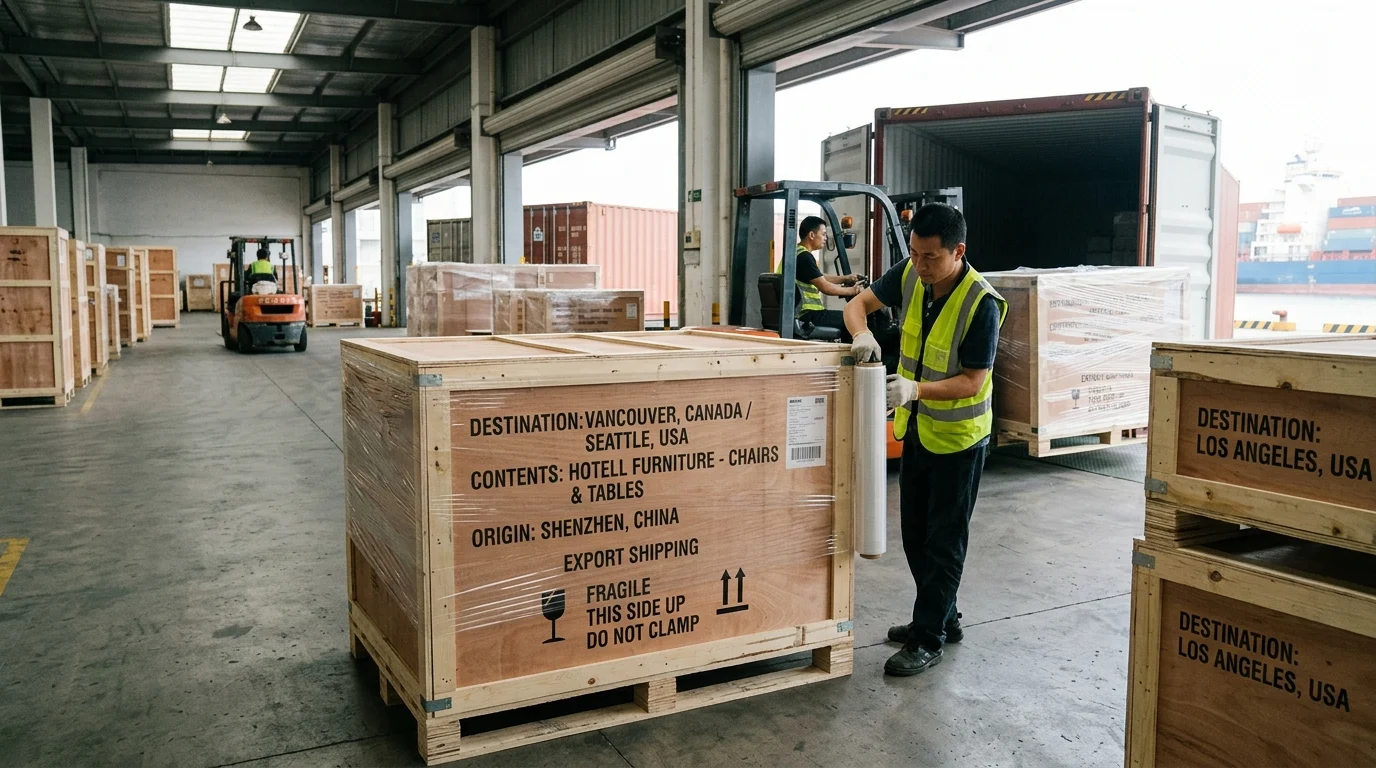
Sourcing hotel furniture from China can deliver meaningful cost advantages, but only when the logistics are planned with the same discipline as construction, financing, and brand approval. For North American hotel developers, the real challenge is not simply buying at factory price—it is coordinating custom production, container freight, customs clearance, inspections, and site readiness without disrupting the opening schedule. With manufacturing often taking 10 to 14 weeks and transpacific delivery adding several more, a missed milestone can quickly become expensive. This guide explains the practical export considerations behind direct FF&E procurement, including project scale, landed cost math, timelines, and category planning for hospitality assets.
Hotel Furniture Export Overview
Direct procurement of hospitality assets from Chinese manufacturing hubs to North American project sites represents a complex, multi-tiered supply chain. Efficiently managing this pipeline requires synchronizing fabrication schedules, transpacific freight, and localized site readiness to ensure seamless property development.
Why Export Planning Affects Hotel Opening Dates
Lead times dictate the critical path of any hospitality development. Standard manufacturing cycles for custom hospitality assets range from 10 to 14 weeks, followed by 4 to 6 weeks of ocean transit and customs clearance, plus a recommended 2 to 3 weeks of contingency buffer. A single miscalculation in the logistics timeline can significantly delay a property’s opening date. As an illustrative scenario, for a standard 150-key midscale property, missing the target opening date can result in lost revenue exceeding an estimated $20,000 per day. It is important to note that this figure varies widely by market tier, season, and product mix, alongside compounding carrying costs for construction loans.
Which North American Projects Benefit from Direct Sourcing
Not all developments possess the scale to justify the complexities of international logistics. As a general industry benchmark, direct sourcing yields the highest return on investment for projects requiring a minimum of 50 to 80 guestrooms, or those with a Furniture, Fixtures, and Equipment (FF&E) budget exceeding $300,000, which typically aligns with factory Minimum Order Quantities (MOQs) of 20 to 50 pieces per custom item. Below this threshold, the fixed costs of container freight, customs brokerage, and quality assurance inspections often erode the unit-cost savings achieved at the factory level.
Rather than viewing the 50 to 80 guestroom threshold as a fixed rule, buyers should consider the cost-driver math: a $10,000 fixed container and brokerage cost distributed across 20 rooms adds $500 per key, whereas spreading those same fixed fees across 100 rooms adds only $100 per key. Fixed logistics costs vary significantly depending on fluctuating ocean freight rates, seasonal surcharges, and inland trucking distances to the final site. Conversely, large-scale resorts and multi-property rollouts leverage economies of scale, frequently reducing overall FF&E capital expenditures by an estimated 25% to 40% compared to utilizing domestic wholesalers, though actual savings depend heavily on current market conditions.
Scope, Terms, and Product Categories

Establishing a precise procurement scope and defining the terms of transfer are fundamental to mitigating financial risk, as FF&E often represents 10% to 12% of total hotel construction budgets. Buyers must delineate exact product classifications and negotiate favorable shipping terms to ensure predictable landed costs.
FF&E, Casegoods, Upholstery, Millwork, and OS&E
The hospitality procurement matrix is broadly divided into Furniture, Fixtures, and Equipment (FF&E) and Operating Supplies and Equipment (OS&E). FF&E encompasses heavy assets, including casegoods (wardrobes, desks, nightstands), seating, and specialized hotel furniture designed for high-traffic commercial use (typically engineered for a 5- to 7-year lifecycle before soft-goods renovation and 10- to 14-years for casegoods). Millwork involves built-in architectural elements requiring precise site measurement, while upholstery introduces stringent textile compliance variables. Defining these categories early prevents scope creep and aligns factory capabilities with project specifications.
Key Incoterms and Shipping Modes
International Commercial Terms (Incoterms) dictate the transfer of risk and cost between the Chinese manufacturer and the North American buyer. Selecting the appropriate term is paramount for budget forecasting and risk management.
| Incoterm | Risk Transfer Point | Buyer Responsibility | Ideal Use Case |
|---|---|---|---|
| EXW (Ex Works) | At factory floor | Maximum (trucking, export customs, ocean freight) | Buyers with consolidated logistics networks in China |
| FOB (Free On Board) | Once loaded on vessel | High (ocean freight, import customs, final delivery) | Standard for most FF&E imports; balances control and cost |
| DDP (Delivered Duty Paid) | At final destination | Minimal (unloading only) | Turnkey projects lacking dedicated import logistics teams |
Payment Terms and Financial Risk: Beyond shipping terms, buyers must establish secure payment structures and account for currency fluctuations. Because the procurement cycle spans several months, USD/CNY exchange rate volatility is a significant variable that directly impacts landed costs. Buyers should consider currency hedging strategies alongside standard payment terms. Direct China sourcing typically requires a 30% to 50% deposit before production (often within 7 to 10 days of PO issuance), with the balance paid before shipment. To protect capital against factory default or non-conformance, buyers should consider using Letters of Credit (L/C) or structured wire transfers tied to successful third-party inspection reports rather than standard upfront telegraphic transfers (T/T).
Compliance and Documentation
Importing commercial goods into the United States, Canada, and Mexico requires strict adherence to federal and regional regulations. Non-compliance results in port holds, costly demurrage fees, or mandatory destruction of non-conforming shipments.
Customs, Tariffs, and Country of Origin
To streamline clearance and avoid penalties, project managers must account for the following regulatory pillars:
- U.S. Tariffs and Duties: Proper Harmonized Tariff Schedule (HTS) classification is critical. Standard duty rates for wood furniture range from 0% to 6%. Importers must also account for the volatility of U.S. Section 301 tariffs. Rather than a blanket rate, these tariffs impose an additional 25% duty on specific Chinese-manufactured HTS codes and remain highly subject to political revision, exclusion notices, and frequent updates. Furthermore, buyers must assess exposure to potential Anti-Dumping and Countervailing Duties (AD/CVD) on specific wood furniture categories, such as wooden bedroom furniture, which can carry severe financial penalties.
- U.S. Customs Bonds and Import Regulations: U.S. importers must secure a continuous customs bond (typically costing $400 to $600 annually for a standard $50,000 bond) for regular imports or a single-entry bond for one-off shipments. Buyers must also navigate the Uyghur Forced Labor Prevention Act (UFLPA), which establishes a rebuttable presumption against goods originating from certain regions in China, and the Lacey Act, which requires plant-product declarations for wooden furniture.
- U.S. Country of Origin Marking: Every master carton and individual piece must be permanently marked in English (e.g., “Made in China”) to pass Customs and Border Protection (CBP) scrutiny without incurring rework penalties.
- Canadian Compliance and CBSA: Canadian imports require distinct compliance measures separate from U.S. rules. The Canada Border Services Agency (CBSA) mandates bilingual (English and French) labeling on consumer-facing packaging and documentation. However, it is critical to distinguish commercial FF&E project shipments from consumer retail goods; bulk hotel furniture cartons and job-site documentation intended strictly for commercial installation are generally exempt from these consumer-facing bilingual labeling mandates. Additionally, Canadian tariff treatments differ, requiring the assessment and payment of the Goods and Services Tax (GST) or Harmonized Sales Tax (HST) at the border.
- Mexican Compliance and Customs: Importing into Mexico requires adherence to Normas Oficiales Mexicanas (NOM standards) for product safety and labeling, as well as Federal Telecommunications Institute (IFT) labeling for applicable electronics. Importers must also navigate specific customs processes, including securing a Padrón de Importadores (importer of record registration) and ensuring proper Spanish-language commercial documentation.
Fire Safety, Formaldehyde, Upholstery, and Packaging Rules
North American safety standards mandate rigorous material testing. To ensure compliance, all FF&E must meet the following criteria:
- Upholstery Flammability: Upholstered seating must comply with California Technical Bulletin 117-2013 (TB117-2013). Serving as the de facto industry benchmark, this standard is widely used voluntarily while federal rulemaking under the Safer Occupancy Furniture Flammability Act (SOFFA) proceeds, as it is not yet a mandatory national enforcement standard.
- Formaldehyde Emissions: For composite wood products, compliance with EPA TSCA Title VI is non-negotiable. It is vital to clarify limits by product type to avoid applying the wrong standard: the regulation restricts formaldehyde emissions to below 0.05 parts per million (ppm) for hardwood plywood, while particleboard and medium-density fiberboard (MDF) have higher permissible limits of 0.09 ppm and 0.11 ppm, respectively.
- Electrical Certifications: Any powered FF&E or fixtures, such as integrated lighting in headboards, must carry recognized electrical safety certifications (e.g., UL, cUL, ETL, or CSA). However, it is important to note that these marks alone do not guarantee inspection passage; final acceptance depends entirely on the local Authority Having Jurisdiction (AHJ)—such as a municipal fire marshal or building inspector—and specific state or provincial building codes.
- Solid Wood Packaging: Packaging utilizing solid wood must meet ISPM 15 standards, requiring heat treatment and proper stamping to prevent agricultural pests.
Pre-Shipment Inspection and Mock-Up Approval
Quality control must be executed prior to containerization. Implementing a pre-shipment inspection utilizing the Acceptable Quality Limit (AQL) methodology—a statistical sampling standard used to measure acceptable defect rates, typically AQL 2.5 for major defects (e.g., structural flaws) and 4.0 for minor defects (e.g., slight finish variations)—ensures factory output matches approved prototypes, targeting an overall defect rate of under 2% prior to container loading. The mock-up room approval process, wherein a single complete guestroom set is manufactured and reviewed (often virtually or via a shipped sample), serves as the definitive benchmark for mass production tolerances.
Logistics and Freight Planning
Executing the physical transfer of FF&E requires strategic cargo management. Optimizing container space and selecting the appropriate transit routing directly influences the final landed cost per room.
FCL, LCL, Air Freight, and Consolidation Options
Ocean freight remains the primary conduit for hospitality logistics. A standard 40-foot High Cube (40HQ) container offers approximately 68 cubic meters (CBM) of usable volume and typically holds 8,000 to 12,000 kilograms of mixed FF&E. Full Container Load (FCL) shipments maximize efficiency and reduce handling damage. Less than Container Load (LCL) is utilized for smaller top-up shipments or prototypes but carries higher volumetric costs and increased damage risk due to consolidation at the origin port and deconsolidation at the destination. Air freight is strictly reserved for urgent replacements, costing up to 10 times more per kilogram than ocean transit.
Packaging, Container Loading, and Damage Prevention
The rigors of maritime transit and intermodal rail transport necessitate robust packaging engineering. Cartons should pass ISTA 3A drop and vibration testing to simulate transit shocks. Strategic container loading—placing heavy casegoods at the base and lighter upholstery atop, secured with dunnage and ratchet straps—minimizes load shifting. Moisture control is equally critical; utilizing estimates of 1.5 to 2.0 kilograms of calcium chloride desiccants per 40HQ container prevents condensation (container rain) during the 15°C to 30°C temperature swings of a transpacific voyage. Note that this desiccant estimate varies widely based on the specific shipping lane, season, and product mix.
Port, Rail, Trucking, and Warehouse Choices
Routing selection dictates transit duration and inland costs. Discharging at West Coast ports (Los Angeles/Long Beach) typically yields a 14- to 18-day ocean transit from Shenzhen or Shanghai, followed by intermodal rail to inland destinations. East Coast routing (New York/New Jersey or Savannah) via the Panama Canal extends ocean transit to 28 to 35 days but significantly reduces inland trucking distances for Eastern Seaboard projects.
Regardless of the port, buyers must budget for post-port and final-mile expenses, which frequently emerge as hidden cost drivers. To manage these effectively, procurement teams should plan for:
- Hidden Port Costs: Drayage fees, chassis shortages, container demurrage, and congestion surcharges at major hubs.
- Intermediate Storage: Securing a third-party logistics (3PL) warehouse near the project site is crucial, as construction delays frequently necessitate intermediate storage of FF&E containers for 30 to 90 days, at average commercial storage rates of $15 to $25 per pallet per month.
- Final-Mile Delivery: Project managers must coordinate practical hotel-site delivery requirements, such as white-glove service, liftgate access, inside delivery, and debris removal, which are major operational pain points during installation.
- Cargo Insurance: Securing comprehensive coverage is a critical necessity to protect against catastrophic loss, container damage, or General Average declarations (a maritime law principle where all cargo owners proportionally share the cost of a vessel’s emergency losses) during transit.
Decision Framework for Buyers
Successfully navigating international procurement requires a systematic approach, aligning financial objectives with supply chain realities. A structured decision framework empowers procurement teams to optimize capital deployment while safeguarding project schedules.
Step-by-Step Project Workflow
A standardized procurement workflow spans 24 to 32
Key Takeaways
- Plan a total export timeline of roughly 16 to 23 weeks by combining 10 to 14 weeks of production, 4 to 6 weeks of ocean transit and customs, and a 2 to 3 week contingency buffer.
- Use direct sourcing primarily for projects with at least 50 to 80 guestrooms or FF&E budgets above $300,000 to better absorb fixed logistics and compliance costs.
- Calculate landed cost per key because a $10,000 fixed freight and brokerage cost adds $500 room across 20 rooms but only $100 per room across 100 rooms.
- Define FF&E, OS&E, casegoods, upholstery, and millwork scope early to reduce specification errors, compliance issues, and budget uncertainty.
- Factor FF&E into the overall development budget carefully, as it commonly represents 10% to 12% of total hotel construction costs.
- Build logistics planning into the project critical path because missed furniture delivery dates can delay opening and create significant daily revenue losses.
Frequently Asked Questions
Q: How long does it take to export hotel furniture from China to North America?
A typical schedule includes 10 to 14 weeks for custom manufacturing, 4 to 6 weeks for ocean freight and customs, and a 2 to 3 week contingency buffer. Buyers should plan around 16 to 23 weeks total.
Q: What size hotel project benefits most from direct sourcing in China?
Direct sourcing is usually most cost-effective for projects with 50 to 80 guestrooms or an FF&E budget above $300,000. Smaller projects may lose savings to fixed freight, brokerage, inspection, and inland delivery costs.
Q: Why can logistics planning affect a hotel opening date?
Furniture delivery often sits on the project’s critical path. If production, ocean transit, customs clearance, or site readiness slips, guestrooms may not be rentable on time, creating lost revenue and added financing or construction costs.
Q: What fixed costs should buyers include in landed cost calculations?
Common fixed costs include container freight, customs brokerage, quality inspections, documentation fees, destination port charges, duties, and inland trucking. These costs should be allocated per room to compare true savings.
Q: What is the difference between FF&E and OS&E?
FF&E includes durable hotel assets such as casegoods, seating, desks, wardrobes, and fixtures. OS&E refers to operating supplies and equipment, such as linens, smallwares, and other items needed to run the property.
Post time: Aug-21-2026