
 joyce@taisenfurniture.com
 0086 15356090777


- New-build and conversion projects benefit most from a coordinated hotel furniture package.
- Renovation projects require accurate site surveys, phased delivery, and low-disruption installation planning.
- Brand-standard rollouts depend on repeatable materials, finishes, dimensions, and quality-control procedures.
- Lobby furniture should be evaluated for durability, cleanability, accessibility, fire-safety coordination, and lifecycle cost.
Hotel lobby furniture wholesale is a project-level purchasing strategy for buyers who need coordinated seating, tables, casegoods, lighting, window treatments, and decorative elements rather than isolated retail items. The 2010 ADA Standards for Accessible Design identify 36 inches as the minimum clear width for many accessible routes, making circulation planning an essential part of lobby furniture selection. This guide explains which project types are suitable, how to evaluate suppliers, and how to control specification, delivery, and maintenance risk.
Which project types suit hotel lobby furniture wholesale?
The best wholesale opportunities are projects with sufficient volume and specification complexity to justify coordinated design, manufacturing, packing, and delivery management.
| Project type | Primary purchasing need | Wholesale suitability | Key risk to control |
|---|---|---|---|
| New-build hotel | Complete FF&E coordination | Very high | Late design changes |
| Hotel conversion | Furniture adapted to an existing shell | High | Irregular dimensions and hidden site conditions |
| Brand-standard rollout | Repeatable specifications across locations | Very high | Finish and dimension inconsistency |
| Major renovation | Replacement of worn public-area furniture | High | Phased delivery and installation disruption |
| Boutique or independent hotel | Distinctive design with controlled quantities | Medium to high | Higher customization cost |
| Serviced apartment or extended-stay property | Durable furniture for longer guest use | High | Storage, cleaning, and replacement planning |
New-build hotels
New-build hotels are the clearest fit because furniture decisions can be coordinated with architecture, lighting, electrical points, flooring, and life-safety planning before production begins.
A lobby package for a new hotel may include reception-area seating, lounge sofas, occasional tables, concierge counters, display units, banquette seating, luggage surfaces, decorative partitions, and coordinated lighting. The supplier must translate the interior designer’s concept into production drawings, approved samples, packing instructions, and installation sequences.
The main advantage is integration. A sofa height can be reviewed alongside table height, power access, sightlines, and circulation. A reception desk can be coordinated with cable management and accessible service positions. This reduces the chance that attractive furniture creates practical problems after delivery.
Hotel conversions and adaptive-reuse projects
Hotel conversions suit wholesale furniture when the supplier can manage measurement uncertainty and modify standard modules without losing visual consistency.
Adaptive-reuse buildings often contain columns, angled walls, low ceilings, heritage details, or uneven floor conditions. Standard hotel casegoods and lobby seating may therefore need dimensional adjustments, fillers, scribed panels, or split delivery units. A supplier should request verified drawings and a site survey before confirming final quantities.
For these projects, the procurement team should separate confirmed dimensions from provisional dimensions. That distinction helps prevent manufacturing based on outdated architectural drawings and reduces expensive rework.
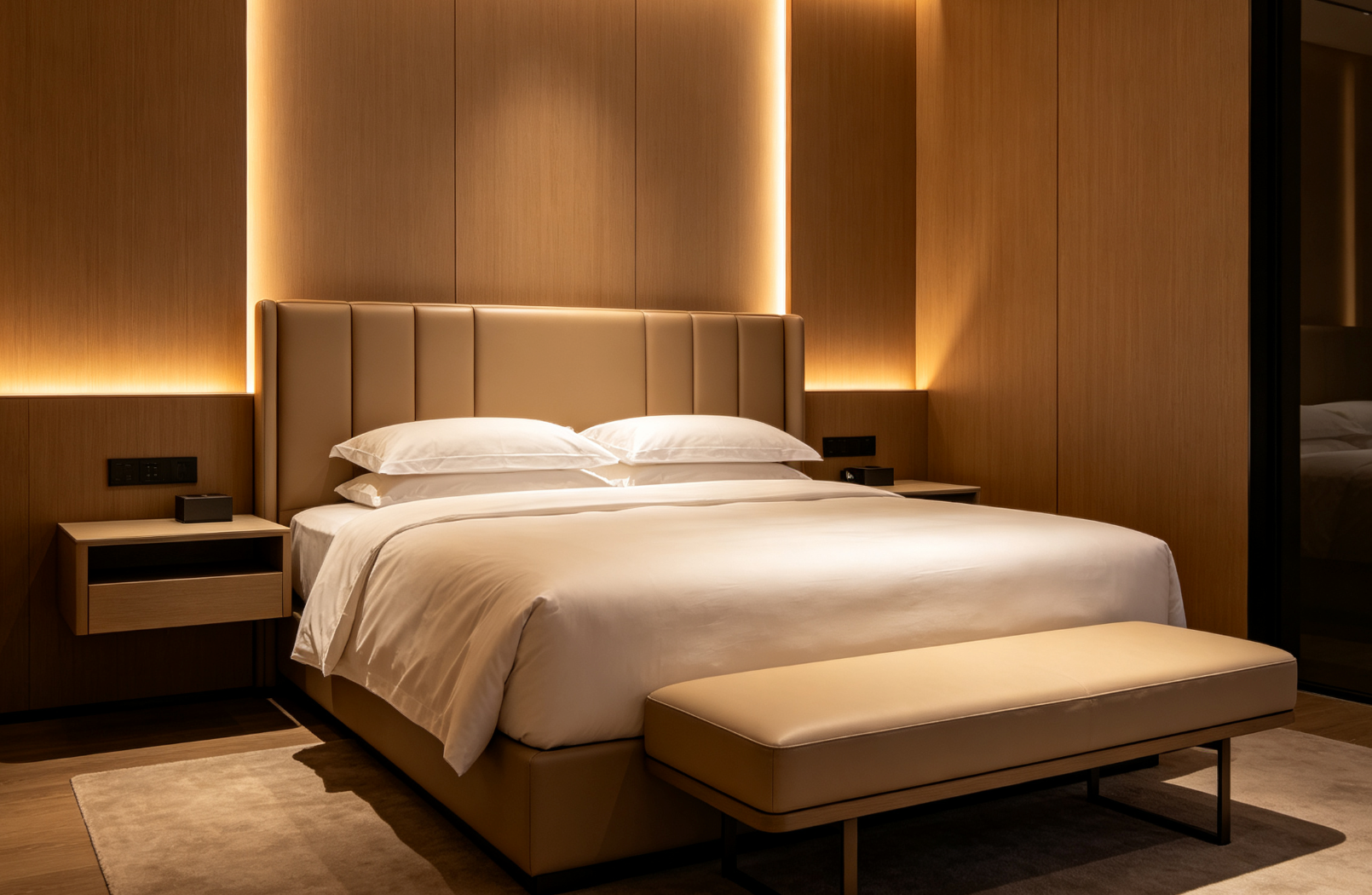
Chain hotel and brand-standard rollouts
Brand-standard projects are highly suitable for wholesale because consistent specifications can be repeated across multiple properties.
Chain procurement normally requires more than a product catalog. The supplier may need to review brand manuals, approved finish schedules, mock-up-room comments, hardware requirements, packaging rules, and inspection procedures. A capable factory converts those requirements into a controlled bill of materials and a repeatable production process.
Consistency should be checked at several points: raw material approval, first article inspection, finish matching, dimensional inspection, packing inspection, and loading documentation. Samples alone cannot prove that a large production run will remain consistent.
How should renovation projects be evaluated?
Renovation projects are suitable when the supplier can support phased procurement, accurate replacement measurements, and controlled installation with minimal disruption to hotel operations.
An operating hotel may need furniture delivered by floor, room type, tower, or public-area zone. Lobby furniture may be installed during overnight windows or between scheduled events. The procurement plan should therefore include storage, labeling, delivery access, protection of finished surfaces, and removal of old items.
Renovation buyers should compare suppliers on process reliability rather than unit price alone. A lower quoted price can lose its advantage if incorrect dimensions, damaged finishes, missing hardware, or incomplete packing create installation delays.
- Complete a site survey and photograph access routes, lifts, doors, columns, and finished surfaces.
- Define the installation sequence before approving production quantities.
- Request carton labels that identify zone, item code, quantity, and installation location.
- Agree on an inspection method for appearance, structure, dimensions, hardware, and packaging.
- Plan replacement parts for high-use components such as glides, hinges, upholstery, and table edges.
What furniture belongs in a hospitality lobby package?
A successful lobby package balances guest comfort, operational use, brand identity, and maintenance requirements.
| Furniture group | Typical application | Specification focus | Numeric planning reference |
|---|---|---|---|
| Guest lounge seating | Waiting, socializing, informal work | Seat comfort, upholstery, frame strength, cleanability | Maintain at least 36 inches of accessible route clearance where applicable |
| Coffee and side tables | Guest work and beverage placement | Edge safety, stability, surface repairability | Coordinate placement with the 36-inch route reference |
| Reception furniture | Check-in, concierge, guest assistance | Ergonomics, cable management, accessible service planning | Use a 60-inch turning-space reference where a turning space is required |
| Banquette seating | Perimeter seating and space zoning | Anchoring, upholstery replacement, cleaning access | Confirm clearances against the 36-inch route reference |
| Display and divider units | Wayfinding, branding, spatial separation | Tip resistance, anchoring, fire-safety coordination | Verify final placement with local code officials |
The numeric references in this table are planning prompts derived from the official ADA accessibility standards, not a complete compliance review. The United States Access Board guidance explains that accessible routes and maneuvering areas must be evaluated in context. Local building, fire, accessibility, and hospitality requirements may impose additional conditions.
What should buyers check before ordering wholesale furniture?
The supplier selection process should test whether a manufacturer can control the complete project chain from design interpretation to after-sales support.
Materials and construction
Commercial lobby furniture should be selected for repeated public use, frequent cleaning, and repairability rather than appearance alone.
Ask for the substrate type, veneer or laminate specification, edge treatment, internal reinforcement, hardware source, upholstery composition, and care instructions. For seating, clarify frame construction, joint method, foam specification, replaceable components, and load testing documentation when required by the project.
For wood-based products, buyers should also request formaldehyde-emission documentation when required by the destination market and project specification. The correct requirement depends on the material, jurisdiction, and certification route, so it should be confirmed during submittal review rather than assumed from a generic product description.
Design coordination
Design coordination is the point at which wholesale furniture becomes a project solution instead of a bulk product order.
A useful submittal package includes layout drawings, elevations, material boards, finish samples, hardware samples, furniture schedules, packing plans, and installation notes. The approval workflow should identify who can approve substitutions and how changes affect cost, lead time, and appearance.
Delivery and quality control
Delivery reliability depends on production control, inspection discipline, protective packaging, and documentation.
Buyers should define whether inspection occurs before packing, during loading, or through an independent inspection agency. They should also agree on acceptable tolerances, color variation rules, carton-drop expectations, replacement-part procedures, and the evidence required for a claim.
For North American projects, the supplier should understand container planning, destination port procedures, local installation constraints, and the difference between factory completion and site readiness. A furniture order is not complete when it leaves the factory; it is complete when the correct items arrive undamaged, can be identified, and can be installed in the intended location.
How can project teams control budget and lifecycle cost?
The lowest unit price is not necessarily the lowest project cost because furniture affects installation labor, maintenance, replacement frequency, storage, and schedule risk.
Use a total-cost comparison that includes product price, sampling, tooling, packaging, freight, duties, inspection, installation, spare parts, and expected maintenance. Compare like for like: the same material grade, hardware level, upholstery performance, packaging standard, and delivery scope.
Value engineering should preserve guest-facing performance. Suitable adjustments may include standardizing concealed components, reducing unnecessary finish variation, using repeatable module sizes, or selecting readily replaceable hardware. Poor value engineering removes structural reinforcement, weakens surface protection, or creates difficult-to-repair details.
Which supplier capabilities matter most?
A project-oriented hospitality furniture supplier should demonstrate coordinated design, manufacturing, commercial packaging, and communication with multiple stakeholders.
- Confirm experience with hotel public areas and room furniture rather than residential-only production.
- Review evidence of approved samples, mock-ups, and controlled revisions.
- Check whether the supplier can coordinate casegoods, seating, lighting, curtains, bathroom furniture, and decorative elements.
- Ask how production lots are inspected and how nonconforming items are isolated.
- Request a realistic production and shipping schedule with approval milestones.
- Clarify warranty scope, spare-part availability, installation support, and claim handling.
Taisen Furniture presents itself as a project-focused custom hotel furniture supplier founded in 2016, with integrated design, manufacturing, and sales capabilities in Ningbo. Its stated product coverage includes guestroom furniture, lobby furniture, hotel chairs, casegoods, bathroom vanities, curtains, lighting, and decorative coordination. For buyers, the relevant question is whether the supplier’s drawings, samples, quality records, and delivery plan match the specific hotel brief.
FAQ
Is hotel lobby furniture wholesale suitable for a small independent hotel?
It can be suitable when the project needs coordinated custom furniture, durable commercial finishes, or a distinctive design that is difficult to source through retail channels. The buyer should compare minimum order requirements and customization charges against the value of a unified package.
What is included in a hotel lobby furniture package?
A package may include sofas, lounge chairs, benches, coffee tables, side tables, reception furniture, banquettes, display units, partitions, lighting, curtains, and decorative elements. The exact scope should follow the approved furniture schedule and responsibility matrix.
How can a supplier match a hotel brand standard?
Provide the brand manual, approved finish references, drawings, hardware requirements, and mock-up comments. The supplier should issue controlled shop drawings and samples before mass production and retain approval records for later comparison.
What is the most important issue in a hotel renovation?
Accurate site information is usually the first priority. Existing walls, floors, access routes, and services may differ from drawings. Survey results should be linked to item codes and installation zones before production quantities are finalized.
How should hotel lobby furniture be maintained?
Use manufacturer-approved cleaning methods, inspect high-contact components, repair loose hardware promptly, and keep replacement upholstery, glides, hinges, or surface repair materials available where practical. Avoid unapproved chemicals that can damage coatings or fabrics.
How does accessibility affect lobby furniture layout?
Furniture must not obstruct accessible routes, maneuvering areas, service points, or required clear floor spaces. The official ADA standards provide federal references in the United States, but project teams must also check local codes and the property’s specific operating requirements.
What should be inspected before accepting a wholesale furniture shipment?
Check item codes, quantities, dimensions, finish consistency, upholstery condition, structural stability, hardware, packaging damage, and installation accessories. Photograph discrepancies and link each issue to the packing list and delivery location.
About the Supplier
Taisen Furniture is a Ningbo-based custom hospitality furniture supplier serving project and volume buyers. Its capabilities cover design coordination, hotel casegoods, lobby seating, chairs, bathroom vanities, curtains, lighting, and decorative furniture. The stated integrated model is intended for new-build, renovation, conversion, and chain-standard projects that require consistent specifications from sampling through delivery. Buyers can request a project review, product schedule, and quotation based on drawings, quantities, finish requirements, and delivery conditions.

Post time: Sep-21-2026