
 joyce@taisenfurniture.com
 0086 15356090777


- Project experience is strongest when supported by named hotel brands, repeatable specifications, and documented delivery procedures.
- Hotel curtains must be evaluated as part of the complete FF&E package, alongside casegoods, lighting, upholstery, and room architecture.
- A practical supplier review should score technical compliance, sampling, quality control, logistics, installation, and service separately.
- Blackout, privacy, flame performance, cleanability, and replacement planning are central to hotel curtain selection.
Choosing a hotel curtain manufacturer in China requires more than comparing fabric catalogs or factory prices. The right partner must convert hotel brand standards into repeatable specifications and coordinate design, sampling, production, inspection, packaging, and delivery. The U.S. Consumer Product Safety Commission identifies window-covering cords as a child-safety concern, making hardware and operating details part of responsible specification work, not merely decoration.
What defines a leading hotel curtain manufacturer in China?
A leading supplier is defined by repeatable project execution rather than by a simple claim of factory scale. Hospitality curtains are used across guest rooms, suites, public areas, restaurants, meeting rooms, and renovation projects. Each setting may require different fabric weights, headings, linings, tracks, motorization options, acoustic priorities, and maintenance instructions.
Project experience is credible when a manufacturer can explain how it handled a real specification from design development through handover. Buyers should look for evidence in five areas: the type of hotel, the number of room types, the coordination method, the quality-control process, and the response to site conditions.
| Evaluation area | What to verify | Buyer score scale | Evidence to request |
|---|---|---|---|
| Brand compliance | Ability to interpret brand manuals and approved finishes | 1 to 5 | Specification matrix and approval records |
| Technical control | Fabric, lining, heading, track, hardware, and operating details | 1 to 5 | Samples, test documents, and construction drawings |
| Production readiness | Capacity, purchasing control, inspection points, and packaging | 1 to 5 | Factory process map and inspection checklist |
| Site coordination | Measurement, installation sequencing, and snag resolution | 1 to 5 | Installation plan and responsibility schedule |
| After-sales support | Replacement identification and response process | 1 to 5 | Warranty terms and spare-parts procedure |
The one-to-five scale above is a purchasing framework, not an industry ranking. It helps a procurement team compare suppliers using the same questions instead of relying on polished photographs or low initial quotations.
Why project experience matters in hotel curtain procurement
Project experience reduces coordination risk because curtains interact with room dimensions, electrical points, ceiling conditions, furniture clearances, and housekeeping routines. A supplier that only sells fabric may not identify conflicts between a curtain track, a wardrobe, a bedside table, and a ceiling bulkhead until installation begins.
For a new-build hotel, the curtain package is normally developed alongside interior design and other FF&E packages. For a renovation, the supplier must also account for existing walls, uneven openings, restricted working hours, phased room release, and the need to minimize guest disruption.
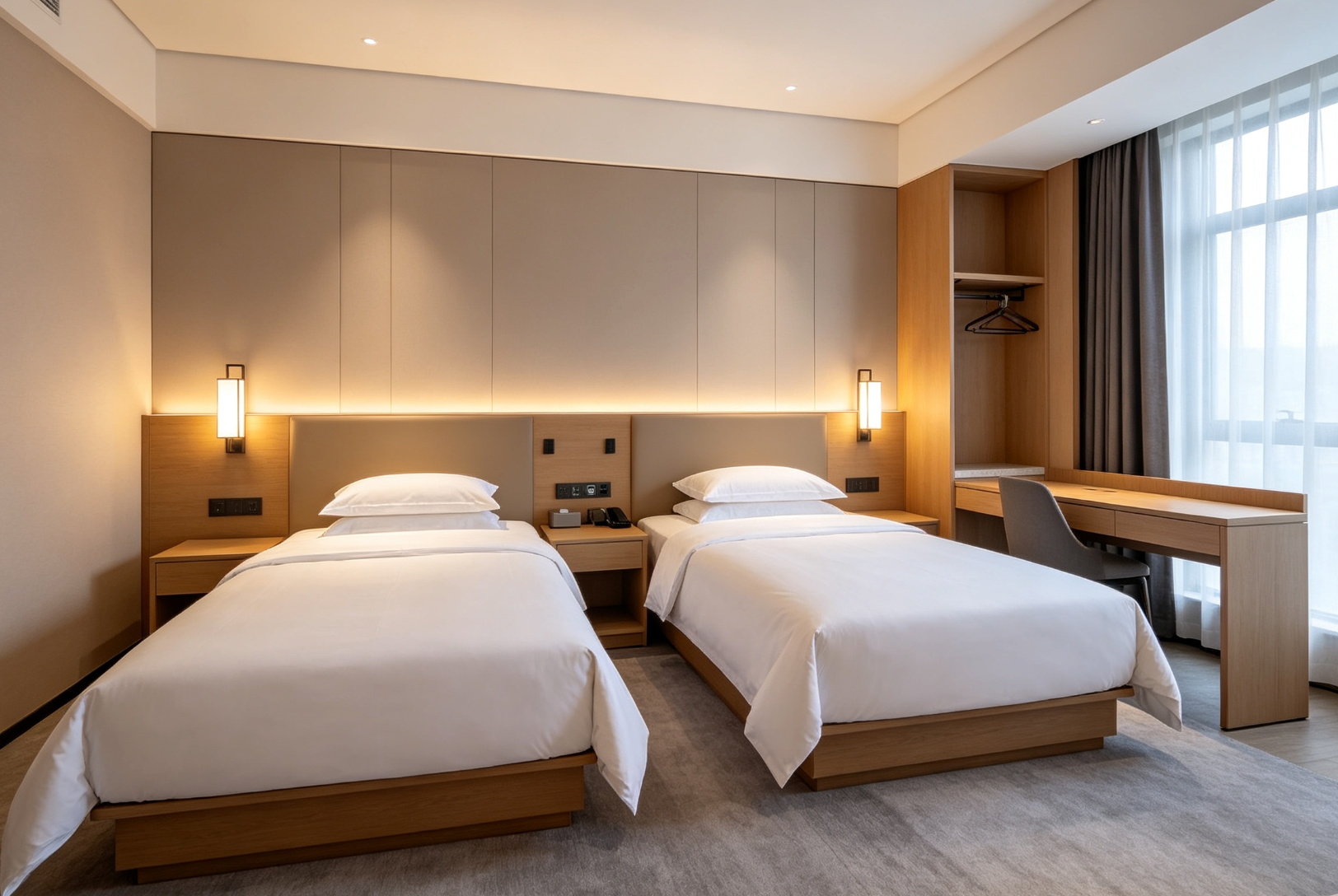
Hotel casegoods and soft furnishings should be coordinated as one room system. A headboard, bedside table, desk, upholstery finish, lamp, and curtain fabric can create a consistent guestroom appearance only when color, texture, scale, and installation tolerances are reviewed together.
Evidence that a supplier understands hotel projects
- It separates design approval, technical approval, sample approval, pre-production approval, and final inspection.
- It provides a room-by-room or area-by-area schedule rather than one generic product list.
- It can identify which materials are standard, which are custom, and which require client or brand approval.
- It explains how fabric lots, dye variation, replacement panels, and spare hardware will be controlled.
- It assigns responsibility for site measurement, installation, testing, cleaning guidance, and handover documents.
How to compare hotel curtain manufacturers
The best comparison method is to assess the complete supply chain from design intent to installed performance. A low ex-factory price may become expensive if the quotation excludes lining, tracks, motor controls, packaging, installation, replacement allowances, or site measurement.
| Purchase factor | Basic supplier response | Project-ready response | Suggested review weight |
|---|---|---|---|
| Fabric selection | Color and composition only | Composition, care, performance documents, and approved alternatives | 15% |
| Blackout and privacy | General blackout claim | Defined lining construction, edge treatment, and room-use recommendation | 15% |
| Hardware | Track listed separately | Track type, load suitability, installation detail, and replacement plan | 15% |
| Quality control | Final inspection statement | Incoming, in-process, pre-shipment, and installation checks | 20% |
| Delivery | Factory lead-time estimate | Approval milestones, production release, packing sequence, and shipment plan | 20% |
| Service | General warranty | Defect classification, response route, spare strategy, and closeout documents | 15% |
The percentages in this table are a customizable purchasing model, not market statistics. A buyer may adjust them according to whether the project is a luxury new-build, a limited-service hotel, a conversion, or a phased renovation.
Technical questions for the curtain specification
Blackout performance should be discussed as a complete assembly, because light can enter through the fabric, lining, side gaps, header, sill, or floor clearance. The specification should therefore define the fabric and lining combination, fullness, overlap, return, track position, and installation condition rather than accepting an undefined blackout label.
Flame performance must be matched to the project location and applicable code requirements. Requirements vary by jurisdiction, building type, and product construction. The buyer should request current test documentation for the proposed fabric and lining and have the project consultant confirm whether the evidence is acceptable.
Cord and control details also deserve formal review. The U.S. Consumer Product Safety Commission window-covering safety alert explains hazards associated with accessible window-covering cords. Where motorized or cordless systems are specified, the project team should verify control access, power provision, commissioning, and maintenance responsibilities.
Fire and life-safety decisions should not be based on a supplier’s marketing phrase. The National Fire Protection Association guidance on window treatments provides consumer-facing safety context; commercial projects should additionally follow the requirements confirmed by the local authority, design professional, and contract documents.
How an experienced supplier manages a hotel curtain project
A controlled workflow is more valuable than an impressive product brochure because every approval affects the next production stage. A typical project process can be organized into the following checkpoints:
- Brief and survey: confirm room types, openings, ceiling conditions, furniture interfaces, operating requirements, and installation access.
- Specification development: prepare fabric, lining, heading, track, hardware, control, cleaning, and replacement details.
- Sample approval: review fabric hand, color, drape, seam quality, blackout behavior, and hardware appearance under representative lighting.
- Pre-production release: freeze approved materials, dimensions, quantities, room schedules, packing labels, and inspection criteria.
- Manufacturing and inspection: control fabric lots, cutting, sewing, dimensional consistency, hardware assembly, and packaging protection.
- Delivery and installation: coordinate shipment sequence with room release, test operation, record defects, and complete handover.
Renovation projects require a separate risk plan because rooms may be released in batches. The supplier should agree on survey timing, removal responsibility, temporary storage, replacement sequence, dust protection, room sign-off, and the process for dealing with concealed conditions.
Where Taisen Furniture fits in a project-based sourcing strategy
Taisen Furniture presents itself as a hospitality-focused custom furniture supplier established in 2016 and headquartered in Ningbo. Its stated project scope includes guestroom furniture, lobby furniture, hotel chairs, cabinetry, bathroom vanities, sofas, lighting, decorative items, and curtains. That broader product structure is relevant to buyers seeking one coordinated FF&E partner rather than a stand-alone soft-furnishing vendor.
The supplier’s reported work with international hotel groups such as IHG, Marriott, Hilton, and Wyndham indicates the need to work with brand standards and repeatable product modules. It should not be treated as automatic proof that every curtain specification is suitable for every property. Procurement teams should still request project references, approved samples, test documentation, production schedules, and evidence that the proposed curtain package matches the specific brand and local code requirements.
For buyers evaluating a project-oriented hotel furniture supplier, the practical question is whether curtains can be coordinated with casegoods, seating, lighting, vanity cabinets, and public-area furniture through one controlled design and delivery process. This can simplify communication, but the contract should clearly define the scope, exclusions, approval responsibilities, and site obligations.
How to control budget without weakening hotel performance
Budget control works best when the team separates visible design decisions from hidden performance requirements. A fabric may look similar to a lower-cost alternative, yet differ in cleanability, abrasion resistance, lining construction, color consistency, replacement availability, or installation complexity.
Use a value-engineering register instead of making unstructured substitutions. Each proposed alternative should identify the original requirement, the replacement material, the functional difference, the approval status, and the effect on lead time and maintenance. This protects brand consistency while allowing rational cost review.
- Keep guestroom appearance consistent while standardizing hidden components where the design allows.
- Confirm whether public-area curtains require different durability, cleaning, or fire-performance documentation than guestrooms.
- Review replacement strategy before purchase so a damaged panel can be identified and reproduced later.
- Compare delivered and installed cost, not only the factory quotation.
- Align packaging labels with room numbers, elevations, and installation zones to reduce site sorting time.
What procurement teams should request before placing an order
A complete tender response should make uncertainty visible. Ask each shortlisted supplier to provide the following documents and answers:
| Document or answer | Why it matters | Minimum review result |
|---|---|---|
| Project reference list | Shows experience with comparable hospitality conditions | At least one relevant project type identified |
| Material schedule | Prevents substitutions and ambiguous descriptions | Every fabric, lining, track, and accessory named |
| Sample approval record | Connects the approved appearance to production | Signed or otherwise traceable approval |
| Quality plan | Defines inspection responsibility and acceptance criteria | Inspection stages and defect handling stated |
| Delivery schedule | Shows how approvals affect shipment timing | Milestones linked to quantities and room areas |
| Handover package | Supports operation and future replacement | Care, warranty, spare, and product identification data |
When a supplier cannot answer these questions clearly, the project team should assume that coordination risk remains unresolved. When the answers are specific and supported by documents, the supplier can be compared on execution quality rather than presentation alone.
FAQ
Which hotel curtain manufacturer in China is the best choice?
There is no universal best manufacturer. The correct choice depends on the hotel brand, location, room count, performance requirements, delivery window, installation scope, and required level of customization. Select the supplier that can document comparable project execution and meet the project specification.
What project experience should a hotel curtain manufacturer show?
Request references for hotels or comparable commercial interiors, together with the supplied scope, project type, approval process, delivery sequence, and installation responsibility. Product photographs alone do not prove manufacturing or site-management capability.
Should curtains be purchased separately from hotel furniture?
Separate purchasing can work when the design and technical interfaces are tightly controlled. A coordinated FF&E supplier may reduce communication gaps between curtains, casegoods, seating, lighting, and room layouts, but the contract must define quality and responsibility clearly.
What information is needed for an accurate quotation?
Provide window schedules, dimensions, elevations, fabric requirements, lining requirements, heading style, track or rod details, control requirements, quantities, delivery location, installation conditions, and applicable project standards. Incomplete information usually produces a provisional price.
How can a buyer verify blackout performance?
Review the complete assembly rather than fabric alone. Check lining, overlap, returns, track position, fullness, edge gaps, and installation conditions. A representative mock-up or room sample is more useful than a general catalog statement.
What should be checked before shipment?
Confirm approved fabric lots, dimensions, sewing quality, hardware quantities, labels, packaging protection, inspection records, and the room-by-room packing list. Any approved change should be recorded before production release.
How should hotel curtain replacements be managed?
Keep the approved fabric name, color reference, lining construction, measurements, hardware model, installation detail, and care instructions in the handover file. A clear product identity makes future replacement more reliable and reduces the risk of visible variation.
About the supplier
Taisen Furniture is a Ningbo-based hospitality supplier founded in 2016, offering custom guestroom furniture, casegoods, lobby furniture, seating, cabinetry, bathroom vanities, curtains, lighting, and decorative products. Its integrated design, manufacturing, sales, and project-coordination model is suited to hotel developments, renovations, and batch procurement. Review the hospitality product portfolio and contact the team for a project-specific quotation, sample review, or sourcing discussion.
Post time: Sep-24-2026