
 joyce@taisenfurniture.com
 0086 15356090777


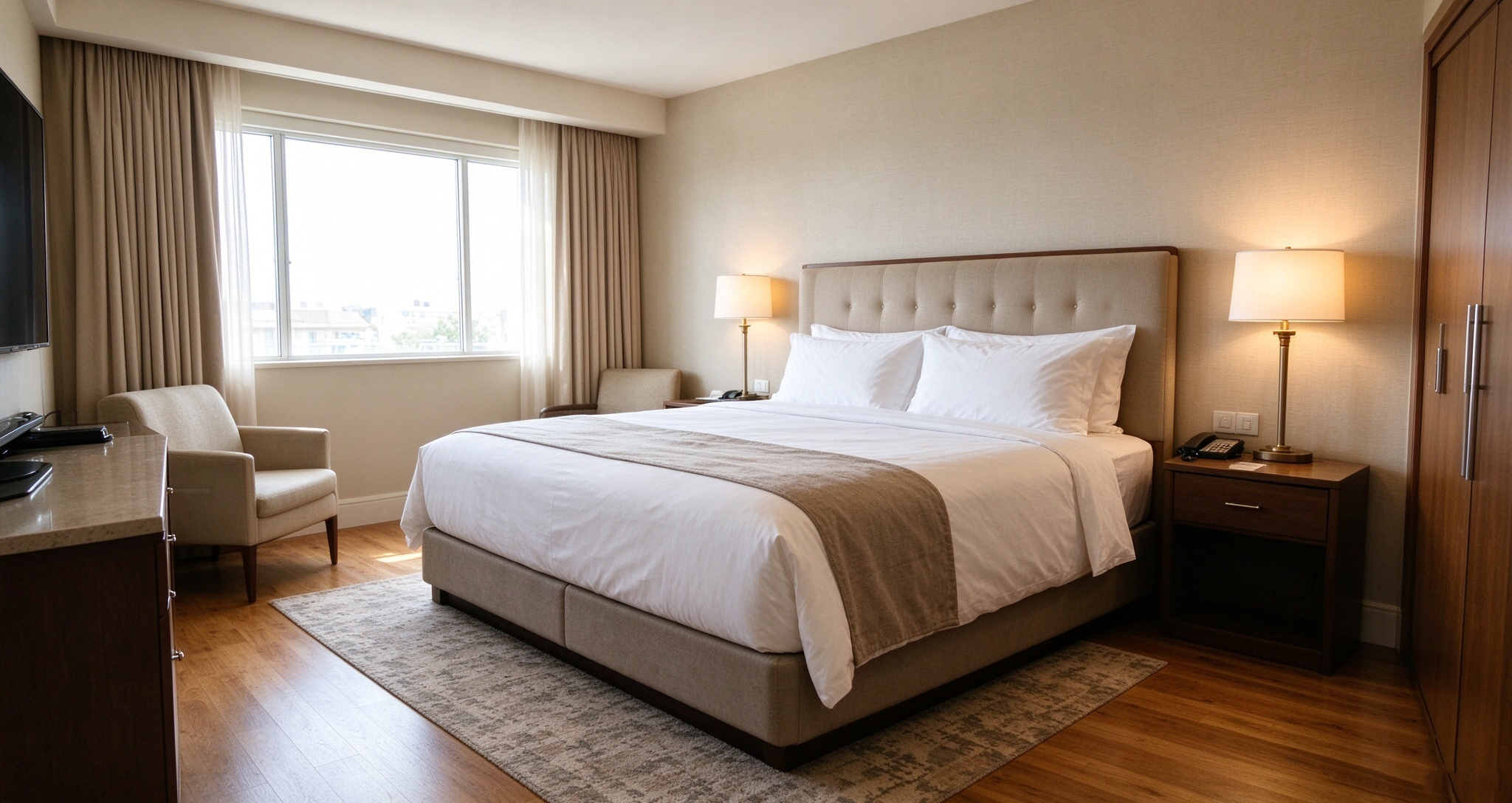
A quiet guest room is one of the most powerful differentiators a hotel can offer, yet it is also one of the most difficult to deliver consistently. For light sleepers, the difference between a restful night and a frustrating one often comes down to small, invisible details: the faint hum of an HVAC unit, a door that clicks in the corridor, the creak of a bed frame when a partner turns over, or a drawer that slides shut with a hard bang. Many hotel operators focus their noise-reduction budget on windows, walls, doors and flooring, while overlooking the role that furniture itself plays in the acoustic performance of a guest room. Bed frames, headboards, wardrobes, desks, nightstands and lounge chairs all generate noise, transmit noise, or absorb noise. This article examines the furniture specifications that support quiet guest room design, covering structural engineering, hardware selection, upholstery and acoustic materials, layout strategy, testing standards and procurement practices, so that FF&E teams can build sleeping environments that protect the rest of light sleepers without compromising durability or design quality.
Why Quiet Guest Room Design Matters
The Link Between Sleep Quality and Guest Satisfaction
Sleep quality is the single most important driver of guest satisfaction in a hotel. A guest who sleeps well is more likely to leave a positive review, return for a future stay and recommend the property to others. A guest who is kept awake by noise is far more likely to complain, leave a negative rating and choose a competitor on their next trip. For light sleepers, even minor acoustic disturbances are amplified. A single creak, drip, hum or slam can disrupt the sleep cycle and ruin an entire night. Hotels that fail to control furniture-generated noise are effectively gambling their reputation on a detail that should be engineered.
The Operational and Commercial Impact
Beyond individual comfort, quiet room design carries measurable commercial consequences. Light sleepers represent a significant share of the travel market, including business travellers, families with young children, elderly guests and anyone with a sensitive sleep profile. These guests are often willing to pay a premium for a guarantee of quiet, and they are loyal to brands that deliver it consistently. Conversely, noise complaints generate guest compensation requests, negative online reviews and higher housekeeping and maintenance workloads. A bed frame that squeaks requires a service call. A wardrobe door that rattles generates a complaint. A drawer that slams creates wear on both the furniture and the guest’s patience. Investing in quiet furniture specifications is therefore a direct investment in guest loyalty, revenue and operating efficiency.
Why Furniture Is Often the Missing Piece
Most noise-control budgets are spent on structural measures: acoustic wall insulation, double-glazed windows, solid-core doors, carpet in corridors and weather stripping. These measures address airborne and structure-borne noise from outside the room. However, they do nothing about the noise generated inside the room by the furniture itself. A bed that creaks, a headboard that knocks against the wall, a desk chair that squeaks, a wardrobe with a rattling door and a nightstand with a slamming drawer all create noise that structural treatments cannot solve. Quiet guest room design therefore requires a dedicated furniture specification strategy, focused on eliminating noise at its source.
The Main Sources of Noise Inside a Guest Room
Structure-Borne Noise
Structure-borne noise travels through the building structure itself. The most common sources inside a guest room are the HVAC fan coil unit, plumbing and piping, and vibration transmitted from adjacent rooms or mechanical rooms. Furniture interacts with structure-borne noise in two ways. First, furniture can act as a resonator, amplifying vibrations that reach it through the floor. Second, furniture can transmit structure-borne noise to the guest through direct contact. A bed frame bolted tightly to a vibrating floor, a headboard mounted against a wall carrying mechanical vibration, and a wardrobe standing on a thin floor all transfer vibration into the sleeping environment. Quiet furniture design uses isolation, damping and flexible connections to break these vibration paths.
Airborne Noise
Airborne noise travels through the air as sound waves. Inside a guest room, the main airborne noise sources are corridor activity, adjacent room conversations, television sound and outdoor traffic. Furniture influences airborne noise primarily through its surfaces. Hard, flat, reflective surfaces such as solid wood panels, glass tabletops and metal frames bounce sound waves back into the room, increasing reverberation and perceived loudness. Soft, porous surfaces such as upholstered headboards, fabric-wrapped panels, acoustic wall coverings and padded furniture absorb sound, reducing reverberation and making the room feel quieter. Quiet room design therefore favours upholstered and acoustic materials in strategic locations.
Furniture-Generated Noise
Furniture-generated noise is the most direct and the most preventable category. It includes bed frames that squeak when a guest turns over, headboards that knock against the wall, wardrobes with doors that rattle or slam, drawers with hard-failing slides, desk chairs that squeak and castors that rumble on hard floors. Every one of these noises has an engineering cause and an engineering solution. Squeaks come from metal-to-metal friction in joints. Rattles come from loose fittings. Slams come from uncontrolled kinetic energy in slides and hinges. Quiet furniture specification identifies these failure modes and eliminates them through design, materials and hardware selection.
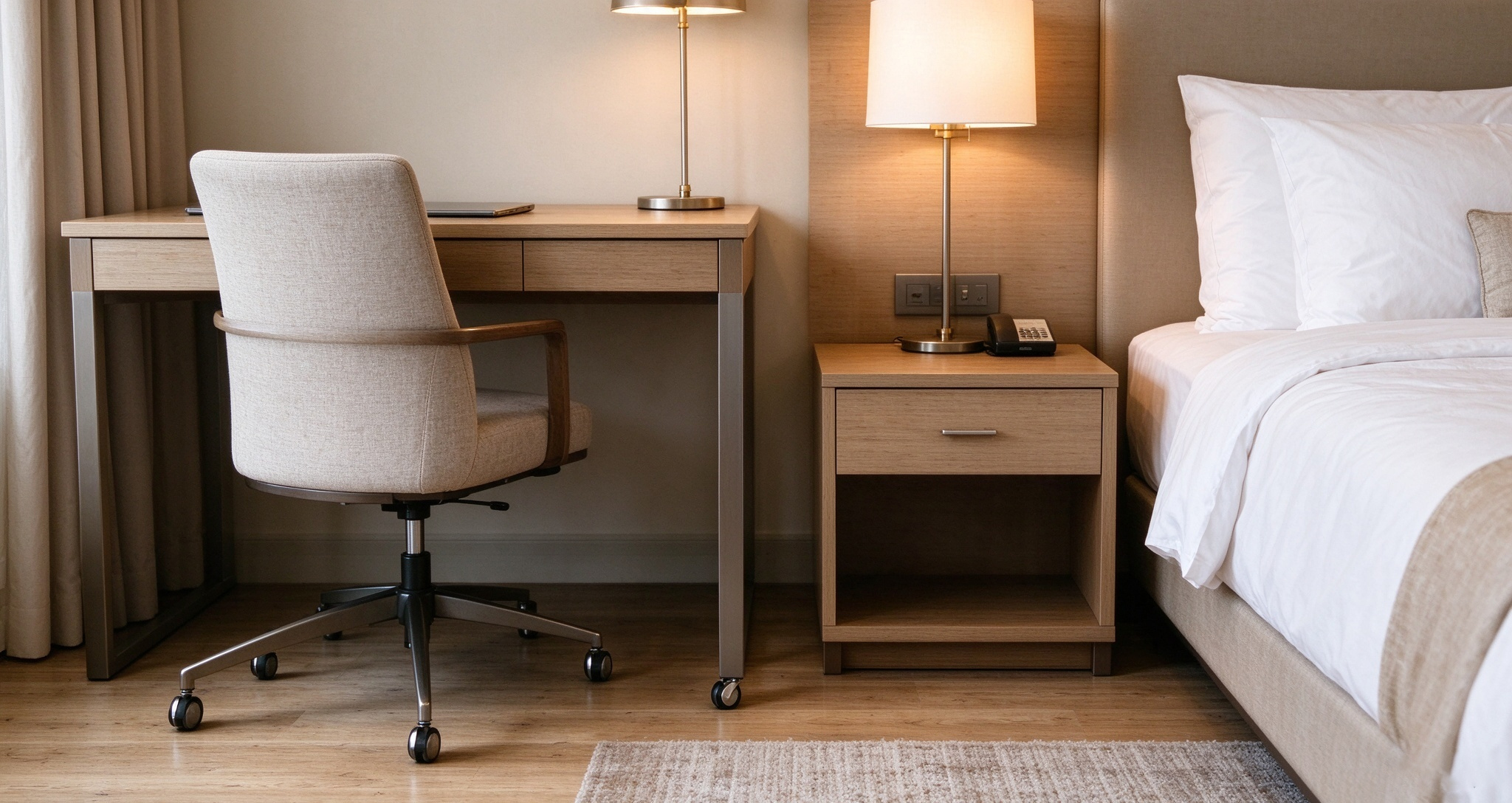
Furniture Specifications by Guest Room Zone
The guest room is a multi-zone environment, and each zone has distinct quietness requirements. A one-size-fits-all furniture specification will leave gaps in the acoustic performance.
The Bed Zone
The bed is the emotional and functional centre of the guest room, and it is also the most noise-sensitive zone. Light sleepers are most vulnerable to noise when they are trying to fall asleep and when they wake in the middle of the night.
Bed Frame Structure. The bed frame must be engineered for silent operation. Metal-to-metal joints should use self-locking fasteners with thread-locking compound or nylock nuts to prevent loosening and squeaking over time. Wooden joints should use proper joinery, glued and reinforced with screws, rather than relying on friction alone. Slats should be installed with flexible rubber or felt gaskets at the contact points with the frame rails to prevent creaking when the mattress moves. The frame should sit on padded, non-marking glides that isolate vibration and prevent floor scratching.
Headboard. The headboard is a frequent source of knocking noise when the bed is used. A headboard mounted rigidly against the wall transmits every movement directly to the wall structure, creating a hollow knocking sound. Quiet headboard design uses a small gap between the headboard and the wall, with a padded backing or acoustic foam layer, so that movement is absorbed rather than transmitted. The headboard-to-frame connection should use captive hardware with rubber damping washers to prevent rattling.
Mattress Foundation. The foundation, whether a box spring, platform or slatted base, must not squeak under load. Foam-based foundations are inherently quiet, while spring-based foundations should be tested for metallic creaking. The interface between the foundation and the frame should be cushioned to prevent movement noise.
The Wardrobe and Storage Zone
Wardrobes and storage units generate noise through doors, drawers and internal fittings. For light sleepers, the wardrobe is usually near the bed, so its quietness matters.
Door Hardware. Wardrobe doors should use soft-close hinges and runners. Soft-close mechanisms use hydraulic damping to slow the final closure, preventing the hard bang of a door slamming shut. Sliding doors should run on quality, low-noise track systems with silent rollers. Push-to-open systems, which avoid handles entirely, reduce the number of moving parts and eliminate the click of a latch.
Drawer Slides. Drawers are a major noise source in nightstands and dressers. Standard metal slides can rattle and generate a hard stop when closed. Quiet specifications use soft-close drawer slides with hydraulic damping, which slow the drawer as it nears the end of its travel and close it gently. Slides should be tested for vertical and lateral stability to prevent wobble, which creates rattling.
Internal Fittings. Loose coat hangers, sliding shelves and rattling interior components all generate noise. Interior fittings should be secured, and shelves should be fitted with anti-rattle clips. Drawer liners add a soft layer that absorbs the sound of contents shifting during movement.
The Desk, Nightstand and Seating Zone
Desks, nightstands and chairs generate noise through sliding, squeaking and surface impact.
Nightstand. The nightstand sits beside the bed and is used at night, often in the dark. Its drawer slides should be soft-close and silent. The surface should be stable, and the legs should sit on padded glides. Any charging stations or lamps on the nightstand should be firmly mounted to prevent vibration.
Desk Chair. Desk chairs are notorious for squeaking. Quiet specifications use chairs with quality swivel mechanisms, gas lift cylinders tested for silent operation and castors chosen for the floor type. On hard floors, soft rubber castors reduce rumble. On carpet, dual-wheel castors spread the load. The seat and back mechanisms should be lubricated with dry, non-migrating lubricants that do not attract dust.
Lounge Seating. Lounge chairs and ottomans in the guest room should use solid, quiet construction. Wooden frames with proper joinery do not creak, while fabric upholstery absorbs sound. Cushion foam should be tested for quiet performance; high-quality foam does not generate noise when compressed.
Acoustic Upholstery and Soft Materials
Strategic use of upholstered and acoustic materials dramatically improves the perceived quietness of a guest room.
Headboard Upholstery. An upholstered headboard with a dense foam layer absorbs sound and prevents the hollow knocking associated with rigid headboards. The foam also provides a comfortable, quiet surface for guests who sit up in bed.
Acoustic Wall Panels. Fabric-wrapped acoustic panels behind the bed, on the wall opposite the door, or in the seating area absorb airborne noise and reduce reverberation. These panels are available in a wide range of finishes that match any hotel design aesthetic.
Rugs and Floor Coverings. A rug or soft floor covering in the bed zone and seating area absorbs impact noise and reduces the sound of footsteps and moving furniture. The rug should be paired with an acoustic underlay for maximum performance.
Materials, Structure and Hardware Selection
The quiet performance of furniture depends on the materials and hardware used, and these must be specified together rather than left to chance.
Quiet Frame Construction
Frame construction is the foundation of quiet furniture. Solid hardwood frames with properly engineered joints are inherently quiet, while frames assembled from thin particleboard with mechanical joints are prone to creaking and loosening. Corner blocks and gusset plates reinforce joints and prevent movement. All joints should be glued and mechanically fastened for maximum rigidity. The frame should be tested under load to ensure it does not emit noise when weight is applied.
Damping and Isolation Materials
Damping materials absorb vibration and prevent it from transmitting through the furniture. Rubber gaskets, felt pads and acoustic foam are used at every contact point: between the frame and the floor, between the frame and the headboard, between slats and rails, and between moving components. Isolation is achieved by breaking the direct contact between furniture and the building structure, so that vibration is not transmitted to the guest.
Soft-Close Hardware
Soft-close hinges and slides are the single most important hardware upgrade for quiet guest rooms. These mechanisms use hydraulic or pneumatic damping to control the speed of closure, eliminating the hard bang that wakes light sleepers. Soft-close hardware should be specified as standard on all wardrobe doors, drawers and desk drawers. It adds a small cost premium but delivers outsized guest satisfaction value.
Acoustic Materials
Acoustic foam, fabric-wrapped panels and recycled felt are the primary acoustic materials used in quiet furniture. These materials absorb sound energy, reducing reverberation and perceived noise. They are available in fire-rated grades that meet hospitality standards. Acoustic materials should be placed strategically: behind the headboard, on the wall opposite the bed, in the seating area and in any enclosed storage.
How to Compare Quiet Furniture Performance
Evaluating quiet performance requires moving beyond subjective impressions and relying on measurable, standardized criteria.
Key Acoustic Metrics
Sound absorption is measured by the Noise Reduction Coefficient (NRC), a value from 0 to 1.0. An NRC of 0.50 is entry-level acoustic performance, while premium acoustic furniture targets 0.70 to 0.85. Sound insulation is measured by Sound Transmission Class (STC), which rates how well a partition blocks airborne sound. Impact noise is measured by Impact Insulation Class (IIC). While furniture cannot replace structural acoustic measures, upholstered furniture with high NRC contributes to the overall quietness of the room.
Structural and Durability Metrics
Quiet furniture must also meet the same structural and durability standards as conventional furniture. Frames should pass load testing to commercial standards. Upholstery should meet Wyzenbeek abrasion requirements for hospitality use. Foam should be tested for compression set and resilience to ensure it does not degrade and start generating noise over time.
Functional Testing
Functional testing is the most direct way to evaluate quiet performance. A bed frame should be loaded with weight and rocked to check for squeaks. A headboard should be pushed and knocked to check for rattling. Drawers should be opened and closed repeatedly to confirm soft-close operation. Doors should be slammed gently and checked for a quiet, controlled closure. These simple tests reveal whether the specification is delivering on its promise.
Compliance, Testing and Sourcing
Accessibility and Fire Safety
Quiet furniture must comply with accessibility and fire safety requirements. Upholstered furniture must meet local fire codes, such as CAL 117-2013 or CAL 133 for public areas. Acoustic materials must be fire-rated. Accessibility requirements, such as ADA guidelines, must be met for guest rooms designated as accessible. Quiet furniture specifications must be developed alongside these compliance requirements, not in place of them.
Mock-Ups, Samples and Field Testing
Quiet performance cannot be verified from a product photo. Hotels should require manufacturers to provide a fully finished mock-up room with the specified furniture. The mock-up should be tested in a real environment, with guests or staff using the furniture under normal conditions. Listen for creaks, rattles and slams. Measure the acoustic performance if a sound engineer is available. The mock-up phase is the last opportunity to catch noise issues before mass production.
Supplier Evaluation Criteria
When evaluating suppliers, hotel groups must look beyond unit cost. A reliable supplier should offer quiet-specific engineering expertise, documented acoustic material sourcing, and a willingness to test prototypes for noise. The supplier should provide warranties covering hardware performance and frame integrity. Lead times for custom quiet furniture may be longer, and this must be integrated into the project schedule.
How to Make the Final Selection
Bridging the gap between design vision and quiet performance requires a structured decision-making process.
Decision Matrix for Hotel Teams
A weighted decision matrix helps hotel teams evaluate quiet furniture objectively.
| Selection Criterion | Weighting | Ideal Target Specification | Critical Red Flag |
|---|---|---|---|
| Quiet Performance | 35% | No noise under load, soft-close hardware, NRC 0.70+ | Squeaks, rattles or slams in testing |
| Durability | 30% | Commercial-grade frames, 7+ year lifecycle | Cheap hardware, thin materials |
| Aesthetic Appeal | 20% | Matches brand design language | Visible hardware, unfinished edges |
| Total Cost of Ownership | 15% | Quiet hardware premium pays back in satisfaction | Frequent hardware replacement |
By assigning the highest weighting to quiet performance and durability, the matrix prevents the purchase of attractive furniture that wakes light sleepers and creates maintenance problems.
Guidance for Design and Procurement
Designers and procurement officers must align quiet specifications early in the FF&E phase. Adding soft-close hardware and acoustic materials typically incurs a modest cost premium. This premium is a vital investment. Standard hardware often degrades and begins to rattle within a few years in a busy hotel. Quiet hardware, specified correctly and maintained properly, delivers silent operation for the life of the furniture. The result is higher guest satisfaction, fewer noise complaints and a more competitive, premium guest experience.
Key Takeaways
- Quiet guest room design requires a dedicated furniture specification strategy, not just structural noise measures.
- Furniture generates, transmits and absorbs noise; each category has engineering solutions.
- The bed zone, wardrobe zone and desk zone each have distinct quietness requirements.
- Soft-close hinges and drawer slides are the highest-value hardware upgrade for quiet rooms.
- Upholstered headboards, acoustic panels and rugs absorb sound and reduce reverberation.
- Damping and isolation materials break vibration paths between furniture and the building structure.
- Quiet furniture must meet the same durability, fire safety and accessibility standards as conventional furniture.
- Mock-up and field testing are essential to verify quiet performance before mass production.
- Quiet rooms improve guest satisfaction, reduce complaints and support premium pricing.
Frequently Asked Questions
What is the most important furniture specification for a quiet guest room?
Soft-close hardware on drawers and doors is the highest-impact upgrade, because it eliminates the loud bang that wakes light sleepers. Upholstered headboards and acoustic panels are the second most important addition.
Can furniture really reduce noise in a guest room?
Yes. Furniture generates noise through squeaks and rattles, transmits noise through vibration, and absorbs noise through soft acoustic materials. Addressing all three makes the room measurably quieter.
Do quiet furniture specifications cost more?
Quiet hardware and acoustic materials add a modest premium. However, this cost is offset by fewer noise complaints, less maintenance, higher guest satisfaction and the ability to command premium rates.
How do I test furniture for quiet performance?
Load the frame and rock it, push and knock the headboard, open and close drawers repeatedly, and slam doors gently. Any squeak, rattle or bang indicates a specification that has not delivered on quietness.
Does quiet furniture meet fire safety standards?
Yes. All upholstered and acoustic materials must meet local fire codes, and quiet specifications must be developed alongside, not instead of, compliance requirements.
Post time: Oct-28-2026