
 joyce@taisenfurniture.com
 0086 15356090777


For global hotel owners, the hardest design question is not whether a property should feel branded or local—it is how to make both priorities work at once. Marriott manages that tension across more than 8,500 hotels in over 130 countries, using strict standards for safety, comfort, infrastructure, and operations while still allowing room for destination-specific character. This balance matters because design decisions influence approvals, construction cost, guest satisfaction, corporate travel confidence, and long-term asset value. The article examines where Marriott draws the line between mandatory consistency and flexible localization, and how developers, architects, and procurement teams can use that framework to create hotels that feel reliable, relevant, and commercially stronger.
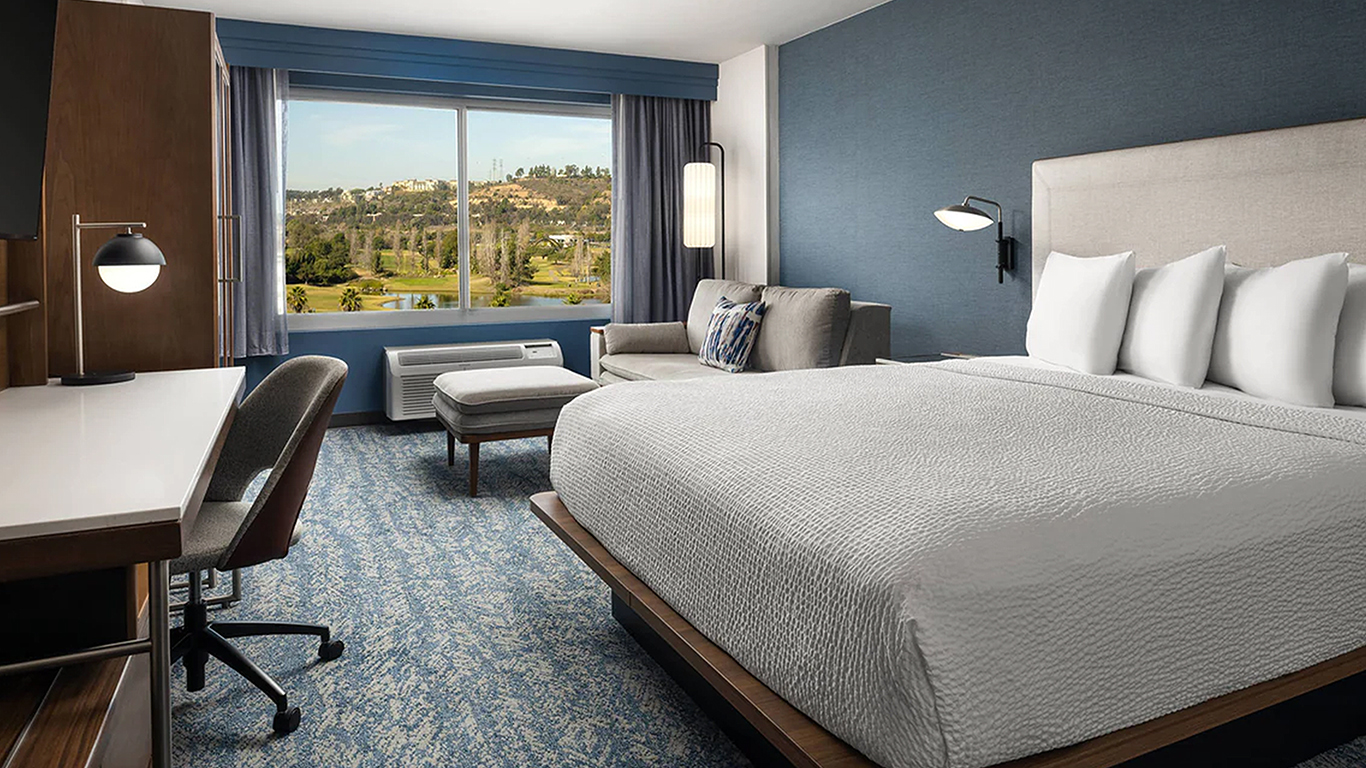
Marriott Brand Consistency vs. Local Design
Navigating the intersection of global brand equity and authentic local experiences is a central challenge in modern hospitality development. Marriott International operates a vast portfolio of over 8,500 properties across more than 130 countries, necessitating a highly calibrated approach to architectural and interior design. For developers, architects, and procurement teams, understanding how Marriott governs this balance is critical to securing project approvals and maximizing asset value.
Why Brand Consistency Matters
At the core of Marriott’s global strategy is the promise of predictability. Corporate travel managers, who dictate a significant portion of transient and group bookings, rely on stringent brand standards to ensure duty of care, consistent service delivery, and reliable infrastructure. Maintaining strict guidelines for life safety, acoustics, and mechanical systems protects the brand’s liability and ensures guest trust.
From an operational standpoint, consistency drives down capital expenditures (CAPEX) and operating expenses (OPEX). Standardized room footprints and prototypical designs allow for economies of scale in procurement, reducing the per-key construction cost. Furthermore, a unified operational standard means staff training, maintenance protocols, and technology integrations can be scaled globally with minimal friction, ensuring a baseline of quality that defines the Marriott portfolio.
How Local Design Adds Destination Relevance
While predictability secures baseline loyalty, modern guest preferences heavily skew toward experiential travel. Integrating local design elements—ranging from indigenous materials and vernacular architecture to regional art programs—combats the fatigue of homogenized, “cookie-cutter” hotel environments. This localization strategy is essential for capturing leisure travelers and premium transient guests who demand destination authenticity.
By weaving local narratives into the spatial design, properties can differentiate themselves within saturated markets. This relevance translates directly to commercial performance, often yielding higher Average Daily Rates (ADR) and stronger local food and beverage (F&B) capture rates. The strategic insertion of localized design signals to the market that the property is intimately connected to its community, elevating the asset from a mere accommodation to a destination in its own right.
Core Standards and Flexible Design Areas

Marriott Global Design (MGD) implements a bifurcated framework that clearly delineates which elements of a property must adhere strictly to corporate prototypes and which areas are open to regional interpretation. This structural approach allows owners to inject local flavor without compromising the foundational brand identity.
Non-Negotiable Brand Standards
Non-negotiable standards primarily encompass areas impacting guest safety, comfort fundamentals, and brand-defining signatures. These include mandatory fire and life safety (FLS) systems, acoustic ratings (typically requiring an STC rating of 50 or higher between guestrooms), and specific mechanical, electrical, and plumbing (MEP) requirements.
Guestroom fundamentals are also heavily guarded. For instance, mattress specifications, minimum lighting levels (often mandated at 30-50 foot-candles at work surfaces), and technology backbones like a minimum 100 Mbps dedicated bandwidth per room are strictly enforced. These elements form the invisible architecture of the guest experience and are rarely subject to localization.
Where Local Materials, Art, and F&B Can Adapt
Flexibility is predominantly granted in highly visible, high-impact zones such as lobbies, specialty restaurants, and the aesthetic finishes of guestrooms. Owners are encouraged to source regional stone, sustainable local timber, and bespoke artwork that reflects the immediate geography or cultural heritage.
Procurement teams can adapt casegoods and seating to fit the local narrative, provided the materials meet commercial grading. For example, when sourcing custom furniture, the pieces must reflect local aesthetics while still achieving Marriott’s rigorous durability standards, such as exceeding 50,000 Wyzenbeek double rubs for upholstery fabrics and utilizing contract-grade joinery.
How to Map Mandatory and Flexible Elements
Successfully mapping these elements requires a clear understanding of brand-specific design pillars. Design teams typically utilize a matrix approach during the schematic design phase to isolate prototypical requirements from localized opportunities.
| Design Zone | Mandatory Core Standard (Fixed) | Flexible Local Element (Adaptable) |
|---|---|---|
| Guestroom Bath | Minimum square footage, fixture flow rates (e.g., 1.5 GPM) | Vanity stone species, localized tile motifs, mirror framing |
| Lobby / Arrival | Circulation clearances, check-in technology integration | Custom millwork, regional art installations, localized lighting fixtures |
| Food & Beverage | Kitchen equipment specs, health/safety clearances | Concept narrative, custom seating fabrics, indigenous menu integration |
| Guestroom Bedding | Mattress coil count, thread count, pillow fill | Decorative throws, custom headboard textiles, localized wallcoverings |
By adhering to this mapping strategy, developers can allocate their interior design budgets more effectively, spending heavily on impactful local touches while relying on cost-effective, approved vendors for mandatory unseen systems.
How Balance Varies by Property Type and Market
The degree to which a property can deviate from prototype design is heavily dictated by its position within Marriott’s brand architecture. A uniform approach to localization is impossible across a portfolio that spans from budget-conscious select-service to ultra-luxury resorts.
Luxury, Premium, Select-Service, and Lifestyle Brands
Select-service brands like Fairfield and Courtyard are driven by operational efficiency and speed to market. These brands typically demand 80% to 90% adherence to prototype designs, aiming to keep turnkey development costs tightly controlled, often targeting a cost-per-key between $110,000 and $150,000 depending on the market. Localization here is usually restricted to curated art packages and specific FF&E finishes.
Conversely, luxury and lifestyle brands such as The Ritz-Carlton, W Hotels, and EDITION operate on an inverted model. These properties may allow up to 70% bespoke, localized design. The brand standards dictate service philosophies, spatial volumes, and luxury material grades, but the actual aesthetic execution is heavily localized to command premium rates and satisfy luxury consumer expectations.
Regional and Cultural Design Factors
Regional geography and cultural norms mandate significant design adaptations, even within strict brand prototypes. Climate variables dictate exterior envelope materials, HVAC tonnage, and fenestration requirements. For instance, a property in the Middle East requires advanced solar shading coefficients and larger mechanical footprints compared to a European counterpart.
Cultural factors also reshape spatial programming. In many Asian markets, Marriott standards are adapted to include expanded F&B footprints, larger banquet facilities for localized event demands, and culturally specific bathroom configurations (such as separate wet rooms), demonstrating that brand consistency must sometimes yield to regional market expectations.
Conversions, Adaptive Reuse, Resorts, and Urban Hotels
The physical nature of the asset further influences the design balance. Ground-up urban hotels often lean closer to prototypes to maximize floor area ratios and expedite construction timelines. Resorts, however, require deep integration with their natural surroundings, necessitating bespoke architectural responses and localized landscaping.
Adaptive reuse and conversion projects, particularly within collection brands like Autograph Collection or Tribute Portfolio, present unique challenges. Owners must implement Property Improvement Plans (PIPs) that average $15,000 to $35,000 per key to meet core Marriott life-safety and technology standards, while simultaneously preserving the historical or local architectural integrity that qualifies the building for the collection brand.
Practical Process for Owners and Design Teams
Achieving the optimal blend of brand compliance and local authenticity requires a disciplined project management approach. Owners, architects, and interior designers must navigate a structured approval sequence with Marriott’s corporate design teams to prevent costly redesigns.
Brand Review and Concept Design Sequence
The process begins with the initial brand pitch and concept narrative, where the localization strategy is formally proposed. Marriott Global Design (MGD) utilizes a phased milestone review process, typically requiring formal submittals at 30%, 60%, and 90% design completion.
During the 30% schematic phase, the focus is on spatial programming and verifying that localized concepts do not violate core brand pillars. The 60% design development phase scrutinizes material selections and FF&E intent, while the 90% phase locks in construction documents and final procurement specifications. Missing these critical alignment checks can result in project delays and compromised brand approvals.
Cost, Sourcing, Durability, and Maintenance Checks
When integrating local design elements, procurement teams face strict commercial viability tests. A bespoke light fixture crafted by a local artisan must still meet UL/CE certification and Marriott’s lumen output requirements. Sourcing locally often introduces logistical hurdles that must be managed against the project schedule.
Furthermore, custom localized FF&E typically requires a Minimum Order Quantity (MOQ) of 50 to 100 units to achieve favorable pricing, with lead times frequently extending to 16-20 weeks. Design teams must ensure that locally sourced materials possess the commercial durability to withstand high-traffic hospitality environments, avoiding residential-grade finishes that will fail prematurely.
Documenting Exceptions and Substitutions
Inevitably, localized designs will conflict with standard brand specifications, requiring a formal variance request. The burden of proof lies with the ownership group to demonstrate that the proposed substitution equals or exceeds the performance of the specified standard.
Documenting these exceptions requires detailed submittals, including physical material samples, warranty data, and independent testing certifications (such as flammability ratings). Owners must prove that the local substitution will meet Marriott’s lifecycle mandates, which typically require a 5-to-7-year replacement cycle for soft goods and a 10-to-14-year lifecycle for hard goods and casegoods.
Decision Framework for the Right Balance
Ultimately, the decision to lean toward rigorous brand standardization or to invest heavily in localized design is a strategic financial calculation. Stakeholders must weigh the upfront capital costs against projected revenue premiums and long-term operating expenses.
When to Prioritize Operational Standardization
In highly transient, price-sensitive markets—such as airport adjacent properties or suburban highway interchanges—operational standardization should take precedence. Guests in these locations prioritize efficiency, cleanliness, and brand familiarity over bespoke experiences.
By adhering strictly to prototypes in these environments, owners can reduce FF&E procurement costs by 15% to 20% through corporate volume purchasing agreements. Furthermore, maintenance and replacement costs are minimized, as standardized parts are readily available and staff require less specialized training to maintain the asset.
When Local Design Creates Measurable Value
Conversely, local design creates measurable financial value in destination markets, urban centers, and resort environments. In these competitive arenas, a highly localized lifestyle or luxury property can drive significant revenue premiums.
Industry data indicates that properties successfully integrating authentic local design and destination-relevant F&B concepts can achieve an Average Daily Rate (ADR) premium of 12% to 18% over their strictly prototyped competitors. This localized approach also dramatically increases non-rooms revenue by attracting local residents to the property’s bars, restaurants, and event spaces.
Final Criteria for Owners and Stakeholders
| Property Classification | Target ADR Premium | Recommended Localization Ratio | Primary Value Driver |
|---|---|---|---|
| Select-Service (Transit/Suburban) | 0% – 5% | Low (10% – 15%) | CAPEX efficiency, speed to market |
| Premium (Urban Core/Business) | 5% – 12% | Medium (30% – 40%) | Group business appeal, brand differentiation |
| Lifestyle / Collection (Destination) | 12% – 20%+ | High (60% – 80%) | Experiential premium, strong local F&B capture |
| Luxury (Resort/Global Gateway) | 20%+ | Maximum (70% – 90%) | Exclusivity, ultra-high-net-worth guest loyalty |
By aligning the design strategy with these financial and market realities, developers can successfully satisfy Marriott’s brand compliance mandates while maximizing the long-term profitability and asset value of their hotel investment.
Key Takeaways
- Protect non-negotiable standards such as fire and life safety, acoustics, MEP systems, mattresses, lighting, and technology infrastructure before proposing localized design changes.
- Use local materials, art, architecture, and F&B concepts in high-impact public spaces to create destination relevance without compromising brand fundamentals.
- Plan for acoustic performance of about STC 50 or higher between guestrooms to meet guest comfort expectations and brand approval requirements.
- Maintain functional benchmarks such as 30-50 foot-candles at work surfaces and dedicated in-room bandwidth of at least 100 Mbps where required.
- Leverage Marriott’s standardized room footprints and procurement expectations to reduce per-key construction costs and simplify long-term operations.
- Treat localization as a commercial strategy, because authentic design can help lift ADR, improve F&B capture, and differentiate a property in crowded markets.
Frequently Asked Questions
Q Why does Marriott enforce strict brand standards across its hotels?
Marriott uses brand standards to protect guest trust, safety, and operational reliability across more than 8,500 properties in 130-plus countries. Consistency also helps owners control CAPEX and OPEX through repeatable layouts, procurement, training, and maintenance systems.
Q Which Marriott design elements are typically non-negotiable?
Non-negotiable items usually include fire and life safety systems, acoustic performance, MEP requirements, mattress specifications, lighting levels, and core technology infrastructure. These elements protect comfort, safety, and brand reliability.
Q Where can Marriott hotels usually incorporate local design?
Local design is most often introduced in visible guest-facing areas such as lobbies, restaurants, bars, art programs, materials, and architectural details. These areas allow a property to reflect its destination without weakening core brand expectations.
Q How does local design improve hotel performance?
Authentic local design can make a hotel feel more connected to its destination, helping attract leisure and premium travelers. It may also support stronger Average Daily Rates and better local food and beverage capture.
Q What role does Marriott Global Design play?
Marriott Global Design sets the framework for balancing required brand standards with flexible local interpretation. It helps developers and designers understand what must remain consistent and where creative adaptation is allowed.
Post time: Aug-24-2026