
 joyce@taisenfurniture.com
 0086 15356090777


- Review completed hotel projects that match your property type, market, and volume.
- Check whether the supplier controls design, sampling, procurement, production, inspection, and packing.
- Compare construction details, material documentation, maintenance requirements, and warranty terms.
- Use a written supplier scorecard before requesting a final quotation.
Choosing a hotel lobby furniture supplier in China requires more than comparing catalogs: ISO 9001:2015 defines requirements for a quality management system, making documented and repeatable processes a useful part of supplier evaluation. This guide explains how to assess custom hotel furniture, hotel casegoods, and hotel FF&E partners for quality, brand consistency, delivery reliability, and lifecycle value.
What makes a hotel lobby furniture supplier high quality?
A high-quality supplier can connect design intent with repeatable manufacturing and project delivery.
For a hotel lobby, quality is visible in the guest experience and measurable in the procurement process. Furniture must suit circulation patterns, public-area traffic, cleaning routines, lighting, acoustic expectations, and the design language of the property. A supplier that only sells individual products may not be equipped to coordinate these requirements across a complete FF&E package.
Look for a partner that can manage custom hotel furniture from concept review through shop drawings, prototypes, production, inspection, packaging, shipment, and replacement support. The supplier should also explain which activities are performed internally and which are outsourced.
| Evaluation area | Evidence to request | Why it matters | Buyer score |
|---|---|---|---|
| Project experience | Reference projects, approved samples, product schedules | Shows whether the supplier understands hotel coordination and repeat orders | 1-5 |
| Manufacturing control | Factory process map, equipment list, inspection records | Reduces variation between approved samples and mass production | 1-5 |
| Material control | Board, veneer, fabric, hardware, coating, and test documentation | Supports durability, appearance, and maintenance planning | 1-5 |
| Project delivery | Production schedule, packing method, shipping plan, escalation process | Protects opening dates and reduces site disruption | 1-5 |
| After-sales support | Warranty terms, spare-parts policy, defect response process | Limits the cost of repairs and replacement items | 1-5 |
The buyer score column is a practical 1-to-5 screening tool, not an industry statistic. Apply the same scoring definitions to every candidate so that the comparison remains consistent.
How should buyers verify China high quality claims?
Quality claims become credible only when a supplier can provide evidence that can be checked against the project specification.
Start with a factory and documentation review. Ask for the legal company name, manufacturing location, main production capabilities, quality procedures, material sources, and examples of similar hotel work. A polished website is useful for understanding product scope, but it is not a substitute for drawings, samples, inspection reports, and references.
Use a sample approval process that records more than color and overall appearance. The approval file should identify dimensions, edge details, joinery, hardware, finish, fabric direction, cable access, backing materials, and any fire or environmental requirements applicable to the destination market.
For materials and finishes, request documentation that is relevant to the actual product rather than a generic certificate. If a supplier makes an origin claim for components or finished goods, review the claim carefully against the Federal Trade Commission guidance on Made in USA claims. Origin, compliance, and performance are separate questions and should not be treated as interchangeable.
For a quality management review, ask how nonconforming products are identified, isolated, corrected, and recorded. ISO explains the principles and requirements of quality management systems in its ISO 9001 overview. Certification can support confidence, but buyers should still verify that the documented system is applied to the specific hotel project.
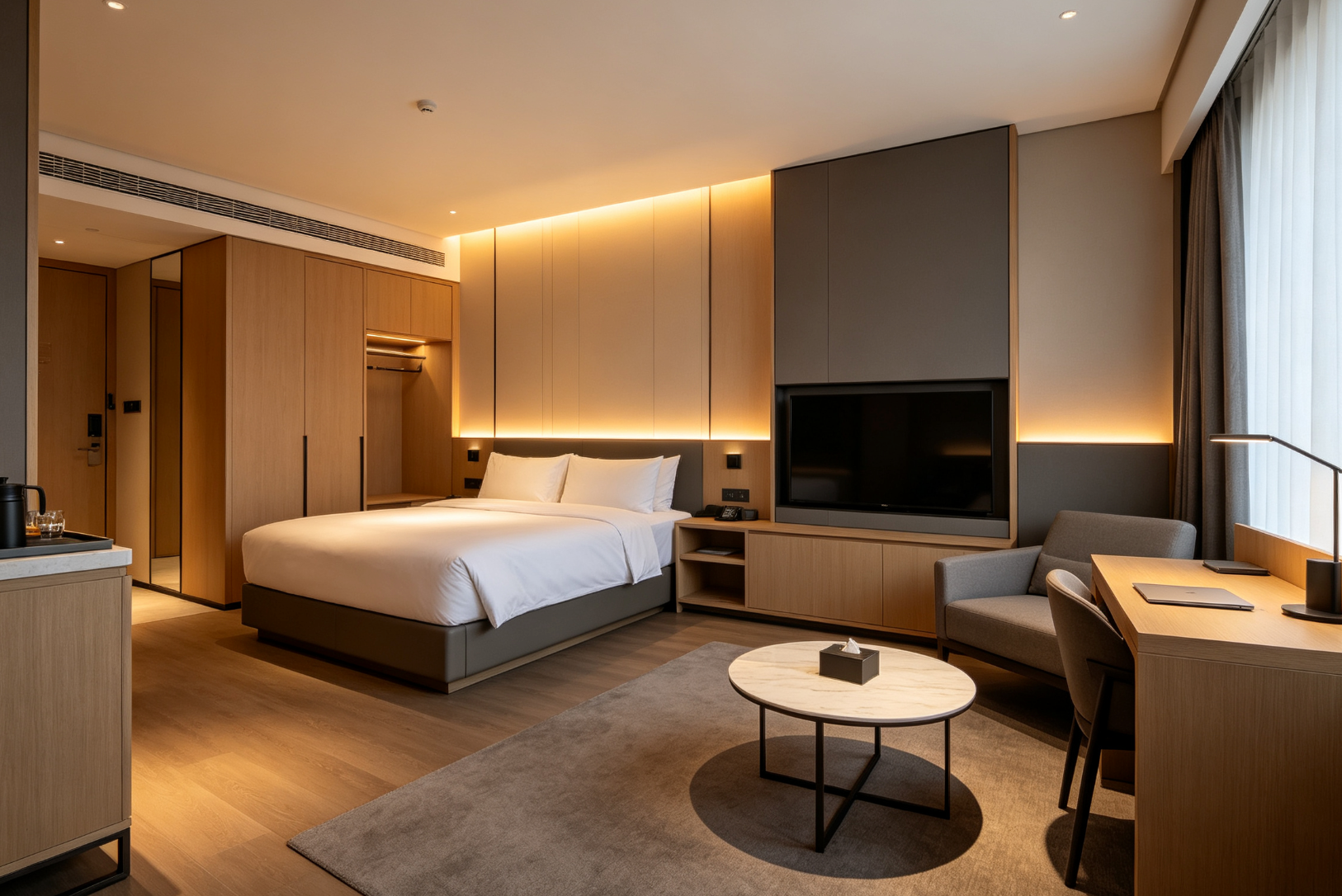
Assess hotel casegoods and lobby construction details
Construction details usually reveal more about long-term value than the front-facing design.
Hotel casegoods commonly include reception counters, console tables, side tables, cabinets, storage units, desks, and other coordinated wood products. Review the substrate, veneer or laminate system, edge treatment, fasteners, leveling method, access panels, and repairability. For public areas, inspect the underside and rear construction because these surfaces affect stability, cleaning, and installation.
Ask how the supplier controls dimensional consistency across repeated units. A lobby may contain many visually related pieces, and small differences in sheen, reveal lines, or hardware alignment can become obvious under strong architectural lighting.
For seating, examine frame construction, foam specification, fabric abrasion information, seam quality, replaceable components, and floor protection. BIFMA publishes furniture standards and resources through its official standards library. The correct requirement depends on the product and market, so the supplier should identify which tests or standards apply rather than displaying a generic compliance statement.
| Product group | Critical inspection points | Common site risk | Recommended evidence |
|---|---|---|---|
| Reception desk | Panel joints, cable routing, leveling, service access | Late coordination with electrical and data services | Approved shop drawing and full-size interface sample |
| Lobby seating | Frame stability, foam recovery, seam alignment, cleanability | Premature wear or difficult replacement | Material swatches, construction sample, care instructions |
| Occasional tables | Base rigidity, top finish, edge protection, floor contact | Scratches, wobble, or damage during relocation | Finish sample and load or stability documentation where applicable |
| Storage and display units | Door alignment, hardware, anchoring, ventilation, access | Installation delays and service problems | Hardware schedule and installation method statement |
Evaluate custom hotel furniture project capability
A capable project supplier treats customization as controlled engineering rather than unlimited design improvisation.
Ask the supplier to explain its workflow in clear stages: design interpretation, technical clarification, quotation, material approval, prototype production, sample sign-off, production release, inspection, packing, shipment, and site support. Each stage should have an owner and a documented approval point.
Brand standards are often expressed through room prototypes, finish codes, approved hardware, clearances, and repeatable details. A useful supplier will convert those requirements into a bill of materials, product schedule, drawings, and inspection criteria. This is especially important for international hotel groups, where one visual standard may need to work across different room layouts and local building conditions.
For renovation projects, ask how the supplier handles field measurements, phased delivery, protection of existing finishes, replacement matching, and low-disruption installation. A factory that is effective for new construction may need a different process for a live hotel with restricted access and narrow delivery windows.
- Request a product matrix showing each item, quantity, finish, dimensions, approved revision, and packing mark.
- Require written treatment of substitutions; no material, hardware, or finish should change without approval.
- Ask for a pre-shipment inspection plan covering appearance, dimensions, function, labeling, and packaging condition.
- Confirm who pays for rework, replacement, transport, and site labor when defects are confirmed.
Compare cost, lead time, and lifecycle value
The lowest quotation is not necessarily the lowest project cost.
Compare quotations on a like-for-like basis. Confirm whether the price includes design development, samples, export packing, documentation, spare parts, delivery terms, installation support, and taxes or duties. A low initial price may conceal thinner materials, fewer quality checks, weaker packaging, or exclusions that appear later as variation orders.
Lead time should be evaluated as a sequence of controllable milestones rather than one broad promise. The quotation should identify the time required for technical confirmation, material approval, prototype review, production, inspection, packing, and shipment. Buyers should also ask what happens when an approval is late or a material becomes unavailable.
Lifecycle value includes cleaning, refinishing, component replacement, inventory management, and the ability to reproduce an item later. A supplier that keeps finish records and technical drawings can make future renovation phases more consistent.
A practical supplier evaluation process
A structured process helps procurement teams separate presentation quality from delivery capability.
- Define the brief: List property type, public-area functions, target aesthetic, quantities, market requirements, delivery location, and installation constraints.
- Shortlist relevant suppliers: Prioritize companies with comparable hotel, resort, serviced-apartment, or renovation experience.
- Review evidence: Compare factory information, project references, drawings, samples, material records, and quality procedures.
- Test communication: Issue the same technical questions to each candidate and assess response clarity, speed, and ownership.
- Approve a sample: Use a written sample approval covering construction, finish, dimensions, hardware, and packaging.
- Contract controls: Include specifications, inspection rights, change control, delivery milestones, defect remedies, and spare-parts terms.
The strongest supplier is usually the one that makes risk visible early. Be cautious when a company avoids technical questions, cannot explain its subcontracting model, changes materials without documentation, or offers a price before understanding the specification.
Questions to ask before placing an order
Ask for answers in writing so they can be compared during commercial and technical review.
- Which parts of the project will be designed and manufactured in-house?
- How are approved materials and finish codes recorded for repeat production?
- What inspection points occur before packing and shipment?
- How are fragile furniture pieces protected against moisture, impact, and handling damage?
- Can the supplier provide replacement parts or reproduce an approved item for a later phase?
FAQ
What is the most important factor when selecting a hotel lobby furniture supplier?
Project execution capability is usually the most important factor. The supplier should demonstrate that it can interpret drawings, control materials, maintain repeatability, coordinate production, and resolve defects without delaying the hotel schedule.
Is factory ownership required for a reliable supplier?
Factory ownership is not the only measure of reliability. A trading or project-management company can be suitable if it clearly discloses manufacturing partners, controls specifications, performs inspection, and accepts responsibility for delivery and defects.
How can buyers verify a supplier sample?
Compare the sample with the approved drawing and specification. Check dimensions, joints, edge treatment, finish consistency, hardware operation, upholstery quality, stability, and the accessibility of service components. Record the approved sample with photographs and revision information.
What should a hotel furniture quotation include?
It should identify product descriptions, quantities, dimensions, materials, finishes, hardware, packaging, delivery terms, sample charges, lead-time milestones, exclusions, warranty terms, and the process for approved changes.
How do buyers reduce delivery risk?
Use milestone planning, early approval of long-lead materials, written change control, pre-shipment inspection, clear packing marks, and a documented escalation contact. Confirm the shipping plan and responsibilities before production begins.
Should price be the main supplier selection criterion?
No. Price should be reviewed alongside quality evidence, durability, maintenance, delivery reliability, documentation, warranty coverage, and the cost of rework or replacement. A comparable technical scope is necessary before price comparisons are meaningful.
What support is important after installation?
Important support includes defect reporting, spare hardware, finish records, replacement production, care instructions, and a defined response process. These provisions are particularly valuable for multi-property hotel groups and phased renovations.
About Taisen Furniture
Taisen Furniture is a China-based custom hotel furniture supplier serving project-scale hospitality procurement. Its capabilities cover design coordination, manufacturing, hotel casegoods, lobby furniture, seating, cabinetry, and related FF&E packages. The company works with international hotel project requirements and supports coordinated sourcing from development through delivery. Review its hotel furniture solutions when building a supplier shortlist, then request project-specific drawings, samples, and a quotation for your property.

Post time: Sep-20-2026