
 joyce@taisenfurniture.com
 0086 15356090777


- Layered lighting produces more depth and flexibility than one bright ceiling fixture.
- Color temperature, dimming, beam direction, and glare control strongly affect perceived comfort.
- Decorative fixtures should reinforce the boutique hotel story while meeting maintenance and safety requirements.
- Lighting layouts must be coordinated with hotel casegoods, mirrors, artwork, curtains, and electrical access.
- LED technology can reduce operating demand and replacement frequency when specified correctly.
Hotel lighting fixtures shape a boutique hotel ambiance by directing attention, supporting guest activities, and making materials appear warmer or cooler. The U.S. Department of Energy states that LED lighting uses at least 75 percent less energy and lasts up to 25 times longer than incandescent lighting, making efficient specification relevant to both atmosphere and lifecycle planning. The best result comes from treating lighting as part of the complete hotel FF&E concept rather than as a late decorative purchase.
Why hotel lighting fixtures matter in a boutique hotel
Lighting is one of the fastest ways to change how guests interpret a hotel interior. A room with identical furniture can feel intimate, clinical, luxurious, or energetic depending on the location, intensity, color, and distribution of light. In a boutique hotel, that effect is especially important because the property often relies on a distinctive narrative rather than a standardized visual language alone.
Guests typically read the lighting before they consciously evaluate the furniture. A softly illuminated reception desk can communicate calm service, while a precisely lit artwork can make a compact lobby feel curated. In guestrooms, bedside illumination supports reading and relaxation, while concealed light around a headboard or vanity can add depth without consuming valuable floor space.
Ambiance should follow the guest journey. Designers should examine arrival, check-in, circulation, dining, sleeping, grooming, and departure as separate scenes. Each scene has different visual and operational needs, so a single lighting color or fixture type rarely performs equally well throughout the property.
How layered lighting creates boutique hotel ambiance
Layered lighting creates visual hierarchy by assigning different jobs to different sources. A practical scheme normally combines ambient, task, accent, and decorative lighting. The layers should be coordinated so that guests can understand the space immediately while still discovering smaller details such as artwork, joinery, textiles, and architectural textures.
| Lighting layer | Primary purpose | Typical hotel application | Key specification question |
|---|---|---|---|
| Ambient | General visibility | Guestroom ceiling, lobby circulation, corridors | Does the light distribute evenly without flattening the room? |
| Task | Supports a specific activity | Bedside reading, writing desk, vanity mirror | Can guests use the area comfortably without glare? |
| Accent | Directs attention | Artwork, textured walls, plants, architectural details | Does the beam emphasize the intended feature? |
| Decorative | Adds identity and visual character | Pendants, chandeliers, wall sconces, table lamps | Does the fixture reinforce the design story and remain serviceable? |
Ambient lighting establishes the base level, but it should not carry the entire design. Task lighting at the desk or vanity prevents guests from depending on decorative fixtures that may create shadows. Accent lighting gives the eye a destination, which is valuable in lobbies, corridors, and compact guestrooms. Decorative fixtures then provide a recognizable signature, particularly in reception areas and restaurants.
Ambient and task lighting in guestrooms
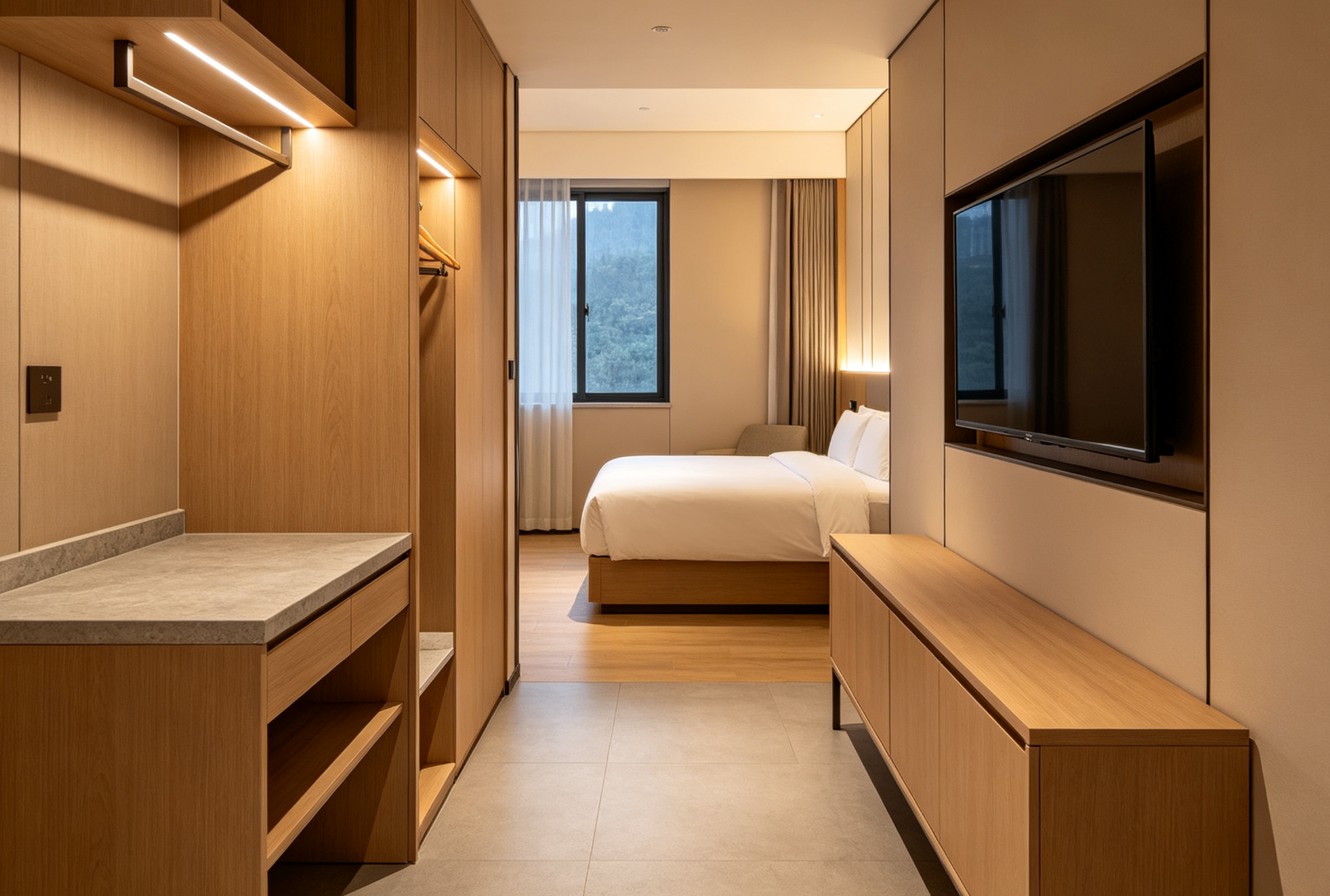
Guestroom lighting should allow guests to switch between activity modes without moving furniture or searching for hidden controls. A bedside pendant or wall-mounted reading light can free the nightstand surface for personal items. A desk lamp or integrated task light can improve the writing area, while low-level circulation light can help guests move safely at night.
Lighting coordination is essential when specifying hotel casegoods. The position of a headboard, nightstand, mirror, desk, television panel, and power outlet determines whether a fixture will be visually centered and practically usable. Before production, the supplier and design team should review reflected ceiling plans, elevations, furniture shop drawings, and fixture mounting details together.
Accent and decorative lighting in public areas
Public-area lighting should make the boutique hotel memorable without making it difficult to navigate. In a lobby, a decorative pendant can mark the reception zone, while wall washing can reveal stone, wood, fabric, or artwork. In a restaurant, focused light over tables can create intimacy, but circulation paths still need clear visibility.
Decorative fixtures should be assessed as operating components, not only as visual objects. Procurement teams should confirm lamp replacement access, cleaning requirements, spare-part availability, mounting strength, dimming compatibility, and coordination with sprinklers, HVAC, signage, and fire-safety systems.
Choosing color temperature, brightness, and glare control
Color temperature affects emotional perception, but consistency and control are more important than choosing a fashionable number. Warm light is commonly associated with relaxation and hospitality, while cooler light can support alertness and visual clarity. The correct choice depends on the finishes, daylight exposure, brand guidelines, camera requirements, and guest activity.
Design teams should review samples in the actual material palette. Wood veneer, painted panels, brass, stone, upholstery, and curtains can all change appearance under different light sources. A finish that looks balanced under a showroom source may appear yellow, gray, or overly reflective after installation.
Glare control protects comfort and perceived quality. Guests may tolerate an attractive fixture briefly, but direct views of bright LEDs, polished metal reflections, or poorly shielded downlights can make a room feel cheap and tiring. Recessed sources, diffusers, indirect illumination, suitable beam angles, and careful fixture placement can reduce this risk.
For technical planning, the Illuminating Engineering Society standards resources provide a recognized professional reference point for lighting practice. Local code, accessibility requirements, energy rules, and the project lighting designer’s calculations should remain the controlling basis for final specifications.
Lighting performance and lifecycle selection
The most attractive fixture is not necessarily the best hotel fixture if it is difficult to clean, repair, replace, or source. Hotel operators evaluate lighting over years of guest use, not only during handover. A fixture should therefore be reviewed for thermal performance, driver access, finish durability, spare parts, warranty terms, and compatibility with the property’s control system.
| Published LED comparison | Value | Operational implication | Source |
|---|---|---|---|
| Energy use compared with incandescent lighting | At least 75 percent lower | Supports lower electricity demand when the installation is correctly designed | U.S. Department of Energy |
| Service life compared with incandescent lighting | Up to 25 times longer | Can reduce relamping frequency in guestrooms and difficult-to-access public areas | U.S. Department of Energy |
| Lighting control reference | Project-specific calculation required | Control zoning, dimming, occupancy strategy, and local code should be reviewed together | ASHRAE standards and guidelines |
The published LED comparison does not mean every retrofit will achieve the same result. Actual performance depends on wattage, operating hours, controls, thermal conditions, driver quality, cleaning, voltage compatibility, and whether the existing optical distribution is suitable. Procurement teams should request complete photometric information rather than comparing decorative appearance alone.
Coordinating lighting with hotel furniture and finishes
Lighting creates ambiance most effectively when it is designed at the same time as the furniture package. A bedside light may conflict with a headboard seam, a vanity fixture may expose uneven mirror illumination, and a pendant may interfere with the sightline to a television or artwork. These issues are easier to solve during design development than after factory production.
For a project using custom hotel furniture, the coordination process should cover:
- Fixture locations in relation to headboards, nightstands, desks, wardrobes, mirrors, and bathroom vanities.
- Cut-outs, cable routes, concealed drivers, access panels, and replacement procedures.
- Finish samples viewed under the proposed lamp source and dimming range.
- Mounting details for wall sconces, pendants, integrated strips, and decorative ceiling fixtures.
- Packaging, labeling, installation sequencing, testing, and spare-unit requirements.
Furniture, curtains, upholstery, and lighting also influence acoustic and thermal perception. A hard, reflective room can feel harsher when paired with strong downlights, while textured upholstery and layered window treatments can support a softer visual environment. This is why a complete FF&E review is more reliable than selecting fixtures independently by room.
Application guide for boutique hotel spaces
Each hotel zone needs a lighting strategy that matches its guest task and brand role. The following guide helps design and procurement teams translate ambiance into practical decisions.
| Hotel zone | Atmosphere objective | Useful fixture approach | Coordination priority |
|---|---|---|---|
| Reception | Welcoming and legible | Layered ambient light, decorative focal fixture, controlled desk illumination | Reception counter, signage, artwork, and guest queues |
| Guestroom | Relaxed and adaptable | Bedside task lights, desk lighting, concealed accent sources, dimmable ambient light | Headboard, casegoods, curtains, outlets, and controls |
| Bathroom | Clean and flattering | Balanced mirror lighting with controlled overhead illumination | Vanity cabinet, mirror, wet-area requirements, and maintenance access |
| Restaurant | Intimate and social | Table-focused light, decorative pendants, restrained circulation illumination | Table layout, ceiling coordination, cleaning, and dimming scenes |
| Corridor | Calm and easy to navigate | Low-glare continuous or repeated lighting with artwork accents | Door numbers, artwork, emergency systems, and ceiling services |
Common specification mistakes to avoid
Most lighting problems come from coordination gaps rather than from a lack of attractive fixture options. Common mistakes include selecting decorative pieces before confirming ceiling services, using one color appearance throughout every space, ignoring the guest’s direct view of the light source, and failing to provide replacement access.
Another mistake is treating dimming as an optional luxury. Dimming allows one room to support arrival, reading, relaxation, housekeeping, and nighttime circulation. It also helps operators respond to daylight variation and guest preferences. However, dimming must be tested with the selected drivers, control protocol, emergency systems, and electrical infrastructure.
For hotel renovations, installation sequencing deserves special attention. A replacement plan should identify which fixtures can be installed room by room, how existing furniture will be protected, and how defects will be recorded. Low-disruption work is easier when lighting dimensions, furniture modules, and electrical points are documented before site delivery.
How to evaluate a hotel lighting fixture supplier
A capable supplier should demonstrate coordination ability, not just provide a catalog of fixtures. Ask for material samples, shop drawings, technical data, mock-up support, packaging plans, inspection procedures, and a clear replacement-parts policy. For a multi-property or branded project, the supplier should also show how design intent is translated into repeatable production details.
When lighting is purchased alongside furniture, evaluate whether the team can coordinate hotel bedroom furniture, public-area seating, casegoods, bathroom cabinetry, curtains, and decorative accessories. A unified project workflow can reduce interface errors between the lighting contractor, furniture manufacturer, interior designer, and general contractor.
Before approval, use a room mock-up or representative sample area to test fixture appearance, dimming response, shadowing, glare, switch locations, cleaning access, and finish interaction. The mock-up is not only a visual exercise; it is a practical test of whether guests and housekeeping staff can use the room easily.
FAQ
What type of lighting creates the best boutique hotel ambiance?
Layered lighting usually creates the most convincing result because it combines general visibility with task support, focal accents, and decorative identity. The exact fixture mix depends on the room function, ceiling conditions, finishes, brand standards, and control strategy.
Should boutique hotels use warm or cool lighting?
Warm lighting is often suitable for relaxing guestrooms and social areas, while a different appearance may be useful for grooming, circulation, or work tasks. The final decision should be tested with the actual furniture, wall finishes, textiles, daylight, and camera requirements.
How do hotel lighting fixtures coordinate with casegoods?
Fixture positions should be checked against headboards, nightstands, desks, wardrobes, television panels, mirrors, and cable routes. Coordination should happen before shop drawings are approved so that mounting points and concealed wiring do not require late changes.
Are decorative hotel fixtures practical for high-use areas?
They can be practical when the design includes durable finishes, secure mounting, accessible lamps or drivers, cleaning procedures, compatible controls, and replacement parts. Decorative value should be evaluated together with serviceability and lifecycle cost.
Why is glare a problem in hotel guestrooms?
Glare can cause visual discomfort, reflections on screens and mirrors, and a lower perception of quality. Shielded sources, indirect light, suitable beam control, matte finishes, and careful viewing-angle analysis can reduce the problem.
Can LED fixtures reduce hotel operating costs?
They can reduce energy use and relamping demand, but the result depends on the complete installation. The Department of Energy reports that LEDs use at least 75 percent less energy and last up to 25 times longer than incandescent lighting. Actual savings should be calculated from the proposed wattage, operating schedule, controls, and maintenance plan.
What should a hotel lighting procurement checklist include?
Include photometric data, color consistency, dimming compatibility, mounting details, driver access, finish samples, spare parts, warranty terms, inspection requirements, packaging, installation instructions, and coordination with furniture and electrical drawings.
About Taisen Furniture
Taisen Furniture is a project-oriented custom hotel furniture supplier serving hospitality procurement teams with integrated design, manufacturing, sales, and delivery coordination. Its portfolio covers guestroom casegoods, lobby furniture, seating, cabinetry, bathroom vanities, curtains, lighting, and decorative accessories for branded and independent hotels. To review related hotel bedroom furniture, hotel lobby furniture, and hotel bathroom furniture, contact the team through its project inquiry page.

Post time: Sep-22-2026