
 joyce@taisenfurniture.com
 0086 15356090777


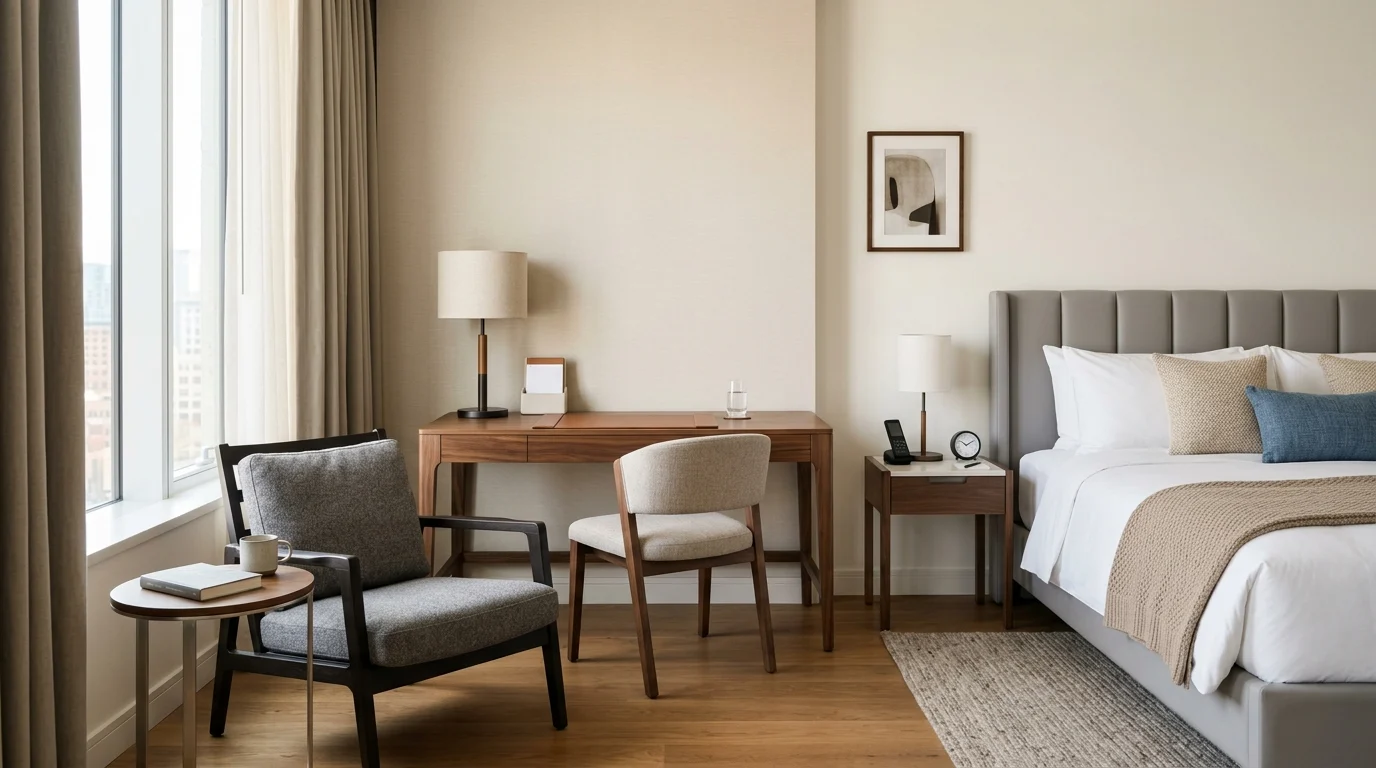
Furniture decisions can make or break a mid-scale hotel renovation because they sit at the intersection of brand compliance, guest perception, and capital discipline. For a 100- to 150-key property, guestroom FF&E alone can represent a major investment, often benchmarked at $10,000 to $15,000 per key, with furniture consuming a substantial share. This article explains how owners, asset managers, and operators can define scope, align PIP obligations, audit existing assets, and time replacements around realistic lifecycle and supply-chain constraints. The goal is not simply to buy new pieces, but to execute a renovation strategy that protects cash flow, minimizes disruption, and supports the property’s competitive position.
Planning Hotel Furniture Replacement
Mid-scale hotel renovation projects require rigorous capital planning, particularly when updating guestroom and public space interiors. The replacement of physical assets dictates a significant portion of the total property improvement plan (PIP) budget and heavily influences the property’s market repositioning. Effective execution demands a granular understanding of asset lifecycles, supply chain dynamics, and brand standard compliance.
Define hotel furniture, FF&E, and scope
Defining the scope of a renovation requires categorizing assets accurately. Furniture, Fixtures, and Equipment (FF&E) encompasses all movable items within the property that are not permanently affixed to the building structure. Within this broad category, hotel furniture specifically denotes casegoods (wardrobes, dressers, nightstands, desks) and soft seating (lounge chairs, task chairs, sleeper sofas). Distinguishing between these categories is critical because casegoods and upholstery degrade at different rates and require distinct procurement channels.
For a standard mid-scale property comprising 100 to 150 keys, the scope of an FF&E replacement program must be strictly delineated to avoid budget overruns. General U.S. industry benchmarks (as of 2023–2024) indicate that comprehensive guestroom FF&E replacements in the mid-scale segment typically demand a capital expenditure (CapEx) of $10,000 to $15,000 per key, though these figures vary significantly based on regional labor rates, brand tier, and existing property conditions. Isolating the furniture allocation from this total—usually comprising 40% to 50% of the FF&E budget—establishes precise baseline costs for the procurement phase.
Clarify ownership, brand, and budget responsibilities
Navigating the matrix of stakeholders is essential for successful CapEx deployment. In franchised mid-scale operations, the brand dictates the design narrative and minimum specification standards through the PIP. However, the financial burden and procurement execution fall upon the property owner or the Real Estate Investment Trust (REIT). The management company acts as the intermediary, ensuring that operational disruptions are minimized while brand standards are satisfied. While independent, non-franchised properties possess greater flexibility without mandatory PIPs, they should still adopt structured lifecycles to maintain market competitiveness.
Clarifying these responsibilities early prevents costly friction during the specification phase. Major franchisors typically enforce a 6- to 8-year replacement cycle for soft goods and a 12- to 14-year cycle for casegoods. Because capital sourcing constraints often dictate replacement timing as much as physical asset condition, ownership groups typically rely on dedicated replacement reserves, PIP lending vehicles, or escrow structures to fund these mandatory cycles. If a property is changing flags (rebranding), the incoming brand’s PIP will supersede existing lifecycle timelines, often forcing an immediate, comprehensive replacement of all guestroom and public area furniture regardless of its current physical condition.
Assessing Condition and Cost

Before committing capital to new procurement, a rigorous empirical audit of the existing inventory is necessary. This phase determines whether assets have reached the end of their functional or aesthetic life, thereby informing the decision to repair or replace.
Audit existing furniture by room and asset type
The physical audit must be systematic and documented room by room. Inspectors evaluate casegoods for structural integrity, hardware functionality, and surface delamination, while soft seating is assessed for foam compression, fabric abrasion, and frame stability. A standardized grading scale—typically ranging from 1 (critical failure) to 5 (like-new condition)—should be applied to each asset class to generate quantifiable data on the property’s overall furniture health.
This granular approach often reveals localized degradation patterns. For instance, properties might discover that desk chairs in business-focused wings exhibit a grade of 2 due to heavy utilization, whereas lounge chairs in leisure suites maintain a grade of 4. By isolating these wear patterns, procurement teams can target replacements more strategically, potentially avoiding blanket replacements of items that still possess three to four years of viable service life.
Compare repair, refinishing, and replacement options
The decision between repairing, refinishing, or outright replacing assets hinges on structural viability and cost thresholds. Refinishing solid wood or high-quality veneer casegoods can extend their lifecycle by 5 to 7 years. However, if the underlying substrate (such as MDF or particleboard) is compromised by moisture, repair is economically unviable. For upholstery, reupholstering is only sensible if the internal frame and suspension systems remain structurally sound.
Based on recent North American market averages, the following table outlines typical cost comparisons for evaluating these options:
| Asset Type | Average Replacement Cost (Per Unit) | Average Repair/Refinish Cost | Viability Threshold |
|---|---|---|---|
| Guestroom Desk (HPL) | $350 – $550 | $200 – $250 | Replace if moisture damage affects >10% of substrate |
| Lounge Chair | $400 – $700 | $250 – $400 (Reupholstery) | Reupholster if hardwood frame passes stress test |
| Task Chair | $150 – $250 | $80 – $120 (Gas cylinder/fabric) | Replace if gas cylinder fails or fabric is heavily soiled |
| Wardrobe/Armoire | $700 – $1,200 | $300 – $450 (Hardware/veneer) | Refinish if veneer is intact and joints are secure |
Model lifecycle cost and durability
Advanced procurement strategies rely on Total Cost of Ownership (TCO) models rather than merely assessing initial acquisition costs. When modeling lifecycle costs, durability metrics are paramount. For mid-scale environments, fabrics should be specified at a minimum of 50,000 Wyzenbeek double rubs to ensure longevity under commercial use. Casegoods specified with High-Pressure Laminate (HPL) tops rather than standard melamine or wood veneer reduce maintenance costs and resist scratching, heat, and moisture.
A comprehensive TCO model incorporates the initial purchase price, freight, installation, anticipated maintenance, and the expected years of service. A $400 lounge chair that requires replacement in four years yields a cost of $100 per year, whereas a $600 chair engineered to last eight years costs only $75 per year. Factoring these durability metrics into the financial model ensures that capital is deployed efficiently over the property’s operational horizon.
Specifying Brand-Ready Furniture
Translating approved designs into technical specifications is a critical risk management exercise. Specifications must bridge the gap between the brand’s aesthetic vision and the rigorous demands of a commercial hospitality environment.
Identify key guestroom specification details
Technical specifications for guestroom furniture should be exhaustive to prevent manufacturing shortcuts. For casegoods, specifications should mandate structural parameters such as 2mm PVC edge banding to prevent chipping, corner blocks for torsional rigidity, and full-extension, ball-bearing drawer glides rated for a minimum of 100 pounds. Substrates must be specified explicitly, favoring moisture-resistant MDF or marine-grade plywood in humid climates or coastal properties.
Upholstery specifications require equal rigor. Beyond fabric rub counts, the technical dossier must detail the density and Indentation Force Deflection (IFD) of the polyurethane foam, ensuring the seating maintains its shape and comfort over thousands of compression cycles. Joint construction must explicitly require mortise-and-tenon or double-doweled joints, reinforced with corner blocks, glued, and screwed, rather than merely stapled.
Address fire safety and code requirements
Compliance with life safety codes and accessibility regulations is non-negotiable and must be explicitly detailed in the furniture specifications. In the United States, upholstered furniture must comply with stringent flammability standards, most notably California Technical Bulletin 117-2013 (CAL 117-2013) or NFPA 260, which dictate the smolder resistance of materials. Properties outside the U.S. must specify comparable international standards, such as the EN 1021 series in Europe. Failure to specify and certify these standards exposes the ownership group to immense liability and potential permit rejections by local fire marshals.
Furthermore, the Americans with Disabilities Act (ADA) imposes strict geometric constraints on furniture in accessible guestrooms within the U.S. market. Desks and work surfaces must provide a clear floor space and offer a surface height between 28 and 34 inches, with a minimum knee clearance of 27 inches high, 30 inches wide, and 17 inches deep as mandated by the 2010 ADA Standards (though some internal brand standards may require up to 19 inches). Wardrobes in ADA rooms must feature lowered hanging rods and accessible shelving. Specifications must clearly delineate these ADA variants from the standard room packages.
Standardize furniture packages where possible
To optimize economies of scale, strictly standardizing furniture packages is highly recommended. Mid-scale properties benefit significantly from reducing the total number of unique Stock Keeping Units (SKUs). Instead of designing distinct furniture layouts for every room variation, standardizing a core package—comprising a modular desk, a universal headboard, and a standard lounge piece—simplifies manufacturing and accelerates installation.
Standardization also mitigates the risk of supply chain disruptions. By avoiding highly bespoke, single-use pieces, properties can keep the average casegoods package cost strictly below the $4,500 to $5,500 threshold per room typical of the U.S. mid-scale sector. Furthermore, standardizing finishes and hardware across the property ensures that future maintenance teams can easily stockpile generic replacement parts, thereby reducing operational downtime when minor damages occur.
Procurement and Sourcing Strategy
The procurement phase dictates the project’s financial efficiency and schedule integrity. Selecting the optimal sourcing channels requires balancing upfront capital savings against logistical risks and lead-time constraints.
Compare domestic and overseas manufacturers
The dichotomy between domestic and overseas manufacturing is a key strategic decision in hospitality procurement. Overseas manufacturers, predominantly located in Southeast Asia and Eastern Europe, offer substantial cost advantages due to lower labor and overhead expenses. They are highly adept at executing large-volume, standardized casegood runs. However, these savings come at the cost of extended supply chains, reduced agility if manufacturing errors occur, and exposure to tariff volatility. Furthermore, offshore procurement carries risks related to potential anti-dumping duties and the logistical complexities of enforcing warranties across international borders.
Domestic manufacturers provide geographic proximity, which translates to superior communication, faster prototyping, and lower freight volatility. While the unit cost from a North American factory may be higher, the ability to conduct site visits, closely monitor quality assurance, and rapidly deploy replacement pieces offers significant risk mitigation. For mid-scale properties, a hybrid approach is often optimal: sourcing bulk casegoods overseas while procuring soft seating and custom public-space pieces domestically.
Evaluate lead times, minimums, and freight risks
Procurement decisions are heavily constrained by project timelines and factory requirements, which fluctuate based on global trade conditions. Based on 2023–2024 logistics data, overseas production typically mandates extended lead times of 12 to 16 weeks, exclusive of ocean transit, and imposes strict Minimum Order Quantities (MOQs), often requiring orders of 50 or more room sets. Conversely, domestic production can compress lead times to 6 to 8 weeks with lower MOQs, albeit at a 20% to 30% unit cost premium.
| Sourcing Origin | Typical Lead Time (Inc. Transit) | Average Cost Premium/Discount | Minimum Order Quantity (MOQ) | Freight & Logistics Risk |
|---|---|---|---|---|
| Domestic (North America) | 6 – 10 Weeks | +20% to +30% Premium | 10 – 20 Rooms | Low (Truckload direct) |
| Overseas (Asia/Europe) | 14 – 20 Weeks | -20% to -30% Discount | 50+ Rooms | High (Ocean freight, port delays) |
| Nearshore (Mexico/LatAm) | 8 – 12 Weeks | Baseline (Mid-point) | 30 – 40 Rooms | Moderate (Border crossing) |
Manage bids, samples, and shop drawings
The Request for Quotation (RFQ) process must be tightly managed to ensure accurate comparative bidding. Manufacturers should be required to submit comprehensive shop drawings detailing construction methods, joinery, and hardware specifications prior to awarding the contract. These drawings serve as the contractual baseline for quality.
Following the approval of shop drawings, the production of a model room is a mandatory milestone for any project exceeding 50 keys. The model room allows the ownership group, brand representatives, and the general contractor to physically interact with the samples. This phase is critical for identifying ergonomic flaws, finish inconsistencies, or installation interferences before mass production commences. Only upon sign-off of the physical samples should the bulk manufacturing release be authorized.
Installation and Final Decision-Making
The culmination of the renovation project occurs during the installation phase. Effective logistics and sequencing are paramount to ensuring that the physical deployment of assets does not severely disrupt the property’s revenue stream.
Coordinate room blocks, warehousing, and delivery
Synchronizing furniture delivery with construction schedules is a complex logistical challenge. Because construction delays are common, relying on just-in-time delivery for overseas containers is highly risky. Securing local Third-Party Logistics (3PL) warehousing is often necessary to receive, inspect, and stage the incoming inventory. Warehousing costs—typically ranging from $15 to $25 per pallet per month based on recent U.S. averages—must be factored into the initial CapEx budget.
From the staging warehouse, delivery to the property must be precisely coordinated with room block closures. Installers require unobstructed access to the service elevators and corridors. The logistics plan must also account for the extraction and sustainable liquidation or disposal of the legacy furniture, ensuring that incoming and outgoing asset streams do not bottleneck at the loading dock. As Environmental, Social, and Governance (ESG) compliance becomes a standard PIP requirement, circular disposal strategies—such as charitable donation, certified resale, or material recycling—should be prioritized over traditional landfilling. Furthermore, specifying FSC-certified woods and low-VOC finishes for incoming products aligns the procurement cycle with contemporary sustainability goals.
Choose phased renovation or full replacement
The strategy for taking rooms offline dictates the financial impact of the renovation. A phased renovation, typically executed floor-by-floor or wing-by-wing, allows the hotel to remain operational and continue generating revenue. Experienced installation crews can typically clear, prep, and install 15 to 20 rooms per week in a phased approach. However, this method extends the overall project duration and exposes guests to construction noise and logistical friction.
Conversely, a full property closure allows for a highly accelerated replacement schedule, drastically reducing labor costs and eliminating guest complaints regarding construction disruption. While full closures are rare in the mid-scale segment due to the severe immediate revenue loss, they may be financially justified during extreme low-season periods or when the furniture replacement is coupled with invasive MEP (Mechanical, Electrical, and Plumbing) overhauls.
Align replacement timing with ROI and guest impact
Ultimately, the timing and execution of the furniture replacement must align with the property’s Return on Investment (ROI) targets. Timing the completion of the renovation to coincide with the onset of the peak booking season maximizes the yield on the newly upgraded rooms.
A successful mid-scale FF&E renovation should immediately influence the property’s commercial performance. Historically, comprehensive furniture and room upgrades in this segment have targeted Average Daily Rate (ADR) increases of 10% to 15%, according to recent U.S. industry benchmarks. However, this revenue impact is not guaranteed; it is highly contingent on local market demand, competitive-set activity, and the property’s pre-renovation baseline. Beyond financial returns, new furniture directly influences non-financial metrics such as Guest Satisfaction Scores (GSS) and online review sentiment. Upgraded ergonomics, modern aesthetics, and pristine conditions frequently translate into higher ratings for room comfort and cleanliness.
Synthesizing these five phases—from initial planning and condition assessment to specification, procurement, and final installation—provides a cohesive roadmap for success. By carefully navigating supply chain variables, regulatory standards, and lifecycle costs, hoteliers can transform a mandatory capital expense into a strategic advantage that elevates the guest experience, drives tangible long-term asset value, and solidifies the property’s competitive standing.
Key Takeaways
- Set a clear FF&E scope early by separating casegoods, upholstery, and public area furniture because each category has different lifecycles and procurement requirements.
- Use $10,000 to $15,000 per key as a planning benchmark for comprehensive mid-scale guestroom FF&E replacement, then isolate furniture at roughly 40% to 50% of that budget.
- Plan around common brand replacement cycles of 6 to 8 years for soft goods and 12 to 14 years for casegoods unless a PIP or rebrand accelerates the timeline.
- Clarify the roles of the brand, owner or REIT, and management company before specification work begins to reduce budget disputes and operational delays.
- Conduct a documented room-by-room furniture audit before purchasing to determine which assets require repair, phased replacement, or full replacement.
Frequently Asked Questions
How much should a mid-scale hotel budget for guestroom FF&E replacement?
A typical mid-scale hotel should plan for about $10,000 to $15,000 per key for comprehensive guestroom FF&E replacement, with furniture often representing 40% to 50% of that total.
How often should hotel soft goods and casegoods be replaced?
Many franchisors require soft goods replacement every 6 to 8 years and casegoods replacement every 12 to 14 years, though timing may change based on property condition, brand standards, or rebranding needs.
What counts as hotel furniture within an FF&E budget?
Hotel furniture typically includes movable casegoods such as wardrobes, dressers, desks, and nightstands, plus soft seating such as lounge chairs, task chairs, and sleeper sofas.
Who is responsible for paying for hotel furniture replacement?
In franchised hotels, the brand sets standards through the PIP, but the owner or REIT usually funds procurement. The management company helps coordinate execution and reduce operating disruption.
Why is a room-by-room furniture audit important before procurement?
A documented audit identifies damaged, outdated, or reusable assets by room and item type, helping owners decide whether to repair, replace, or phase purchases more efficiently.
Post time: Sep-08-2026