
 joyce@taisenfurniture.com
 0086 15356090777



Why FF&E Contractors Should Evaluate Chinese Hotel Furniture Manufacture
For Furniture, Fixtures, and Equipment (FF&E) contractors, navigating the global supply chain is a high-stakes endeavor where procurement efficiency directly impacts project viability. Chinese manufacturing hubs, particularly in Guangdong and Zhejiang provinces, remain the dominant source for hospitality casegoods and seating. Evaluating these manufacturers rigorously is not merely a cost-saving exercise. It is a critical risk management strategy, especially in an era defined by geopolitical trade risks, tariff exposure, and supply chain volatility. Contractors must act on these risks by evaluating a supplier’s export license diversity, bonded warehouse capabilities, and flexibility with Incoterms to ensure resilience against sudden trade disruptions.
A systematic evaluation process ensures that the selected supplier can interpret complex architectural specifications, scale production to meet hard opening deadlines, and maintain the aesthetic and structural integrity required by international hotel brands. While budgets vary widely by region and brand tier, an upscale hotel often requires an FF&E budget of $15,000 to $30,000 per key, making the financial exposure tied to vendor selection substantial. Contractors must look beyond surface-level marketing to assess operational capacity, financial stability, and true hospitality expertise.
How sourcing affects project margin and opening timelines
Strategic sourcing directly determines a contractor’s bottom line. While highly dependent on project scope, brand tier, and regional dynamics, procuring directly from capable Chinese manufacturers can yield estimated cost savings of 20% to 35% compared to utilizing domestic wholesalers or intermediaries. However, experienced contractors know that these margin improvements on paper are instantly wiped out if production delays, sudden tariff shifts, or customs scrutiny jeopardize the property’s opening timeline.
Standard lead times for custom hospitality projects typically range from 12 to 16 weeks. This comprises roughly 4 to 6 weeks for shop drawings and mock-ups, 4 to 6 weeks for mass production, and 4 to 5 weeks for ocean freight and customs clearance. A manufacturer with inefficient production scheduling or inadequate raw material staging can push this timeline past 20 weeks. FF&E contractors must evaluate a factory’s historical on-time delivery rates and their ability to absorb order amendments without derailing the critical path.
Which stakeholder priorities should guide evaluation
Effective evaluation requires balancing the competing priorities of the project’s primary stakeholders: the property owner, the hotel brand, and the operations team. Owners are primarily focused on capital expenditure (CapEx) control, return on investment, and long-term asset durability. They require manufacturers who can deliver high perceived value within strict budget constraints.
Conversely, brand representatives prioritize strict adherence to design narratives and proprietary standard operating procedures (SOPs). They expect the manufacturer to perfectly replicate approved finishes and comply with brand-specific fire and safety ratings. Finally, the operations and housekeeping teams require ergonomic, low-maintenance designs—such as high-pressure laminate surfaces and snag-free joinery. A qualified manufacturer must demonstrate the engineering acumen to satisfy all three stakeholder groups simultaneously through intelligent material selection and structural design.
What Defines a Qualified Chinese Hotel Furniture Manufacturer
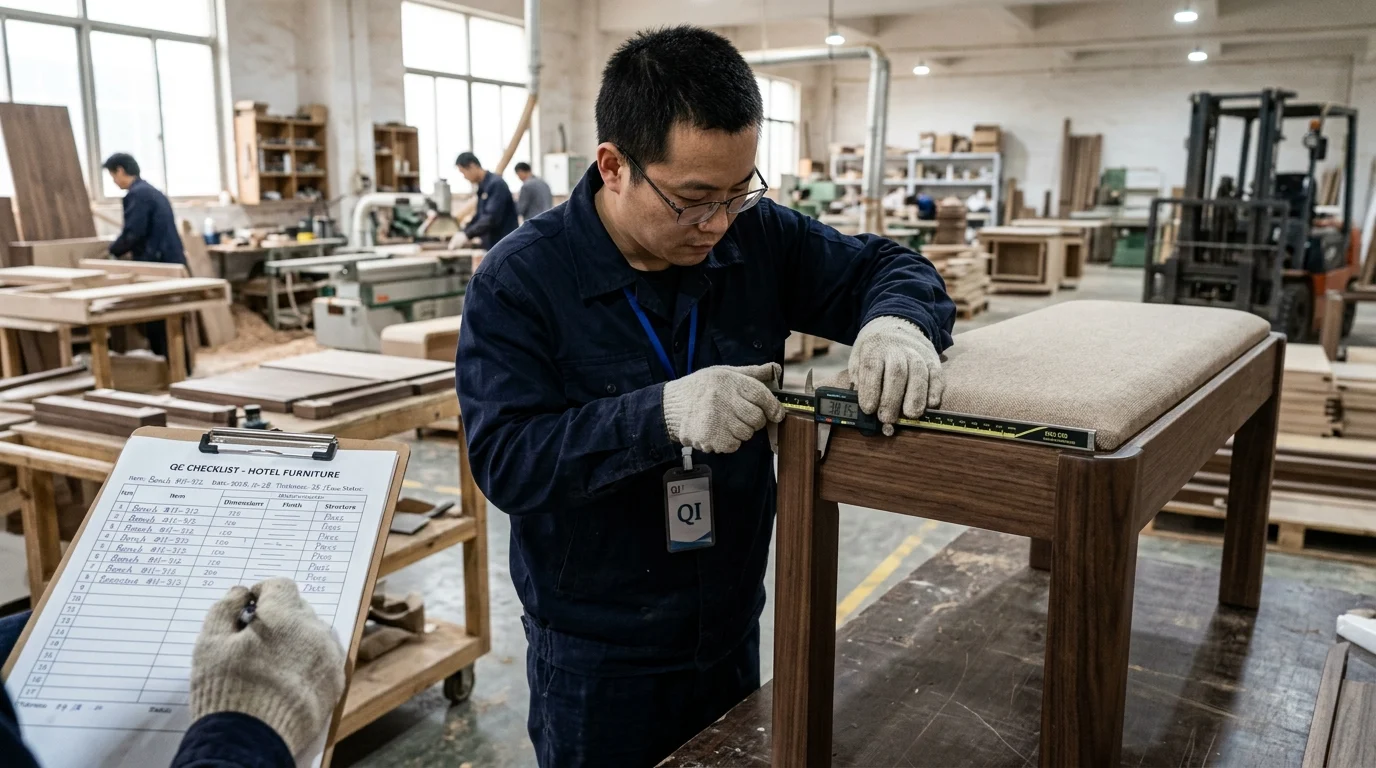
A qualified manufacturer is defined by its vertical integration, specialized hospitality experience, and robust quality management systems. Contractors must utilize objective metrics—such as facility footprint, equipment modernization, and verifiable project portfolios—to separate tier-one suppliers from high-risk vendors.
How to distinguish factories from trading companies
The first filter in any evaluation is determining whether the entity is a true manufacturer or a trading company acting as a middleman. Contractors frequently encounter sophisticated trading companies masquerading as factories with polished English websites. While trading companies offer broad catalogs and fluent communication, they introduce margin stacking and severely limit the contractor’s control over quality and production schedules.
Contractors should request the entity’s official Chinese Business License and check the “Business Scope” (经营范围) and “Registered Capital” (注册资本). Historically, a registered capital exceeding 10 million RMB indicated a substantial enterprise. However, due to China’s post-2014 subscribed capital registration reform, registered capital is not reliably paid-in. Contractors should instead verify tangible assets and paid-in status rather than treating 10 million RMB as a hard threshold.
Furthermore, it is important to add nuance to this distinction: many legitimate manufacturers use captive trading companies or factory-owned export offices due to licensing constraints. Additionally, hybrid OEM/ODM models exist where a factory manufactures core items but trades others to complete a catalog. While direct factories are preferred for large-scale rollouts, trading companies can still be legitimate, strategic partners for pilot orders, highly mixed niche categories, or when navigating complex multi-vendor consolidations. Verifying production ownership through a physical site visit or a live video audit remains essential to confirm the existence of manufacturing infrastructure.
| Metric | Direct Factory | Hybrid / Captive Trading | Trading Company |
|---|---|---|---|
| Business License Scope | Manufacture, Production, Export | Manufacture & Trade | Wholesale, Trade, Export |
| Pricing Structure | Direct factory cost (lower) | Factory cost + minimal overhead | Factory cost + 10-20% markup |
| Customization Control | High (direct access to engineers) | High to Medium | Low (relayed communication) |
| Quality Assurance | In-house QC protocols | In-house & partner QC | Dependent on third-party factories |
Which manufacturing capabilities matter most
Hospitality environments subject furniture to rigorous wear and tear, necessitating advanced manufacturing capabilities that residential factories often lack. While facility size requirements vary, a qualified facility often possesses between 15,000 and 30,000 square meters of dedicated production space to handle the volume of a standard 200-key project. However, this is a flexible benchmark. Smaller, highly specialized factories can be exceptionally qualified depending on the product mix and regional variance.
Key technological indicators include the presence of multi-axis CNC routing machines for precise wood cutting, and automated edge-banding machines utilizing Polyurethane (PUR) adhesives, which offer superior moisture and heat resistance compared to standard EVA glues. Additionally, contractors must evaluate the finishing department. A qualified manufacturer will operate pressurized, dust-free painting and curing rooms to ensure flawless lacquer applications, which are critical for high-end casegoods.
Another critical capability is intellectual property (IP) protection. When FF&E contractors send proprietary brand shop drawings overseas, they must ensure the manufacturer has strict design confidentiality protocols. This includes non-disclosure agreements (NDAs), clear mold ownership terms, and rigorous drawing control to prevent brand designs from leaking into the open market.
What evidence proves hospitality project experience
Producing 500 identical residential dining chairs is fundamentally different from engineering a custom furniture package that integrates power/data modules, accommodates specific baseboard clearances, and meets commercial fire codes. Contractors must demand evidence of specific hospitality project experience.
Valid evidence includes a portfolio of completed 4-star and 5-star hotel projects, supported by bills of lading, installation photographs, and reference letters from international procurement agencies or hotel brands. Furthermore, contractors should assess the manufacturer’s Minimum Order Quantity (MOQ) flexibility. While standard mass-production MOQs might be high, a factory accustomed to hospitality projects will typically accommodate MOQs of 50 to 100 keys—though this varies by factory scale and region—understanding the bespoke nature of FF&E rollouts.
Key Hotel Furniture Specifications and Compliance Factors
Evaluating a manufacturer’s ability to meet stringent technical specifications is the most technical phase of the procurement process. Hotel furniture must bridge the gap between residential aesthetics and institutional durability.
Contractors must ensure that the manufacturer understands international compliance standards and possesses the engineering capability to execute complex shop drawings. This phase transitions the evaluation from assessing the company to analyzing the product.
How to compare materials, joinery, and finishes
The structural longevity of hotel furniture relies heavily on material selection and joinery techniques. Substrates for casegoods typically utilize Medium Density Fiberboard (MDF) or plywood. For hospitality applications, contractors must verify that the factory uses high-density MDF (typically >700 kg/m³) to ensure screw-holding capacity.
Joinery must exceed residential standards. Drawers should feature English dovetail or French dovetail construction, supported by heavy-duty, full-extension, soft-close glides rated for at least 50,000 cycles. Frames require double-dowel or mortise-and-tenon joints reinforced with glued and screwed corner blocks.
| Specification | Residential Standard | Hospitality Standard |
|---|---|---|
| Laminate Thickness | 0.4mm – 0.6mm | 0.8mm – 1.0mm (HPL) |
| Lacquer Hardness | 1H – 2H | >= 3H (Scratch resistant PU/UV) |
| Veneer Thickness | 0.2mm – 0.3mm | 0.45mm – 0.6mm |
| Drawer Glides | Standard roller, 25lb capacity | Undermount soft-close, 75lb+ capacity |
Which certifications and documents to request
Compliance with international safety and environmental regulations is non-negotiable, as failure can result in delayed property openings or denied occupancy permits. FF&E contractors must verify the manufacturer’s ability to provide certified materials and the accompanying documentation.
For upholstery, the factory must demonstrate compliance with fire retardancy standards such as California Technical Bulletin 117 (CAL 117) or the UK’s BS 7176, often requiring specialized foam and treated fabrics. For composite wood products, compliance with CARB Phase 2 or EPA TSCA Title VI is mandatory to restrict formaldehyde emissions.
Beyond environmental and safety standards, social responsibility and sustainability audits are now standard procurement gatekeepers for major international hotel brands. Contractors should request certifications such as BSCI, WRAP, SA8000, and FSC/PEFC. Crucially, contractors must verify these certifications directly with the issuing bodies (e.g., SGS, Bureau Veritas, FSC). Accepting factory-provided PDFs at face value is a common and costly pitfall, as fraudulent or expired certificates run rampant and can lead to disastrous liability. Additionally, requesting ISO 9001 and ISO 14001 certifications provides a baseline assurance of operational maturity.
How to assess value engineering without reducing quality
Value engineering (VE) is a critical service provided by top-tier manufacturers, allowing contractors to align ambitious design concepts with strict budgets. However, poorly executed VE compromises durability. A qualified manufacturer will propose intelligent material substitutions rather than structural downgrades.
For example, replacing solid wood tops with high-grade wood veneer over an MDF core, or utilizing High-Pressure Laminate (HPL) for horizontal surfaces, can reduce casegood costs by 15% to 25% while actually increasing resistance to water rings and scratches. Contractors must apply a strict safety caveat here: factory-proposed material substitutions can inadvertently downgrade fire ratings or structural integrity. Any substituted materials must be explicitly re-certified to ensure they still meet the brand’s stringent safety standards. Crucially, material substitutions typically require direct, formal sign-off from the hotel brand’s design or technical team—not merely the contractor—to prevent compliance liability and brand-standard violations. Contractors should evaluate a factory’s engineering team by their ability to provide proactive, compliant VE suggestions during the shop drawing phase.
How to Verify Production Quality and Capacity
Even the most impressive specifications are meaningless without consistent execution on the production floor. Verifying quality and capacity requires a hands-on approach, utilizing structured audits and strict sampling protocols.
FF&E contractors must establish a clear quality control (QC) framework before mass production begins, ensuring that the manufacturer’s internal standards align with the project’s Acceptable Quality Limit (AQL) requirements.
Which factory audit steps to include
A comprehensive factory audit should evaluate the entire production lifecycle, from raw material intake to final assembly. Experienced contractors know that a pristine showroom means nothing if the raw material warehouse lacks climate control. Contractors must verify that the factory utilizes industrial kilns or climate-controlled storage to maintain wood moisture content strictly between 8% and 12%, preventing warping and cracking in the final destination’s climate.
The audit must also examine the factory’s inline quality control stations. Are parts inspected after cutting, after edge-banding, and before painting? A reliable manufacturer will maintain historical defect rate data, typically targeting a defect rate of less than 2%. Finally, contractors should assess the packaging area to ensure sufficient space and equipment for secure container loading.
How to manage mock-up rooms and control samples
The mock-up room (or model room) is the ultimate test of a manufacturer’s capability. Typically executed 8 to 12 weeks prior to mass production, this phase involves producing 1 to 3 complete key configurations. It allows the contractor, designer, and owner to review ergonomics, scale, and finish accuracy in a physical space.
Once the mock-up is approved, these pieces become the “golden samples” or control samples. Contractors must ensure these samples are signed, dated, and securely stored at the factory. The manufacturer’s willingness to strictly adhere to the control sample during mass production, without unauthorized material substitutions, is a definitive indicator of their reliability. Contractors must remain vigilant against “quality fade”—a common and costly risk where manufacturers gradually substitute cheaper materials or relax quality control after the golden sample is approved. Continuous inline inspections are required to prevent this.
What packaging and logistics factors to check
Inadequate packaging can destroy perfectly manufactured furniture during the trans-Pacific journey. Contractors must evaluate the factory’s standard export packaging protocols. Casegoods require 5-ply corrugated cartons, reinforced with minimum 10mm thick EPE foam, and rigid edge protectors on all vulnerable corners.
Logistical capacity is equally important. To mitigate geopolitical risks and tariff volatility, contractors should evaluate if the manufacturer offers bonded warehouse strategies or flexible Incoterms (such as DDP or FOB variations) to buffer against sudden supply chain disruptions. The factory must also demonstrate experience in optimizing container loads. A standard 40-foot High Cube (40HQ) container typically accommodates 15 to 20 standard guestroom sets, though this is a variable estimate heavily dependent on the specific product mix, the ratio of flat-pack to fully assembled items, and the scale of the furniture. The manufacturer must provide accurate volumetric calculations (CBM) early in the process to allow the contractor to forecast freight costs accurately.
How to Make the Final Manufacturer Decision
The culmination of the evaluation process is selecting the manufacturer that presents the optimal balance of risk and reward. This decision must be driven by data rather than intuition or solely by the lowest bid.
Contractors must synthesize their findings into a structured decision-making framework, ensuring that the chosen partner is contractually bound to the agreed-upon standards and capable of executing the project strategy.
How to use a weighted scoring model
To make the selection process objective, contractors should implement a weighted scoring model. While weightings vary by project, a standard matrix might allocate 30% to Pricing, 30% to Quality and Mock-up Execution, 20% to Production Capacity and Lead Time, and 20% to Communication and Financial Stability.
By grading each shortlisted factory against these criteria, contractors can clearly identify the supplier that offers the best overall value. A factory that bids 10% lower but scores poorly on capacity and communication represents a severe risk to the project timeline, a vulnerability the scoring model will highlight.
How contracts should address specifications and approved samples
The final decision must be solidified through a comprehensive manufacturing contract. This document must explicitly reference the approved shop drawings, the physical control samples, and the specific material brands (e.g., specifying a particular brand of drawer glides or laminate) to prevent bait-and-switch tactics.
Crucially, the contract must include enforceable penalties for delays and quality failures. While terms vary widely by project scope and negotiation leverage, standard industry contracts often stipulate a penalty of 0.5% of the total order value per week of delay, capped at 5%. Furthermore, the contract should clearly define the AQL standards (e.g., AQL 2.5 for major defects, 4.0 for minor defects) and mandate an associated sampling plan—such as ISO 2859-1 General Inspection Level II—to ensure these metrics are operationally meaningful during the final third-party pre-shipment inspection.
When to choose one manufacturer or multiple suppliers
Finally, the contractor must decide whether to award the entire FF&E package to a single manufacturer or split the order among specialized suppliers. For mid-sized projects (under 200 keys), utilizing a single consolidated supplier reduces management overhead, simplifies color matching across different pieces, and optimizes container loading.
However, for large-scale projects exceeding 500 keys, or projects with highly complex designs, splitting the order—for instance, awarding casegoods to a specialized panel-furniture factory and seating to a dedicated upholstery manufacturer—can mitigate risk and leverage specialized expertise. The contractor must weigh the logistical complexity of managing multiple vendors against the benefits of specialized production. Splitting the order introduces hidden coordination costs that contractors frequently underestimate. These include multiplied QC travel expenses, fragmented warranty accountability when pieces fail, and the high risk of cross-factory color-matching failures—such as a nightstand from Factory A clashing with a headboard from Factory B.
Key Takeaways
- Evaluate Chinese hotel furniture manufacturers as a risk management decision, not just a cost-saving exercise.
- Direct sourcing from qualified Chinese factories can save an estimated 20% to 35%, but delays, tariffs, or customs issues can erase the margin quickly.
- Plan around a typical 12- to 16-week timeline for custom hospitality furniture, including drawings, mock-ups, production, freight, and clearance.
- Verify export license diversity, bonded warehouse options, Incoterm flexibility, and on-time delivery history before awarding a project.
- Select suppliers that can balance owner CapEx goals, brand design standards, and operations requirements for durability and maintenance.
- Use mock-ups, shop drawings, finish approvals, and compliance documents to confirm that the factory can execute brand-level hospitality specifications.
Frequently Asked Questions
Why should FF&E contractors consider Chinese hotel furniture manufacturers?
Chinese hubs such as Guangdong and Zhejiang offer strong hospitality casegoods and seating capacity, often with lower direct sourcing costs. The benefit is only reliable when the manufacturer can meet brand standards, export requirements, quality expectations, and project deadlines.
How much can direct sourcing from China save on hotel furniture?
For suitable projects, direct procurement from capable Chinese manufacturers may reduce costs by an estimated 20% to 35% compared with domestic wholesalers or intermediaries. Savings depend on scope, specifications, freight, tariffs, and supplier reliability.
What lead time should contractors expect for custom hotel furniture?
A typical custom hospitality furniture timeline is about 12 to 16 weeks, including shop drawings and mock-ups, mass production, ocean freight, and customs clearance. Poor scheduling or material shortages can extend timelines beyond 20 weeks.
What supplier documents should be checked before placing an order?
Contractors should verify business and export licenses, product compliance records, quality control documentation, material certificates, fire and safety test reports, and references from completed hotel projects. These checks reduce legal, customs, and performance risks.
How can contractors judge whether a factory understands hotel brand standards?
Review past hospitality projects, mock-up accuracy, finish matching, shop drawing quality, and the factory’s ability to meet brand-specific SOPs, fire ratings, durability requirements, and approved design narratives.
Post time: Sep-24-2026