
 joyce@taisenfurniture.com
 0086 15356090777


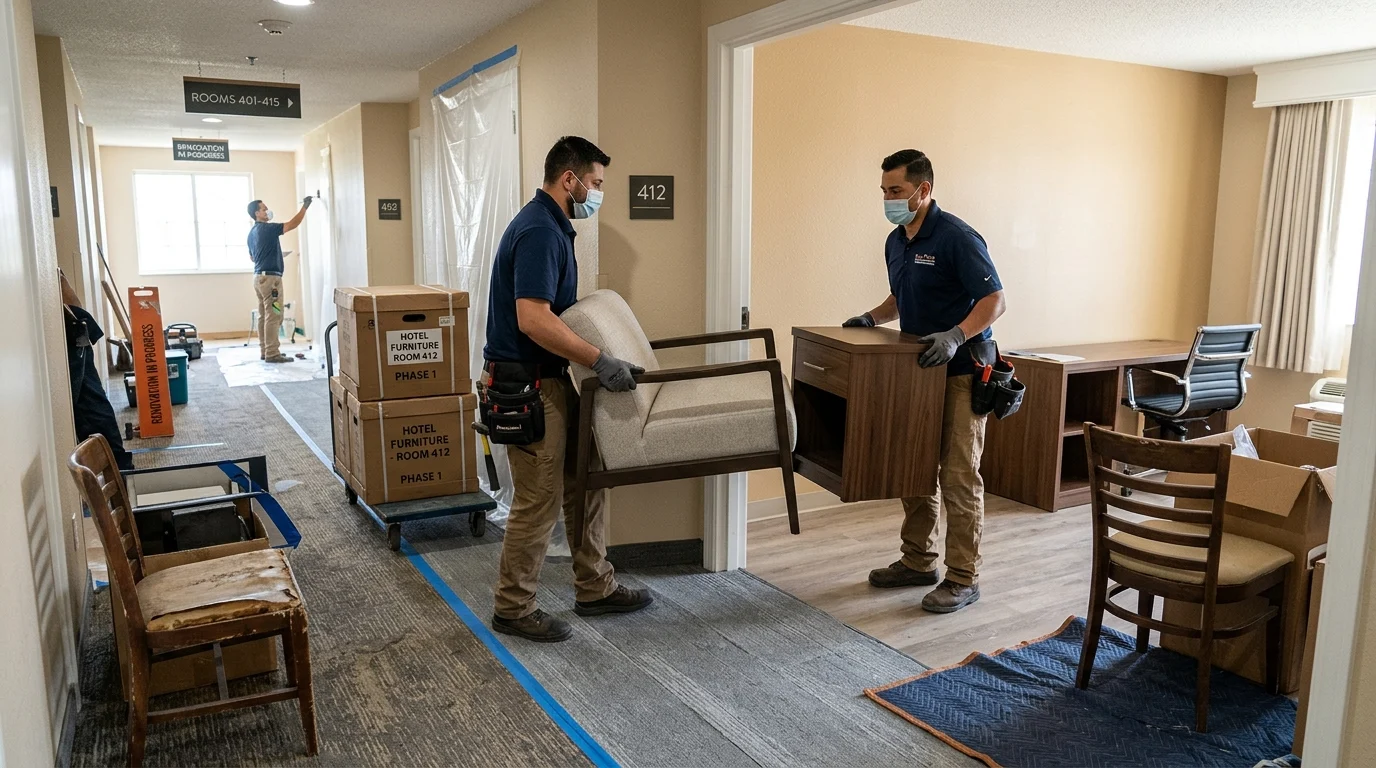
Why Fast-Track Furniture Replacement Matters
Phased renovations allow hotels to remain operational and generate revenue while upgrading their physical assets, a critical balance in the highly competitive hospitality sector. In markets where occupancy rates remain consistently high, taking rooms offline for extended periods severely impacts Revenue Per Available Room (RevPAR). For a midscale property charging an Average Daily Rate (ADR) of $180, leaving just 20 rooms out of order for an extra week results in a potential $25,200 gross revenue loss, assuming full occupancy. Even adjusted to a more typical 70% to 75% market occupancy rate, the financial impact remains substantial. Fast-track replacement solutions mitigate this exact vulnerability by aligning procurement timelines strictly with accelerated construction schedules.
Traditional procurement models often struggle to accommodate the fluid nature of active hotel environments. Global supply chain volatility, extended ocean freight transit times, and factory delays routinely push standard renovation schedules off track. Implementing expedited strategies provides hotel operators with a robust hedge against these disruptions, ensuring that capital expenditure (CAPEX) projects are completed on time without eroding profitability.
Defining fast-track replacement for phased hotel renovations
Fast-track replacement refers to accelerated custom manufacturing and delivery pipelines designed specifically to shrink lead times from the standard 14 to 16 weeks down to a compressed 6 to 8 weeks. This rapid turnaround is essential when updating furniture—such as commercial bedroom sets—during active hotel operations. Rather than shutting down an entire wing or property, operators execute micro-phased, floor-by-floor renovations that demand precise, staggered deliveries of finished goods.
Unlike off-the-shelf purchasing, fast-track is a compressed custom process. It relies on nearshore manufacturing, domestic warehousing of pre-approved brand standards, or modular casegoods that require minimal assembly. The defining characteristic of this model is the elimination of sequential bottlenecks; shop drawings, material sourcing, and prototyping are executed concurrently rather than consecutively, allowing production lines to activate weeks earlier than traditional methods.
Business risks of delayed furniture replacement
Delays in Furniture, Fixtures, and Equipment (FF&E) delivery introduce cascading financial and operational risks that extend far beyond initial budget overruns. Properties face extended labor costs for idle installation crews and general contractors, which can easily escalate into thousands of dollars per day in unionized urban markets.
When new furnishings fail to arrive on schedule, project managers are forced to either leave rooms out of order indefinitely or temporarily re-install outdated items, effectively doubling labor expenditures.
Furthermore, operating with degraded assets poses a severe threat to a property’s brand reputation and market positioning. Properties operating with visibly worn furnishings risk a negative impact on guest satisfaction and online reviews. In an era where digital reputation directly dictates booking volumes and algorithm visibility, the business risk of delayed physical upgrades translates into long-term market share erosion.
What Hotels Should Compare Before Choosing a Solution
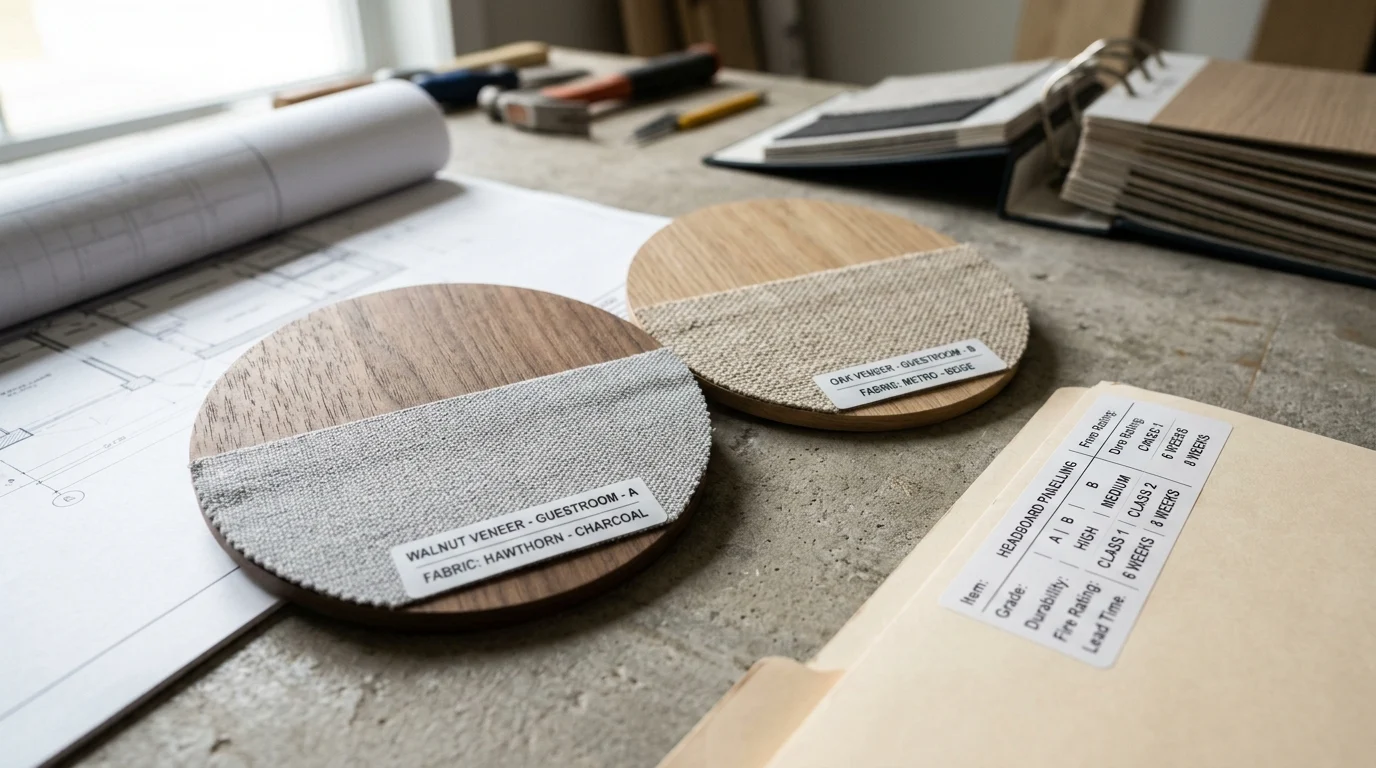
Selecting the optimal replacement solution requires hotel owners and asset managers to weigh initial capital expenditure against long-term durability, brand compliance, and delivery speed. A rigorous comparative analysis ensures that the chosen strategy aligns with both the immediate renovation timeline and the property’s overarching financial parameters.
The typical FF&E budget allocation for midscale to upscale properties ranges between $3,500 and $8,000 per key. Because fast-track solutions restructure traditional economies of scale to prioritize speed, decision-makers must carefully evaluate how expedited models impact this baseline cost, and whether the operational savings justify any potential premiums.
Cost comparison of replacement models
(Note: All costs, premiums, and timelines discussed below are estimated industry averages and vary by market conditions.)
Comparing replacement models requires evaluating direct manufacturing costs, freight expenses, and the financial impact of revenue displacement. Fast-track models often command an estimated 10% to 15% premium on unit costs due to expedited manufacturing shifts, air freight utilization for critical components, or domestic warehousing overhead. However, evaluating true ROI requires a net-impact framing: this upfront premium is frequently offset by the revenue saved when rooms return to active inventory weeks earlier.
| Replacement Model | Average Cost Per Key (Midscale) | Typical Lead Time | Minimum Order Quantity (MOQ) |
|---|---|---|---|
| Standard Custom Import | $3,500 – $5,000 | 14 – 18 weeks | 50+ Rooms |
| Fast-Track / Nearshore | $4,200 – $6,000 | 6 – 8 weeks | 20+ Rooms |
| Ready-Made Stock | $3,000 – $4,500 | 2 – 4 weeks | No Minimum |
As the table illustrates, standard custom imports offer the lowest unit cost but carry the highest risk of operational disruption due to extended lead times. Conversely, fast-track and ready-made solutions require higher upfront investment or compromise on customization but guarantee rapid deployment.
It is important to note that fast-track timelines depend heavily on securing exclusive production slots at nearshore facilities. Because factory capacity is limited, midscale properties may face bottlenecks if they do not lock in these slots early. Additionally, compressed timelines can strain quality assurance (QA) protocols, increasing the risk of defects. Buyers should budget for actionable mitigations—such as requiring in-process factory photos, mandating pre-shipment third-party inspections, and reserving a 48- to 72-hour onsite punch-list buffer per room block—to offset this risk.
Balancing brand standards, durability, and lead times
Major hospitality flags dictate strict material specifications that cannot be compromised simply for the sake of speed. For flagged properties (e.g., Marriott, Hilton, IHG), brand standards often supersede baseline fire and accessibility codes. Upholstery fabrics, for instance, must typically meet or exceed 50,000 double rubs on the Wyzenbeek scale to withstand aggressive commercial wear and chemical cleaning protocols. Balancing these rigorous standards with tight lead times means hoteliers must navigate brand approval processes with agility.
Procurement teams often utilize pre-approved alternative programs to maintain momentum. If a specified custom laminate requires a 12-week lead time, a fast-track solution might substitute an in-stock, visually identical laminate from a domestic supplier that meets the exact same scratch-resistance and aesthetic criteria. However, fast-track material substitutions require formal brand-waiver approval, not just internal visual matching, to prevent compliance failures. Securing these rapid brand waivers is a critical mechanism for keeping the fast-track timeline intact.
Evaluating custom manufacturing versus ready-made options
The decision between fast-track custom manufacturing and ready-made stock hinges heavily on the scale of the property, its brand tier, and its architectural layout. Because fast-track custom pipelines enforce Minimum Order Quantities (MOQs) of 20 to 50 rooms, they are best suited for projects requiring exact dimensional fits—vital for older, adaptive-reuse properties with irregular room footprints.
Ready-made stock, consisting of off-the-shelf inventory with no MOQs, is ideal for immediate replacement needs where standard dimensions suffice. For properties undergoing rolling renovations, ready-made casegoods and soft seating provide necessary flexibility without stalling the project.
It is crucial to recognize that fast-track and ready-made solutions are not universally applicable. Ultra-luxury bespoke properties, hotels with strict historic preservation constraints, or projects governed by brand waiver boards with inflexible meeting schedules often find fast-track limitations too restrictive, necessitating traditional custom pipelines.
How to Streamline Procurement and Sourcing
Efficient procurement and sourcing are the engines that drive fast-track renovations. Streamlining these administrative processes eliminates the bureaucratic bottlenecks that routinely stall production before a single piece of material is cut or assembled.
Optimizing the approval workflow and establishing clear communication channels between the factory, the purchasing agent (PA), and the brand representative can shorten timelines by roughly one to two weeks. This administrative efficiency secures a critical buffer for the physical manufacturing and freight phases.
Procurement steps that reduce approval delays
While sequential approvals are standard for 14-week pipelines, a 6- to 8-week fast-track window mandates concurrent reviews. Standard procurement steps often suffer from prolonged review cycles for shop drawings, finish samples, and strike-offs. Decision-makers must implement a simultaneous review process, limiting stakeholder feedback windows to a strict 48- to 72-hour period. Utilizing digital 3D renderings and augmented reality (AR) tools is no longer just a best practice; it is essential to expedite spatial approvals before physical prototypes are ever required.
Overnighting physical control samples simultaneously to the interior designer, the hotel owner, and the brand representative ensures that the factory receives the final ‘Approved for Construction’ (AFC) stamp without waiting for items to be mailed sequentially from one office to the next. Establishing a single point of authority for final sign-offs further prevents contradictory feedback from derailing the compressed production schedule.
Verifying fire safety, accessibility, and compliance
Regulatory compliance is non-negotiable and must be verified before sourcing begins to prevent costly re-manufacturing or failed building inspections. All upholstered items must comply with stringent fire safety standards, such as CAL 117-2013 or NFPA 260 in the United States, or BS 7176 for international properties. Fast-track vendors must provide pre-certified materials to avoid the delays associated with independent laboratory burn testing.
Beyond fire safety, casegoods and spatial layouts must be dimensioned to guarantee compliance with accessibility laws. The Americans with Disabilities Act (ADA) requires a minimum 36-inch clear width for accessible routes, along with specific height requirements for desks and wardrobes.
While standards like CAL 117 and the ADA provide useful baselines, fire safety and accessibility regulations vary significantly by jurisdiction. Project teams must verify local municipal codes rather than treating national standards as universally sufficient. Failing to verify compliance with these specific metrics during the expedited sourcing stage can result in denied occupancy permits, rendering the fast-track timeline useless.
Documents to secure before production begins
Securing the correct, standardized documentation prior to production safeguards the project’s integrity and prevents miscommunications on the factory floor. Essential documents include a comprehensive Bill of Materials (BOM) and a detailed FF&E matrix that cross-references every single item to specific room types and floor plans. Without a flawless matrix, factories risk producing incorrect quantities for king versus double-queen room configurations.
Furthermore, procurement teams must secure written manufacturer warranties—typically ranging from 3 to 5 years for commercial casegoods and 1 to 3 years for soft seating—along with explicit terms regarding defect replacement policies. Only after these documents, alongside signed control sample tags, are fully executed should the procurement team authorize the transfer of the initial 30% to 50% production deposit to commence manufacturing.
How to Plan Logistics and Installation
The ultimate success of a fast-track replacement program relies heavily on the flawless orchestration of logistics and installation. Even the most efficient manufacturing process is rendered ineffective if goods are damaged in transit, lost in customs, or arrive at a property that is physically unprepared to receive them.
Effective logistics planning for a hotel renovation requires coordinating multiple moving parts to handle massive volumes of freight. A standard midscale property renovation generates tens of thousands of pounds of freight per floor. Managing this influx without disrupting active guest operations demands rigorous phasing, strategic off-site staging, and disciplined installation sequencing. Furthermore, procurement speed is only one part of the equation; on-site skilled-labor availability, installer shortages, and trade coordination often dictate the true pace of the renovation.
Phased delivery strategies that minimize room downtime
Phased delivery strategies prioritize just-in-time logistics to minimize the number of rooms taken offline simultaneously. Instead of accepting massive inventory shipments all at once, operators schedule deliveries in distinct, manageable blocks—typically 15 to 20 rooms at a time. This allows the property to isolate construction noise and debris to a single floor or specific wing, maintaining a consistent revenue stream from the remainder of the building.
This micro-phasing typically operates on a precise turnaround cycle per block. As one block of rooms undergoes final cleaning and is returned to the booking inventory, the demolition and delivery cycle begins immediately on the next block. This rolling strategy ensures that the general contractor and installation teams maintain continuous workflow without costly idle days waiting for the next freight container to arrive.
Storage, staging, and freight coordination
Storage and staging present significant logistical challenges during active hotel operations. Because active properties rarely have the loading dock capacity or secure square footage to store hundreds of large crates, project managers must coordinate with local third-party logistics (3PL) providers. Utilizing off-site, climate-controlled warehousing is essential to protect raw materials from humidity and temperature fluctuations.
While local warehousing costs vary, an estimated average of $1.50 to $2.50 per square foot monthly is a necessary investment for fast-track success. The 3PL facility allows bulk freight to be received, unboxed, inspected for transit damage, and staged. Box trucks can then shuttle exact daily quantities to the hotel via ‘white glove’ delivery services, preventing corridor congestion, minimizing damage risks to freshly painted walls, and keeping the property’s limited loading areas clear for daily food and beverage deliveries.
Operators must also weigh the environmental and financial trade-offs of expedited freight. Relying heavily on air freight or frequent less-than-truckload (LTL) shipping significantly increases a project’s carbon footprint and logistical premiums. Seeking to consolidate local shuttle runs where possible is critical to mitigating these impacts.
Installation sequencing for predictable renovation phases
Installation sequencing must follow a rigid, logical schedule to align with the overarching renovation phases and prevent trades from working over one another. Even with expedited freight, a lack of available installation crews or skilled labor shortages can create severe bottlenecks that derail timelines. Trades must move through the room in a specific order, allowing realistic buffers for paint curing, flooring acclimation, and quality assurance.
| Block Phase | Renovation Activity | Key Action Items | Trade Responsible |
|---|---|---|---|
| Phase 1 | Demolition & Prep | Remove old FF&E, patch walls, prime | Labor / General Contractor |
| Phase 2 | Finishes & Curing | Apply wallcoverings, paint (allow curing), install flooring (allow acclimation) | Painters / Flooring Installers |
| Phase 3 | Hard Goods Install | Assemble beds, mount headboards, desks | Specialized FF&E Installers |
| Phase 4 | Soft Goods & Lighting | Place seating, art, lighting, initial clean | Installers / Housekeeping |
| Phase 5 | QA & Punch List | 48- to 72-hour buffer for inspections and corrections | Project Managers / Brand Reps |
Adhering strictly to a sequenced block schedule similar to the table above allows project managers to guarantee predictable renovation phases. Casegoods installers are not delayed by wet paint, and soft seating is not exposed to the dust generated by flooring removal. Incorporating realistic trade buffers and QA checkpoints is the cornerstone of keeping a fast-track project on schedule without sacrificing quality.
How Decision-Makers Should Select the Best Option
Finalizing a fast-track strategy requires a holistic view of the project’s constraints, objectives, and long-term implications. Decision-makers must synthesize budget limitations, strict brand requirements, and operational realities into a cohesive execution plan that satisfies multiple stakeholders.
A structured evaluation framework allows ownership groups and asset managers to confidently commit to multi-million-dollar renovation investments. The ultimate goal is to select a procurement and installation pathway that yields a reliable asset lifecycle, protects immediate room revenue, and elevates the guest experience without compromise.
Key criteria for owners, operators, and designers
Owners, operators, and designers each bring different, sometimes competing, priorities to the selection process. Hotel owners focus heavily on Return on Investment (ROI), capital preservation, and minimizing revenue displacement, often prioritizing speed and baseline cost.
Operators demand highly durable materials that withstand daily abuse, high turnover, and aggressive housekeeping chemicals, prioritizing functionality and warranty coverage.
Conversely, interior designers and brand representatives advocate for aesthetic fidelity, ensuring the final product aligns with the brand’s narrative and visual standards.
The most successful fast-track solutions successfully negotiate these three criteria, ensuring that an accelerated lead time does not result in a substandard product that degrades visually or structurally within 36 months, which would force an early and costly replacement cycle.
When a hybrid replacement strategy works best
A hybrid replacement strategy often provides the most effective balance of speed, cost efficiency, and customization for mid-tier and upscale properties. In this model, complex or highly visible custom casegoods—such as intricate built-in wardrobes, stone-topped vanities, or signature architectural headboards—are ordered through traditional 14-week pipelines to ensure exact design fidelity and lower unit costs.
Simultaneously, easily swappable items like ergonomic task chairs, mattresses, standard soft seating, and decorative lighting are sourced from fast-track or ready-made inventory. This dual-pipeline approach allows the hotel to immediately refresh the room’s core comfort elements and improve guest satisfaction scores in the short term, while waiting for the bespoke architectural pieces to arrive for a final, streamlined installation phase.
However, splitting orders across custom and ready-made vendors introduces real-world coordination risks. Project managers must actively guard against finish mismatches—such as clashing wood veneers or laminates—and reconcile potentially incompatible warranty terms between different suppliers to ensure the final room design remains cohesive.
Final approval checklist before committing
Before issuing the final purchase order and transferring deposits, decision-makers must complete a rigorous, final approval checklist. This checklist must verify the final landed unit pricing—accounting for all potential tariffs, fuel surcharges, and 3PL freight handling fees—to ensure the fast-track premium does not break the approved CAPEX budget. Furthermore, it must confirm the exact delivery sequence dates in writing.
Additionally, the checklist must mandate a physical or highly detailed virtual mock-up room review. This step tests ergonomics, lighting integration, spatial flow, and ensures that the 36-inch ADA clearances translate flawlessly from paper blueprints to physical reality. Finally, procurement teams must verify that an ‘attic stock’ overage of 2% to 5% is included in the final order to account for future damages, ensuring the property remains visually consistent throughout the lifecycle of the new furnishings.
Key Takeaways
- Plan fast-track FF&E procurement early to reduce standard 14–16 week lead times to a more renovation-friendly 6–8 week window.
- Use phased, floor-by-floor delivery schedules to keep more rooms sellable and protect RevPAR during active renovation work.
- Calculate the revenue risk of delayed rooms before approving procurement timelines, since 20 offline rooms at a $180 ADR can represent up to $25,200 in lost weekly gross revenue.
- Prioritize suppliers that can run drawings, sourcing, prototyping, and production in parallel to eliminate avoidable bottlenecks.
- Evaluate furniture replacement options by delivery reliability, durability, brand compliance, and lifecycle value rather than lowest upfront cost alone.
Frequently Asked Questions
What does fast-track furniture replacement mean for hotel renovations?
It means using accelerated manufacturing, sourcing, and delivery processes to reduce typical FF&E lead times from about 14–16 weeks to roughly 6–8 weeks, helping hotels renovate rooms in phases without long shutdowns.
Why is phased renovation important for hotels?
Phased renovation lets hotels keep part of the property open and generating revenue while upgrades are underway, reducing the financial impact of taking rooms out of service.
How can delayed furniture delivery affect hotel revenue?
If 20 rooms at a $180 ADR remain offline for one extra week, the potential gross revenue loss can reach $25,200 at full occupancy, before considering contractor delays or labor costs.
What furniture items are commonly replaced during phased hotel upgrades?
Hotels often replace guestroom casegoods, headboards, nightstands, desks, wardrobes, seating, and full commercial bedroom sets that must meet durability, design, and brand-standard requirements.
How do fast-track solutions shorten project timelines?
They reduce sequential bottlenecks by overlapping shop drawings, material sourcing, prototyping, manufacturing, and delivery planning instead of waiting for each step to finish before starting the next.
Post time: Aug-25-2026