
 joyce@taisenfurniture.com
 0086 15356090777


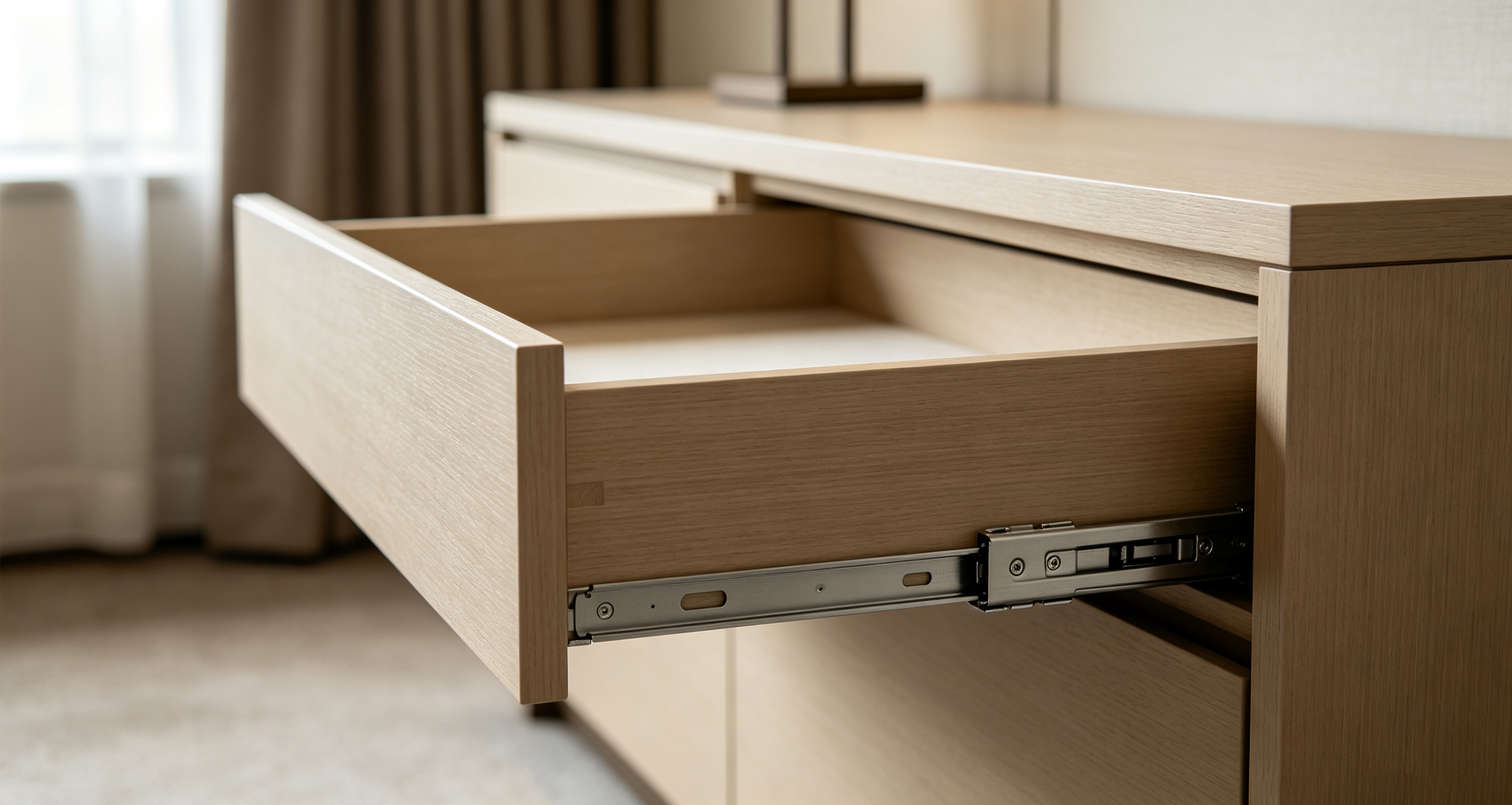
Every hotel FF&E specification hinges on small, high-frequency components that guests rarely notice until they fail. Drawer hardware sits in this critical category. Guestroom dressers, minibar cabinets, vanity drawers, wardrobe storage, and café sideboard drawers are opened and closed dozens of times per week, across hundreds of guest stays. A cheap, low-cycle slide will rattle, stick, fail to stay closed, or create disruptive noise that hurts guest satisfaction scores. For procurement teams, interior designers, and furniture manufacturers, the most common decision point is not just slide load rating or extension type, but the operating mechanism: soft-close damping slides, or handleless push-to-open touch latch systems.
These two hardware families serve different design priorities, maintenance workflows, guest accessibility, and long-term failure modes. Soft-close hardware focuses on controlled, silent closure and impact reduction, while push-to-open hardware delivers clean, minimalist aesthetics with no protruding handles or knobs. Neither is universally “better” for hotel projects. The right selection depends on the brand design language, guest demographic, room type, cleaning and housekeeping routine, budget tier, and durability testing requirements written into the FF&E package. Many specifiers also misunderstand the overlap: push-to-open and soft-close can be combined in premium hybrid slides, but hybrid units carry higher cost, tighter installation tolerances, and more complex service paths, which makes them risky for mid-scale hotel rollouts with limited on-site maintenance support.
This guide breaks down how each mechanism works, their commercial-grade performance benchmarks, failure risks specific to hotel environments, recommended room-by-room applications, compliance and testing standards, and a practical decision framework for your next hospitality FF&E tender.
What Is Soft-Close Drawer Hardware for Hotel Furniture?
Soft-close slides are built around an integrated hydraulic or pneumatic damper paired with a return spring. The mechanism activates only in the final travel segment of the drawer, typically the last 30 to 50 millimetres before full closure. When a guest or housekeeper pushes the drawer shut, the damper catches the motion, slows the drawer’s velocity, and pulls it fully closed without slamming, clattering, or transferring heavy impact force to the drawer front, cabinet box, and fasteners.
Commercial hospitality soft-close slides differ drastically from residential soft-close hardware. Residential versions are usually rated for 20,000 to 30,000 opening cycles. Hotel-grade slides must survive repeated, inconsistent force from many different users. A tired guest may slam the drawer; a housekeeper may rush through room turnover and push drawers hard. That is why reputable FF&E hardware suppliers specify a minimum cycle rating of 50,000 cycles for mid-tier hotels and 80,000 to 100,000 cycles for luxury, high-occupancy urban properties. The damping cylinder must be sealed to prevent oil leakage, which is a common hidden failure point. Leaked damping fluid creates stains on drawer bottoms, linens, and guest personal items, and once the fluid escapes, the slide reverts to a normal, noisy slide with no buffer against impact.
Soft-close slides are available as side-mounted ball-bearing slides or concealed undermount slides. Undermount soft-close is the preferred option for upscale guestroom furniture because the hardware is hidden from view, creating a clean drawer box while retaining the quiet closing function. These slides usually offer three-dimensional front adjustment, so installers can align the drawer front flush and evenly after transportation, installation, and minor wood movement caused by humidity swings. Humidity stability is a major concern for coastal hotels, tropical resorts, and properties with variable HVAC schedules. Wood case goods expand and contract, and adjustable hardware reduces service calls where drawers bind, gap, or sit crooked.
The core benefits of soft-close hardware in hospitality are noise reduction, impact protection, and intuitive operation. Noise is a high-priority metric for guestrooms. Thin partition walls mean drawer slams can travel between adjacent rooms, creating complaints from light sleepers, business travellers on overnight stays, and wellness-focused hotel brands. Soft-close removes the sharp acoustic spike of a slammed drawer, helping properties maintain quiet-room standards. The damping also protects the furniture itself: repeated slamming loosens veneer edges, pulls screws out of particleboard or MDF cabinet carcasses, and weakens drawer front joints over time. For hotel owners, slower furniture degradation means fewer replacement units during the FF&E lifecycle and fewer punch-list items at project handover.
There are trade-offs, however. Soft-close slides require a pull point: a handle, recessed finger pull, routed groove, or cutout grip. That adds visual elements to the furniture design, which may conflict with minimalist, contemporary brand standards. The damping resistance also creates a slight closing bias. If a drawer is loaded unevenly with heavy items, or if the cabinet frame is slightly out of square, the soft-close mechanism may not engage reliably. Guests may leave drawers partially ajar, which is a housekeeping hazard. Open drawers can catch on luggage, cleaning carts, and wheelchairs, and they also create security concerns for minibar and in-room safe storage drawers. Housekeeping teams must check every drawer to confirm full closure during turnovers, adding small increments to labour time per room.
What Is Push-to-Open Drawer Hardware for Hotel Furniture?
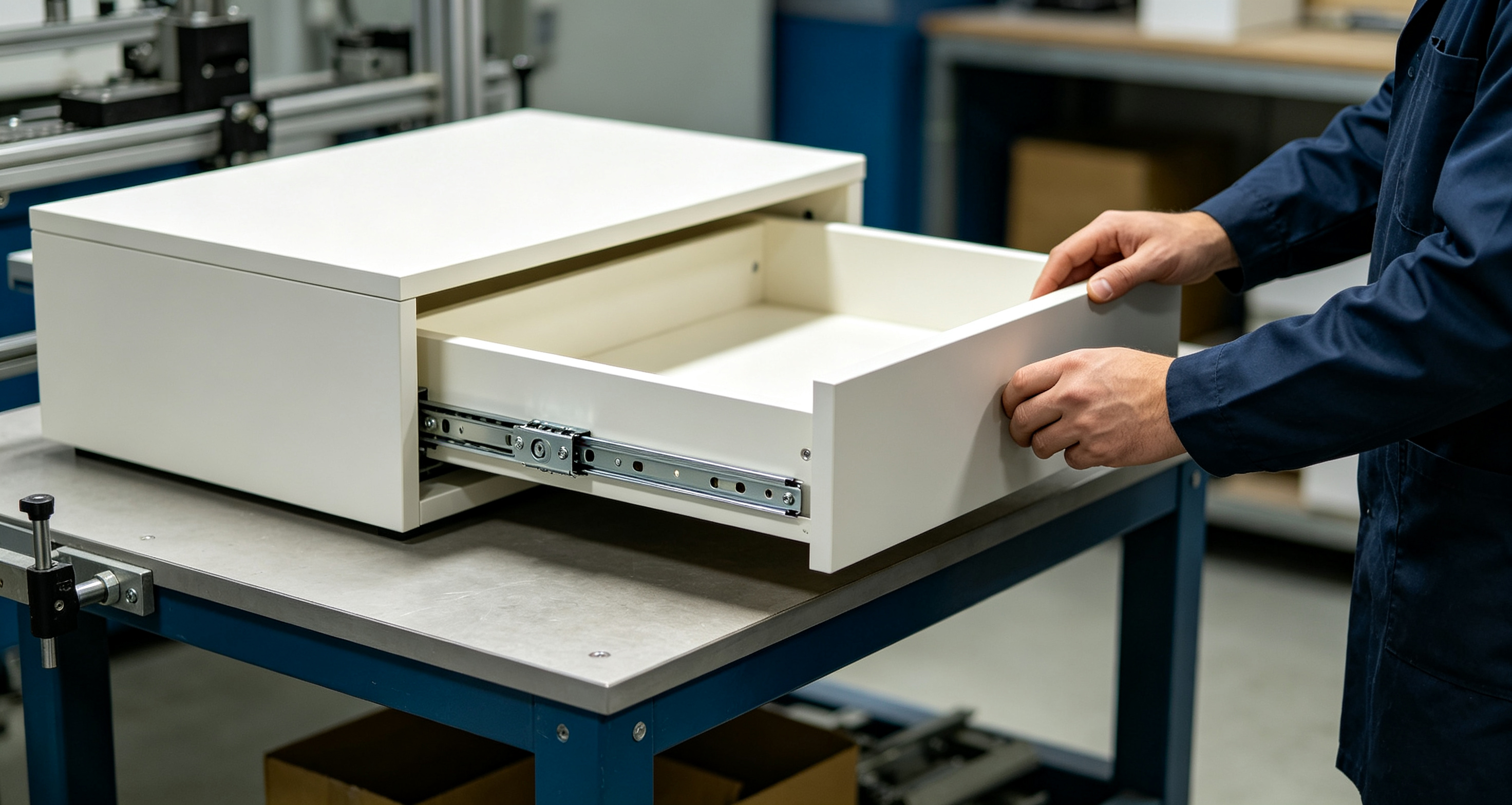
Push-to-open, or touch-latch drawer systems, eliminate visible handles entirely. The core mechanism is a spring-loaded release latch mounted to the slide or cabinet back. When the user presses the closed drawer front inward by a small trigger distance, the latch releases and the spring ejects the drawer outward by roughly 20 to 30 millimetres, creating enough gap for the user to grip the drawer front and pull it fully open. To close, the user pushes the drawer back until the latch catches and locks it in the closed position.
This hardware is the backbone of handleless hospitality furniture, which has grown rapidly in modern boutique hotels, lifestyle brands, extended-stay suites, and wellness resorts. Without protruding knobs or bar handles, the furniture surface is continuous, smooth, and visually calm. This delivers two practical operational wins for hotels: reduced impact injury risk and easier cleaning. Handles are snag points for luggage straps, backpacks, clothing, and cleaning cloths. They also collect dust, soap scum, and hair around the base, requiring extra wiping time. Handleless push-to-open drawers have flat, uninterrupted fronts that housekeeping staff can wipe in one motion, cutting down surface cleaning labour.
Commercial-grade push-to-open hardware is built with reinforced latches and heavy-duty springs, unlike cheaper residential touch latches that jam or lose spring tension quickly. The trigger force is a critical specification point. Too light, and the latch can release accidentally when luggage bumps the drawer, or when the cabinet is moved during deep cleaning. Too heavy, and guests with limited hand strength, elderly travellers, or guests with arthritis and neurodiverse sensory sensitivities will struggle to operate the drawer. Hospitality spec sheets typically target a trigger force between 15 N and 25 N for accessible, inclusive design.
Push-to-open systems also have distinct failure modes that procurement teams must understand before specification. The most frequent issue is misalignment. The latch requires precise front-to-back clearance. If the drawer front warps, the cabinet box shifts, or installation gaps are uneven, the latch will fail to catch reliably. The drawer either will not stay closed, or it will not trigger when pressed. Springs fatigue over time, especially in high-use rooms, and the ejection travel shortens. When the ejection distance shrinks below 10 mm, guests cannot get a grip, and the drawer becomes effectively unusable.
Another downside is noise on closing. Standard push-to-open latches do not include damping. When the drawer is pushed closed, the front hits the cabinet frame with a sharp click. This sound is quieter than a full slam, but it is more repetitive. Guests often tap and re-press the drawer multiple times because they cannot feel whether it has latched correctly. This behaviour creates repeated clicking noise, which front desk teams frequently receive complaints about. Premium hybrid push-to-open plus soft-close slides solve this, but they are far more expensive, harder to source consistently across large projects, and require factory-trained installers. Many hotel groups avoid hybrid hardware for standard rollouts to keep spare parts inventory simple.
Side-by-Side Performance Comparison Table
| Evaluation Metric | Soft-Close Drawer Hardware | Push-to-Open Drawer Hardware |
|---|---|---|
| Primary function | Dampened, silent automatic closing | Handleless touch release, manual latching |
| Guest operation | Pull via handle / finger pull; gentle push to close | Press front to eject; push firmly to latch shut |
| Noise profile | Low closing noise; no sharp impact | Quiet opening, audible click on latching |
| Aesthetic outcome | Requires handle or recess grip | Fully flat, seamless handleless front |
| Installation tolerance | Moderate, 3D adjustment available | Tight, sensitive to gap and alignment |
| Common failure point | Damping fluid leakage, failed damper | Spring fatigue, latch misalignment, failed catch |
| Recommended cycle rating | 50,000–100,000 cycles | 50,000–80,000 cycles |
| Accessibility note | Easy for most users; grip required | Trigger force must be calibrated for limited dexterity |
| Housekeeping impact | Risk of partial closure; visual check required | Faster surface cleaning; risk of accidental unlatching |
Hotel Room-by-Room Application Guidance
Guestroom layouts create very different use cases for drawer hardware, and the best specification strategy is often mixed, not uniform across the entire property.
Guestroom Dresser and Storage Drawers
Dresser drawers hold clothing, travel documents, chargers, and toiletries. For full-service, family-friendly, and mid-market hotels, soft-close hardware is usually the safer default. The intuitive pull handle design works reliably for all guest demographics, including children, older guests, and international travellers who may not expect touch-latch furniture. The damping reduces the chance of late-night noise from guests packing luggage. Luxury lifestyle and design-focused boutique properties may specify push-to-open here to maintain a seamless wall of furniture, but the design team must include service contingency for latch repairs during the warranty period.
Vanity and Bathroom Drawers
Bathroom environments bring high humidity, steam, and frequent water splashes. Corrosion resistance becomes as important as the operating mechanism. Soft-close undermount slides with zinc-nickel plating perform well here, as long as the cabinet includes ventilation to reduce trapped moisture. Push-to-open latches are also popular for vanity drawers, because handleless surfaces resist water spot buildup and are easier to wipe down. However, the latch mechanism must be rated for damp environments; unprotected steel springs will rust and seize within 12 to 24 months in humid bathrooms.
Minibar and Pantry Drawers
Minibar drawers are high-risk security and operational points. Hotel operators need drawers that stay securely closed when not in use, to prevent theft of beverages and snacks, and to avoid unattended open drawers that block housekeeping carts. Soft-close slides are widely preferred for minibar storage because they self-pull closed. Even if a guest pushes it halfway, the damper finishes the closure. Push-to-open latches can work for minibars, but the latch quality must be excellent. Cheap latches can pop open during transit, cleaning, or minor bumping, leading to inventory loss and audit headaches.
Lobby, Restaurant, and Banquet Sideboards
Public-area furniture sees unpredictable, heavy traffic from guests, staff, and event attendees. Soft-close slides are the standard for banquet storage drawers and host station cabinets. Staff operate these drawers constantly during service, and the quiet closing mechanism prevents disruptive noise in dining spaces. Push-to-open is sometimes used for display sideboards that are opened infrequently, but they are not recommended for high-cycle back-of-house storage furniture.
Commercial Testing and Compliance Standards for Hotel Drawer Hardware
Residential hardware test standards are not sufficient for hotel FF&E. Specifiers should reference recognised commercial furniture durability standards in the bill of materials and factory inspection checklists. The most widely accepted criteria include cycle testing, load testing, corrosion resistance, and structural impact testing.
Cycle testing runs the drawer through repeated open-close cycles at a defined load, usually 20 kg for standard guestroom drawers. The hardware must maintain its function and noise performance at the end of the test. For soft-close slides, inspectors verify that damping strength does not degrade significantly. For push-to-open latches, inspectors verify that trigger force stays within the specified range and that the latch does not slip or fail to catch.
Corrosion testing is non-negotiable for coastal, island, and spa hotels. Salt spray testing confirms whether plating and polymer components resist oxidation. A hardware item that passes cycle testing but fails salt spray testing will develop sticking and jamming problems quickly in marine climates.
A second critical table summarises compliance specification thresholds for tender documents.
| Test Item | Soft-Close Commercial Spec | Push-to-Open Commercial Spec |
|---|---|---|
| Cycle test minimum | 50,000 cycles, 20 kg load | 50,000 cycles, 20 kg load |
| Salt spray resistance | Minimum 48 hours without red rust | Minimum 48 hours without red rust |
| Operating temperature range | 0°C to 45°C | 0°C to 45°C |
| Load rating per pair | 30–40 kg full extension | 30–40 kg full extension |
| Trigger / closing force | Controlled closing force < 20 N | Trigger force 15–25 N |
Common Specification Mistakes in Hospitality FF&E Projects
The first frequent mistake is selecting residential-grade hardware to cut initial cost. Procurement teams often compare retail slide pricing and underestimate the wear in hotel settings. A 30,000-cycle residential slide may look identical, but it will start damping poorly or jamming in less than one year of full occupancy. The cost savings on the component are erased by service calls, replacement labour, and guest complaints.
The second mistake is specifying push-to-open hardware without defining the trigger force. Factories will default to the cheapest latch available, which often has either overly stiff or overly sensitive action. This creates accessibility failures and inconsistent guest experience across rooms. If push-to-open is part of the design, the FF&E drawing package must include trigger force, ejection travel distance, and latch alignment tolerances.
The third mistake is mixing hardware standards without planning spare parts. A project that uses three different slide brands and a mix of soft-close, push-to-open, and hybrid hardware creates a complicated spare parts locker. When a drawer fails, the maintenance team may not have the correct replacement latch or damper on hand, delaying repair and leaving a defective room out of service. Standardisation is a powerful risk control for large hotel rollouts.
The fourth mistake is ignoring wood movement. Both hardware types rely on consistent cabinet geometry. If the furniture manufacturer uses unseasoned timber or poorly engineered composite panels, drawer fronts warp, gaps shift, and even premium hardware will perform poorly. Hardware performance is only as reliable as the case goods construction it is mounted into.
Maintenance and Lifecycle Planning
Soft-close slides have a predictable service path. When damping fails, the slide is usually replaced as a complete pair. Replacement is straightforward for maintenance teams, and replacement slides are widely stocked by FF&E suppliers. Preventative maintenance is minimal: occasional cleaning of the ball track to remove dust and debris that creates binding.
Push-to-open hardware requires more regular inspection. Maintenance staff should check latch function during quarterly deep room audits. Early warning signs include inconsistent ejection, drawers that rattle closed, or drawers that open on their own. Latch springs and catch inserts are often replaceable separately, which is cheaper than full slide replacement, but only if the supplier provides service components. Before awarding a furniture contract, buyers should confirm whether spare latches and springs are available for the selected hardware model, and what the lead time is for small replacement orders.
For hotel brands targeting a 7-year FF&E refresh cycle, soft-close hardware generally aligns better with low-fuss maintenance. Push-to-open works beautifully for design-forward properties with dedicated on-site maintenance teams and established spare parts supply chains.
Key Takeaways for FF&E Buyers
Soft-close drawer hardware is the workhorse of mainstream hotel furniture. It delivers consistent quiet performance, forgiving operation for all guest groups, simpler maintenance, and lower risk of accidental opening. It is the safest default choice for large-scale brand rollouts, family hotels, accessible rooms, and high-occupancy urban guestrooms.
Push-to-open touch-latch hardware is a design-led solution for handleless, minimalist furniture. It delivers premium visual results and easier surface cleaning, but it carries tighter installation tolerances, higher sensitivity to alignment and humidity, and a different set of guest experience risks. It is best suited for boutique properties, lifestyle brands, vanity zones, and low-cycle display storage, not for high-traffic back-of-house drawers.
Hybrid hardware that combines push-to-open release and soft-close closure is available, but it should be treated as a special specification rather than a standard. It raises component cost, installation complexity, and spare parts complexity.
The best FF&E specification is rarely one-size-fits-all. By mapping hardware function to each drawer location, documenting clear test standards and force parameters, and validating spare parts availability before production, buyers can avoid costly field failures and deliver a guest experience that feels polished, reliable, and quiet for the full lifecycle of the furniture.
FAQ
Q: Can I retrofit soft-close onto existing push-to-open drawers? A: Retrofit is possible but usually requires replacing the full slide set and adding a handle or finger pull. The cabinet opening and drawer front may also need modification, so retrofitting is rarely economical for large hotel portfolios.
Q: Are push-to-open drawers suitable for accessible rooms? A: Yes, only when the trigger force is calibrated within an accessible range. Overly stiff latches create barriers for guests with limited hand strength. Always test samples with accessibility review panels before approving production.
Q: Which hardware holds up better in coastal salt-air environments? A: Neither type has an inherent advantage. The critical factor is plating and corrosion testing. Specify zinc-nickel or stainless steel hardware and require salt spray test reports from your supplier.
Q: How do I reduce click noise on push-to-open drawers? A: Use latches with integrated rubber bumpers on the catch point. Avoid low-cost metal-on-metal latch designs. For noise-sensitive rooms, soft-close remains the more reliable option.
Q: What is the typical price difference between the two systems? A: Basic soft-close slides are generally lower cost than commercial push-to-open systems. Hybrid push-to-open + soft-close slides carry the highest unit price and service cost.
Post time: Nov-11-2026