
 joyce@taisenfurniture.com
 0086 15356090777


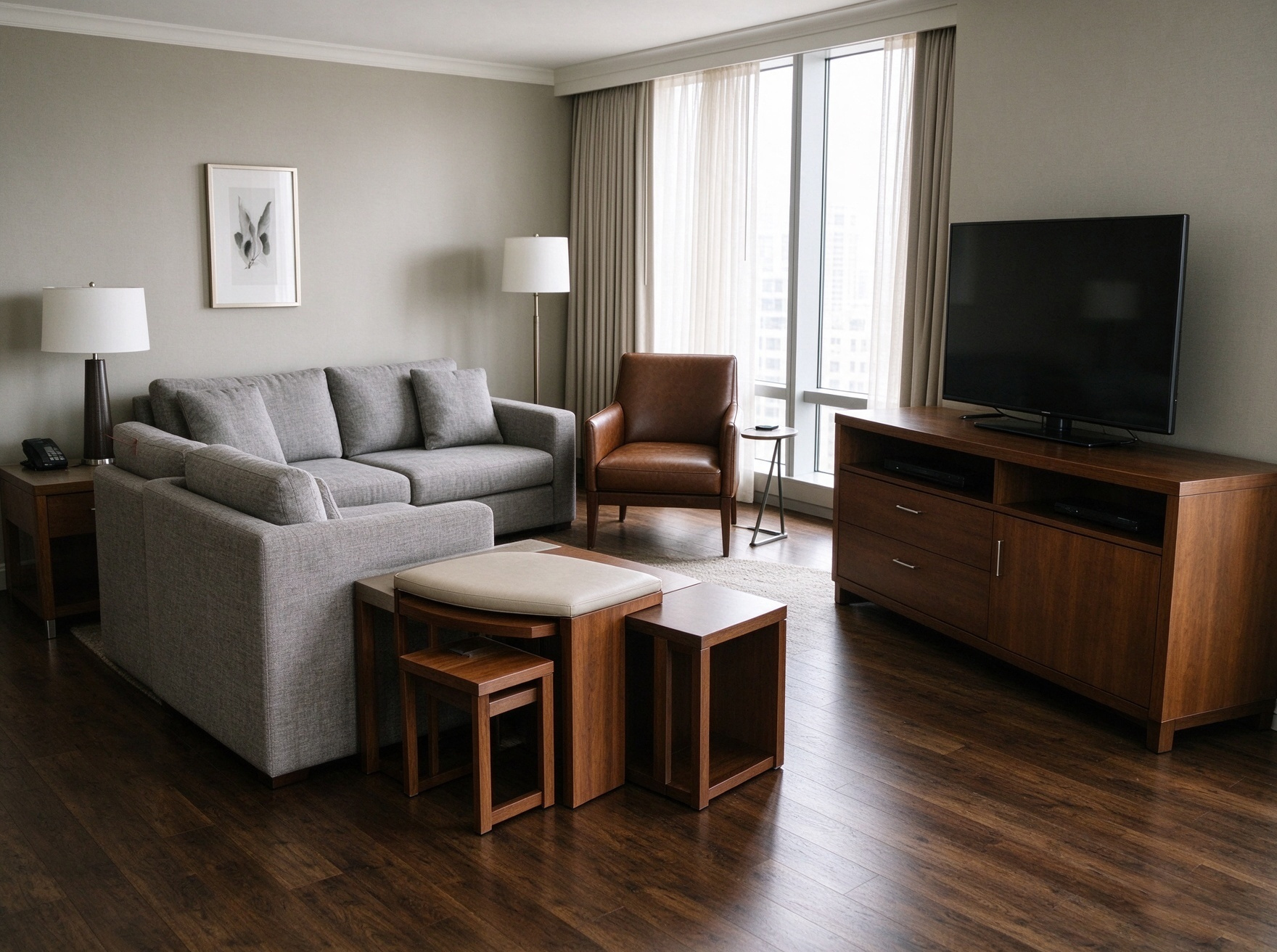
The hotel industry is entering a new era of accountability. Sustainability is no longer a marketing label applied to a room after it opens; it is an operational requirement shaped by tightening environmental regulations, investor expectations, and guest behaviour. Public spaces and guestrooms are filled with furniture that is traditionally built to last twenty or thirty years, then demolished and sent to landfill at the end of its life. When a hotel undertakes a renovation, entire inventories of beds, desks, lounge chairs, sofas, tables and wardrobes are stripped out and discarded. Much of that material is glued, stapled and laminated in ways that make it nearly impossible to separate, repair, reuse or recycle. This article explores a different path: circular hospitality furniture, designed for disassembly, supported by take-back programs that give products a second, third or even fourth life. It outlines the design principles, material choices, procurement practices and supplier partnerships that allow hoteliers to reduce waste, lower carbon footprints and control long-term costs without compromising the durability and comfort that commercial hospitality demands.
Why Circular Design Matters for Hospitality
The Scale of the Problem
Hospitality runs on cycles of renovation. A typical hotel refreshes its FF&E (furniture, fixtures and equipment) every seven to ten years, with some brand standards pushing full replacement more frequently. Every refresh produces a significant volume of waste. Chairs that could be repaired are thrown out. Sofas with perfectly good frames are discarded because their cushions are worn. Tables with damaged tops are trashed because the top cannot be separated from the base. In many regions, used commercial furniture ends up in landfill because there is no cost-effective channel for collection, refurbishment or recycling.
This linear model is increasingly expensive. Disposal fees are rising, landfill capacity is shrinking in many markets, and some jurisdictions are introducing extended producer responsibility schemes that hold furniture makers accountable for what happens to their products after sale. Guests are also paying attention. Travelers who care about sustainability actively research hotels that demonstrate genuine environmental commitment. A hotel that can credibly show it reduces waste, reuses materials and designs for a longer product life builds trust and differentiation.
The Business Case for Circularity
Circular design is not purely an environmental argument; it is a financial strategy. When furniture is designed for disassembly, components can be repaired and replaced individually. A broken armrest is swapped out instead of discarding the entire chair. A worn cushion cover is replaced while the frame continues in service. This modular repairability extends the useful life of an asset and reduces the frequency of full replacement purchases.
Take-back programs shift the economics of procurement. Instead of treating a furniture order as a one-time purchase with no end-of-life plan, hoteliers and suppliers agree in advance on what happens when the furniture is retired. The supplier collects the old products, refurbishes what can be saved, recovers materials that cannot be reused, and feeds them back into new production. Some of that recovered material returns to the same hotel as an upgraded product. The result is a closed loop that stabilises supply, reduces raw material dependence and creates a predictable, long-term partnership between buyer and manufacturer.
There is also a growing reputational dividend. Many corporate clients and event planners now ask hotels about their sustainability practices before signing contracts. Chain brands are including circularity criteria in their FF&E standards. Being able to document a genuine circular program helps hotels win business and meet investor ESG targets.
Core Design Principle: Design for Disassembly
The foundation of circular hospitality furniture is design for disassembly, often abbreviated as DfD. This is the deliberate practice of engineering furniture so that it can be taken apart at the end of its life, or whenever repair is needed, without destroying the components.
Modular Construction
The most important principle is modularity. A circular chair is not a single monolithic object; it is a system of replaceable parts. The seat cushion, backrest, armrests, frame and fabric cover are each designed as independent modules. Each module connects to the others using standardised, accessible fittings rather than permanent adhesives.
Modular construction changes the maintenance equation. When a hotel notices a worn cushion in a busy lobby, it orders a single replacement cushion instead of purchasing a new chair. The old cushion is returned to the supplier, who refills it with fresh foam and re-covers it for the next cycle. This small change dramatically reduces waste and cost over the life of the furniture.
Mechanical Fasteners Instead of Adhesive
Traditional furniture relies heavily on glue. Wood joints are bonded, panels are laminated, upholstery is stapled into frames and edge banding is heat-sealed. Glue creates a strong bond, but it makes disassembly impossible without breaking the parts.
Circular furniture replaces glue with mechanical fasteners wherever practical. Screws, bolts, cam locks, clips and sliding connectors allow components to be separated cleanly. A tabletop can be unbolted from its legs. A sofa back can be detached from its base. Upholstery can be held in place with hook-and-loop strips or button-on covers instead of being stapled permanently into the frame. These connections are designed to survive the vibrations, impacts and daily loads of commercial use, while remaining accessible to a trained technician.
Standardised Parts and Open Specifications
Circular design rewards standardisation. When components use standardised sizes and connection patterns, spare parts are easier to source, repair is faster and refurbishment is more economical. Open specifications, shared with repair technicians and refurbishment partners, make it possible for parties other than the original manufacturer to service the furniture.
Standardisation also simplifies take-back logistics. When a supplier collects used furniture, standardised parts are easier to sort, grade and route to the correct recovery stream. A frame from one model can be reused with components from another. Consistent dimensions reduce the complexity of refurbishment and make the whole recovery system more efficient.
Labeling and Material Identification
For materials to be recycled properly, they must be identified. Circular furniture carries clear labelling that marks the material composition of each major component. A chair frame labelled with its wood species or recycled content, a cushion marked with its foam type, and a fabric tag showing its fibre composition all enable accurate sorting at end of life.
Material identification matters because recycling facilities need to know what they are handling. Mixed materials that cannot be distinguished are usually downgraded to low-value use or rejected entirely. Clear labelling lets recyclers separate wood, metal, foam and textiles with confidence, sending each stream to the right recovery process.
Material Choices That Support Circularity
Renewable and Recycled Content
Circular furniture favours materials that can be renewed or recovered. Sustainably sourced wood, especially certified timber from responsibly managed forests, can be reused across multiple product cycles before it is finally chipped for composite panels or biomass. Recycled aluminium and steel maintain their quality through repeated remelting, making them excellent choices for frames and structural components. Recycled plastics can be engineered into durable panels, edge trims and protective caps.
The choice of upholstery is equally important. Fabrics made from recycled polyester, recycled nylon or natural fibres with low processing impact are easier to integrate into circular programs. Some suppliers now offer fabric that itself is designed for recycling, using a single polymer family so the textile can be reclaimed and remanufactured at the end of its life.
Avoiding Permanent Bonding of Dissimilar Materials
A common obstacle to recycling is the permanent combination of dissimilar materials. A chair frame that is glued to a metal bracket, or a tabletop bonded to a plastic edge, is difficult to separate. Once mixed, these materials become hard to recycle economically.
Circular design avoids permanent bonding across material families. Components are joined with fasteners that can be undone, or with adhesives that are water-soluble or designed to break down under specific conditions. Where bonding is unavoidable, the designer ensures that the bonded unit can be removed as a single, identifiable component that still has reuse value.
Foam, Cushion and Textile Considerations
Cushions present a particular challenge. Conventional upholstery foam is glued or stapled into frames, and many types are difficult to recycle. Circular designs favour removable cushion modules with mechanical attachment. The foam itself should be a type that can be reprocessed, and the fabric cover should zip off for cleaning, repair or replacement.
This modular cushion approach has immediate practical benefits for hotels. Covers can be changed when they stain or wear, without discarding the foam. Foam can be replaced when it loses resilience, without discarding the frame. The result is a seating system that continuously renews itself while keeping the structural asset in service.
Take-Back Programs and Recovery Models
How Take-Back Works
A take-back program is a formal agreement in which the furniture supplier commits to collecting its products at the end of their service life and managing their recovery. The arrangement is defined at the point of purchase, with clear terms about collection, ownership, condition requirements and the recovery routes available.
When furniture reaches the end of its useful life, the hotel notifies the supplier. The supplier arranges collection, transports the products to a processing facility, and then routes each item through the appropriate recovery stream: refurbishment for reuse, component harvesting for spare parts, material recycling, or safe disposal of any residue that cannot be recovered. Some programs offer buy-back or trade-in value for furniture that is returned in good condition.
Refurbishment and Reuse
The highest-value recovery route is refurbishment. A well-designed circular chair can be fully reconditioned: the frame is inspected and repaired, the foam is refreshed, the cover is replaced and the finished product is returned to service. Refurbished furniture can be placed back in the same hotel, deployed to another property, or sold into a secondary market that appreciates quality commercial furniture.
Refurbishment is cost-effective because it preserves the highest-value components. Frames, especially those built from solid wood or high-grade metal, represent most of the embodied value of the furniture. Keeping a frame in service for three product lifecycles instead of one can cut the total cost of seating dramatically while delivering the same comfort and durability.
Component Harvesting and Material Recycling
Not every product can be refurbished. Severely damaged items, or components at the end of their technical life, are harvested for parts. Undamaged legs, armrests, fasteners and mechanisms are removed and used in repairs or new assemblies. The remaining material is separated into streams: wood for composite panels or biomass, metal for remelting, foam for reprocessing and fabric for fibre reclamation.
Material recycling closes the loop. Recycled wood, metal and foam return to suppliers as feedstock for new furniture. A circular program can therefore truthfully claim that a portion of every new product contains recovered content from earlier generations of the same furniture line.
Procurement: How to Buy Circular Furniture
Writing Circularity Into the Specification
Circularity does not happen by accident; it must be specified. When drafting an FF&E brief or a request for proposal, hotels should include explicit circular requirements. These include design for disassembly, standardised and replaceable components, material identification and labelling, and a documented take-back commitment from the supplier.
The specification should also cover performance. Circular furniture must meet the same commercial standards for load capacity, abrasion resistance, fire safety, stain resistance and longevity as conventional furniture. Sustainability is not an excuse for lower durability; in fact, a longer-lasting product is more circular because it stays in service longer.
Lifecycle Costing Instead of Lowest Price
Procurement decisions should be made on lifecycle cost, not initial price. A slightly more expensive chair that can be repaired, refurbished and taken back is cheaper over ten years than a low-cost chair that must be replaced twice. Lifecycle costing includes the purchase price, maintenance and repair costs, the frequency of replacement, disposal fees and any take-back value.
A simple example illustrates the point. A standard chair costing a lower amount might be replaced every eight years. A circular chair costing somewhat more might last fifteen years with regular component replacement, and return a take-back credit at the end. Factoring in maintenance, disposal and replacement, the circular option delivers a lower total cost over the product’s life.
Evaluating Suppliers
Buyers should evaluate suppliers on more than price and appearance. Key questions include: Does the manufacturer publish disassembly instructions? Are spare parts available for ten years or more? What is the take-back commitment and how is it enforced? What recovery routes are available in the hotel’s region? Can the supplier document the recycled content of its products? Is there third-party verification of sustainability claims?
A genuine circular supplier treats the furniture as a service relationship rather than a one-time sale. They are prepared to support the product through multiple lifecycles, and they can show a real recovery operation rather than a marketing brochure.
Compliance and Documentation
Circular procurement increasingly involves formal documentation. Environmental product declarations quantify the environmental impact of a product across its life. Material declarations document what the product contains. Carbon footprint reporting is requested by investors and corporate clients. Hotels should ask suppliers for these documents and keep them on file as part of their own sustainability reporting.
Challenges and Common Pitfalls
Greenwashing and Vague Claims
The biggest risk in circular procurement is greenwashing. Some suppliers describe their products as sustainable or recyclable without a genuine program behind the label. Buyers should be suspicious of claims that cannot be verified. Does the supplier actually operate a collection and recovery operation? Can they name the refurbishment facility and the recycling partners? Is the take-back commitment written into a binding agreement?
Verification is the antidote to greenwashing. Third-party certifications, independent audits and documented recovery volumes all help buyers separate genuine circularity from marketing.
Over-Engineering and Fragility
Circular design must not compromise strength. A chair that uses quick-release fasteners that loosen under normal use, or a sofa that cannot withstand daily commercial loads, will fail early and defeat the purpose of circularity. Circular furniture must be engineered to the same commercial durability standards as conventional products, with connections designed to hold firmly under years of heavy use while still remaining serviceable.
Logistical Complexity
Take-back programs require logistics. Collection from multiple properties, transportation to a processing facility, sorting, refurbishment and redistribution all depend on an efficient supply chain. In regions without established infrastructure, circular programs are harder to run. Hotels should work with suppliers who have practical recovery networks in their operating region, or who partner with specialist logistics and recycling companies.
Cost Perception
Circular furniture sometimes carries a higher initial price because of higher quality materials and more thoughtful engineering. Buyers who focus only on upfront cost may reject it. The counter-argument is lifecycle value. Hotels that compare total cost over the product’s life, including maintenance, replacement, disposal and take-back value, usually find the circular option is competitive or cheaper.
Integration with Brand and Design
Circularity must not compromise the aesthetic and functional quality that a hotel brand requires. A circular chair should be indistinguishable in appearance and comfort from a conventional premium chair. It should match the design language of the property, meet the brand’s FF&E standards and satisfy guest expectations.
The best circular programs are built around strong design. Materials are chosen for their beauty as well as their recyclability. Wood is selected for its grain and warmth, fabric for its texture and colour, metal for its finish and strength. The result is furniture that is both beautiful and sustainable, a combination that modern travellers increasingly expect and reward.
A Practical Roadmap for Hoteliers
Starting a circular furniture program does not require a complete overhaul overnight. A practical roadmap begins with a pilot. Choose one public zone or a limited number of guestrooms, specify circular furniture there, and establish a take-back agreement with the supplier. Track the results: cost, waste reduction, maintenance effort and guest response.
Once the pilot proves itself, expand the program. Apply circular specifications to new FF&E orders. Extend take-back agreements across more product categories. Build documentation and reporting so the program can be verified and communicated. Over time, circularity becomes embedded in how the hotel buys furniture, renovates its spaces and manages its assets.
Key Takeaways
- Circular hospitality furniture is designed for disassembly, using modular construction and mechanical fasteners instead of permanent adhesives.
- Standardised, replaceable components extend product life and cut the cost and waste of full replacement.
- Clear material labelling enables accurate sorting and effective recycling at end of life.
- Take-back programs create a closed loop, with suppliers collecting, refurbishing and recovering their products.
- Refurbishment preserves the highest-value components and delivers the strongest financial return.
- Circularity must be written into FF&E specifications, evaluated through lifecycle costing and verified through documentation.
- Circular furniture must meet the same commercial durability and fire-safety standards as conventional furniture.
- Starting with a pilot zone and expanding gradually makes circular procurement manageable and credible.
- Guests, corporate clients and investors increasingly reward hotels that can demonstrate genuine sustainability.
Frequently Asked Questions
What is design for disassembly in furniture?
Design for disassembly means engineering furniture so components can be separated, repaired and replaced without destroying the product. It relies on modular construction and mechanical fasteners instead of permanent glue.
How does a take-back program work?
A take-back program is a formal agreement where the furniture supplier collects its products at the end of their service life and manages recovery through refurbishment, component harvesting, material recycling or safe disposal.
Is circular furniture more expensive than conventional furniture?
The initial price can be slightly higher, but lifecycle costing, which includes maintenance, replacement, disposal and take-back value, usually shows circular furniture is competitive or cheaper over the product’s life.
Does circular furniture compromise durability?
No. Circular furniture must meet the same commercial standards for load capacity, abrasion resistance, fire safety and stain resistance as conventional furniture. A longer-lasting product is itself more circular.
How can a hotel start a circular furniture program?
Start with a pilot zone, specify circular furniture there, establish a take-back agreement with the supplier, track the results, and then expand the program across more product categories and properties.
Post time: Oct-26-2026