
 joyce@taisenfurniture.com
 0086 15356090777


Introduction
Capsule hotels operate on a unique balance: maximum guest capacity within a limited footprint, while maintaining safe, functional shared zones for check-in, dining, luggage storage, social seating, and rest. Unlike traditional full-service hotels with spacious lobbies and low guest turnover, capsule hotel common areas are high-traffic, multi-user spaces. Guests carry rolling luggage, sit for short or extended periods, place backpacks and personal belongings on surfaces, and often interact with furnishings with less supervision than in upscale boutique properties.
The core design brief for capsule hotel common area furnishings is twofold: space efficiency and resistance to intentional or accidental damage. “Vandal-resistant” does not mean heavy, unattractive, prison-grade furniture. It means engineered robustness: scratch-proof surfaces, tamper-proof hardware, reinforced joints, stain-resistant upholstery, stable anti-tip geometry, and finishes that resist marker graffiti, scuffs, and heavy impact. Compact design is equally non-negotiable. Every centimetre of floor space reserved for furnishings reduces the number of sleep pods the venue can install, directly affecting revenue potential.
For FF&E specifiers, the biggest risk is specifying standard residential or conventional hotel lobby furniture. Those products fail quickly in capsule hotel environments: thin particleboard cabinets swell and break, lightweight chairs tip easily, exposed screws are loosened or removed, soft fabrics tear and stain, and flimsy tables buckle under backpacks and luggage weight. Replacing damaged furniture frequently erodes profit margins and creates an unkempt impression that discourages repeat bookings. This guide breaks down the environmental demands, material selection rules, structural specifications, layout principles, testing benchmarks, procurement checklists, and common design mistakes for compact, vandal-resistant capsule hotel common area furnishings.
Understanding the Stressors in Capsule Hotel Shared Zones
Before selecting furniture, it is critical to map the different stressors each common zone faces. Capsule hotel public space usually includes reception counters, waiting seating, shared dining pantries, luggage storage zones, charging stations, rest benches, and small social nooks. Each zone carries its own risk profile.
Luggage impact is one of the most frequent causes of damage. Hard-shell suitacles, rolling cases, and heavy backpacks strike chair legs, table edges, and cabinet corners dozens of times per day. Graffiti and marker scribbles are a recurring concern in unsupervised shared lounges. Abrasion from repeated sliding of bags creates permanent scuff marks on tabletops and seating edges. Overloading is common: guests stack multiple backpacks, food containers, and personal electronics onto small tables or bench seats. Accidental tipping occurs with lightweight seating when guests lean back or shift their weight suddenly.
Moisture and cleaning stress add another layer of risk. Pantry and refreshment zones see regular liquid spills, food grease, and repeated wiping with strong commercial cleaners. Corrosion can set in on low-grade metal hardware. Loose fasteners become a safety hazard, and exposed sharp broken edges create liability for the operator.
A common misconception is that vandal resistance only targets deliberate destructive behaviour. In capsule hotel practice, most “vandal-style” damage is passive and cumulative: repeated scuffing, overloading, rough handling, and poor supervision. Good furnishings are engineered to survive this normalised heavy use.
Compact Design Principles for Capsule Hotel Public Zones
Compactness is not simply buying smaller furniture. It is a space-zoning strategy that preserves circulation, fire egress routes, and clear access to sleep pods, washrooms, and emergency exits. All furniture layouts must comply with local fire and accessibility codes before aesthetics are considered.
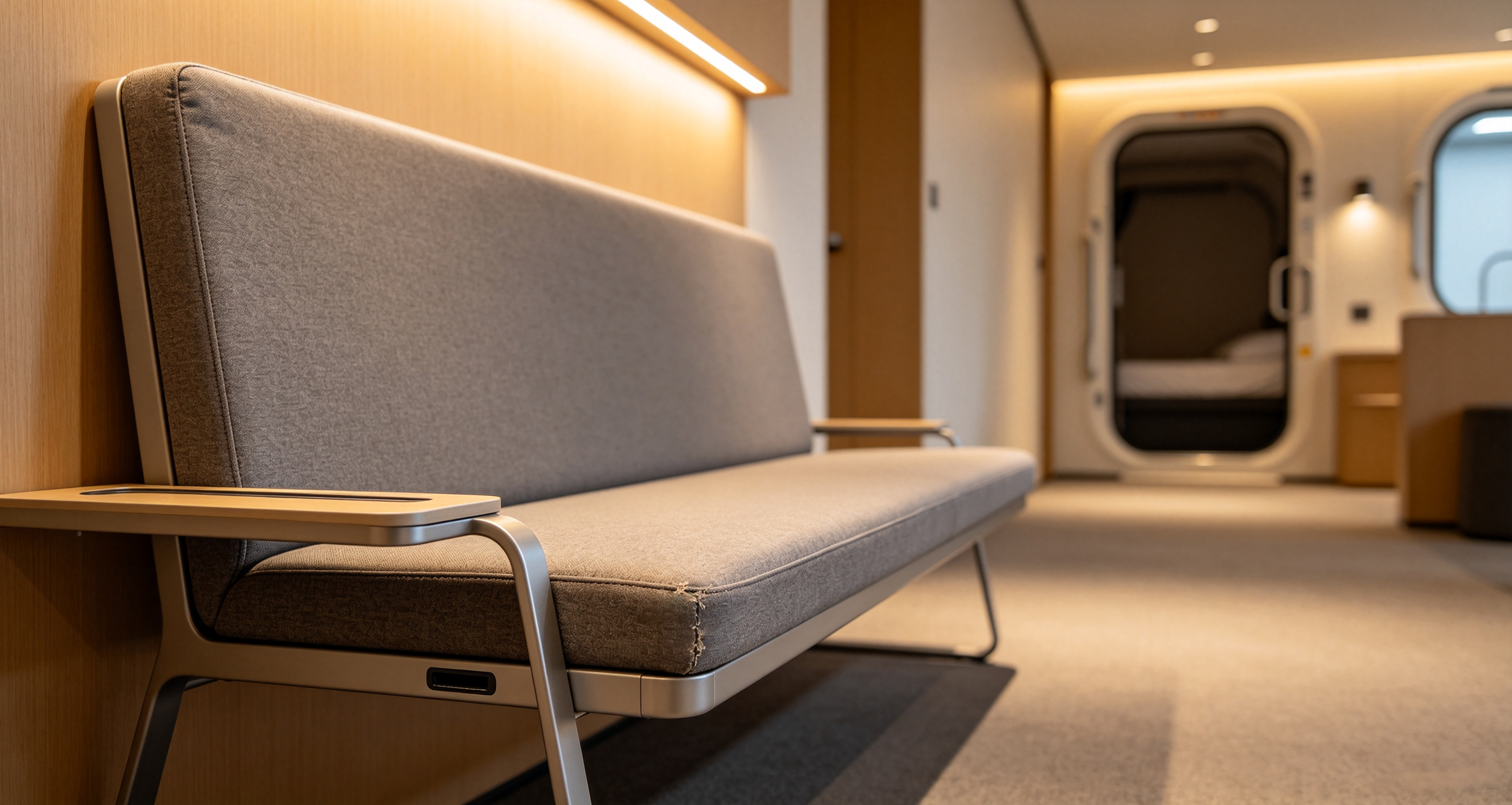
Modular multi-purpose furnishings are the primary solution. A single bench may combine seating, under-seat luggage storage, and integrated USB charging ports. A narrow countertop can serve as check-in, pantry workspace, and dining surface. Wall-mounted tables fold away when not required, freeing floor space during peak check-in hours. Stackable or nesting chairs are ideal for flexible seating: extra chairs can be stored neatly under counters or in storage closets when the lounge is quiet, then pulled out during evening arrival surges.
Vertical space utilisation reduces floor footprint. Wall-mounted lockers, floating charging shelves, and overhead storage racks keep the ground clear for guest movement. Furniture profiles should be low-profile and linear; bulky curved sofas and deep armchairs consume disproportionate floor area and block sightlines for staff monitoring.
Clear circulation corridors must be preserved. Even the most space-saving furniture is a poor choice if it narrows escape routes or creates blind corners where damage or safety incidents go unseen. The specifier should mark circulation widths on floor plans first, then fit furniture within the remaining allowable envelope.
The following table compares compact layout strategies and their suitability across capsule hotel common zones.
| Compact Furnishing Strategy | Best Application | Space Benefit | Key Risk to Mitigate |
|---|---|---|---|
| Nesting / stackable guest chairs | Waiting lounge, pantry seating | Chairs stack or nest for compact off-peak storage | Must pass stack stability and weight impact tests |
| Integrated storage bench with charging | General lounge and waiting zones | Combines seating + luggage storage + power supply | Reinforce under-seat frame to prevent sagging from heavy backpacks |
| Wall-mounted fold-down tabletops | Pantry, remote charging nooks | Zero permanent floor footprint when folded | Use heavy-duty hinge hardware, anti-slam design, weight rating clearly marked |
| Slim linear modular counter | Reception + self-service refreshment zone | One surface serves multiple operational functions | Edge reinforcement to resist luggage impact |
| High-density wall locker banks | Luggage storage area | Stores guest bags vertically without occupying floor seating space | Anti-pry lock hardware, reinforced cabinet panels |
Vandal-Resistant Material and Finish Specification
Material selection balances impact resistance, graffiti cleanability, scratch performance, weight, and budget. Soft, porous, low-density materials are almost always eliminated from high-risk capsule hotel public areas.
Panel and Surface Materials
High-pressure laminate (HPL) is the most widely specified surface material for tabletops, pantry counters, and cabinet panels. Commercial-grade HPL offers excellent scratch resistance, chemical resistance against common cleaners, and easy removal of permanent marker graffiti with standard cleaning solvents. Compact HPL without a separate substrate is preferred for high-impact edges, as particleboard or MDF substrates can delaminate if the laminate surface is chipped.
Solid phenolic panels, mineral composite, and powder-coated steel are premium alternatives. Phenolic panels are water-proof, impact-resistant, and extremely difficult to mark permanently. Powder-coated steel panels resist gouging and scratching, and graffiti can be wiped clean from smooth, dense coatings. Solid surface is attractive for premium capsule hotel projects but can be vulnerable to deep scratching from hard luggage corners.
Standard MDF, particleboard, thin veneer, and soft plywood should be avoided in high-traffic shared zones. Once the surface finish is breached, these materials swell, crumble, and become difficult or impossible to repair.
Frame and Hardware Materials
Structural frames rely primarily on powder-coated aluminium or welded steel. Aluminium is lighter, easier to move during reconfiguration, and naturally corrosion-resistant when the coating remains intact. Welded carbon steel offers superior impact resistance for heavy-use benches and reception counters, but it must receive a high-quality powder coating and proper pretreatment to prevent rust. Stainless steel hardware, preferably grade 304 or higher, is mandatory for all exposed fasteners, hinges, latches, and brackets.
Tamper-resistant fasteners are a core vandal-resistance feature. Standard Phillips or slotted screws can be removed easily by guests. Security Torx, pin hex, or one-way breakaway fasteners prevent casual disassembly. All fastener heads should be recessed and covered with tamper-proof caps wherever possible. Joint construction should be welded, through-bolted, or reinforced with heavy-gauge metal brackets. Glue-only or stapled joints will fail rapidly under rough use.
Upholstery for Seating
When upholstery is required, select commercial performance fabrics with high Wyzenbeek abrasion ratings, typically 60,000 cycles or higher for capsule hotel common seating. Solution-dyed olefin, marine-grade vinyl, and coated performance polyester resist staining, tearing, and graffiti transfer. Open-weave, loose-knit, natural cotton, linen, and delicate velvets are unsuitable, as they snag easily and absorb permanent stains.
Cushion foam should be high-density, commercial-grade polyurethane or reticulated foam. Thin, low-density residential foam compresses quickly. Seating should avoid loose, removable throw cushions that can be stolen, damaged, or left scattered. If cushions must be removable, specify secured covers with heavy-duty zippers and anti-theft stitching.
The next table summarises material performance for vandal-resistant capsule hotel FF&E.
| Material | Typical Application | Vandal / Wear Performance | Maintenance Notes |
|---|---|---|---|
| Compact HPL | Table tops, pantry counters, cabinet faces | Excellent scratch and graffiti resistance | Clean marker with approved solvent; inspect edges for chipping |
| Powder-coated welded steel | Bench frames, locker frames, reception base | Superior impact resistance | Touch up coating immediately if gouged to prevent rust |
| Powder-coated structural aluminium | Stackable chair frames, light modular units | Good impact resistance, light weight | Protect coating from heavy concentrated impact |
| 304 stainless steel hardware | Hinges, latches, security fasteners | High corrosion and tamper resistance | Specify tamper-resistant head styles |
| Performance coated vinyl / olefin | Bench and lounge seating upholstery | Resists stains, marker, tearing | Wipe clean with commercial disinfectants |
| Standard particleboard / MDF | Not recommended for high-traffic public zones | Poor, vulnerable to edge damage and moisture | Only acceptable in fully protected, low-contact back-of-house zones |
Structural Safety and Anti-Tip Design
Vandal resistance is not only about resisting scratches and graffiti. It must prevent injury caused by furniture collapse or tipping. Capsule hotel guests often lean backward on chairs, climb onto benches, or lean heavily on narrow tables. All freestanding seating and tables should meet recognised commercial seating standards such as ANSI/BIFMA load and stability requirements.
Wide, low-slung bases improve stability. Narrow, tall, lightweight furniture has high tipping risk. If furniture is wall-mounted, the wall substrate and mounting brackets must be rated for the full live load, not just the empty furniture weight. Fold-down tables require a positive locking support mechanism that cannot collapse unexpectedly.
Sharp exposed corners should be eliminated or protected with integrated rounded edge profiles. Capsule hotel public areas are busy, and guests carrying bags or rushing between pods frequently bump into furniture. Radius edges reduce laceration risk and also absorb impact better than sharp square corners.
Load ratings must be clearly documented in the supplier submittal package. Bench seating should be rated for continuous multi-person occupancy. Table tops should withstand concentrated point loads from heavy backpacks without permanent deflection.
Integration of Guest Amenities into Furnishings
One of the most effective ways to reduce clutter and extra furniture is to integrate guest amenities directly into the shared furnishings. Charging ports, reading lights, cup holders, and small shelf nooks can be built into benches, tables, and reception counters. This removes the need for freestanding charging stations or side tables that consume floor space and become easy targets for damage.
Integrated electrical components also need vandal-resistant treatment. USB-C and AC power outlets should be recessed or protected inside heavy-duty impact-resistant housings. Exposed cords are a hazard and easy to pull loose. Wiring channels should be enclosed inside the furniture frame, with access panels secured by tamper-resistant fasteners for maintenance.
Luggage lockers are a special category of common-area furnishings. Locker doors must be anti-pry, hinges should be heavy gauge, and locking systems should support guest PIN access or RFID locks. Avoid cheap cam locks that can be forced open easily.
Cleaning, Repair and Lifecycle Planning
Capsule hotel operators rely on fast, low-effort cleaning. All surfaces should be smooth, with minimal decorative grooves, carved details, or deep texture that traps dirt, food residue, and marker ink. Furniture should be designed so that damaged components can be replaced individually: a single tabletop, a chair leg, or an upholstery panel, rather than requiring the whole unit to be scrapped.
Before mass ordering, request a material mock-up test. Apply permanent marker, scuff the surface with luggage corners, and test cleaning protocols to confirm graffiti can be removed without leaving haze or discolouration. This practical test is far more revealing than data sheets alone.
Standardisation of SKUs is a procurement advantage. When all public seating and tabletops use the same finish and hardware, spare parts inventory stays small, and repairs can be completed quickly between guest rotations.
Common Specification Pitfalls
The first frequent mistake is prioritising visual compactness over stability. A tiny, stylish chair may fit the floor plan but tip easily under normal guest movement. The second mistake is assuming “commercial grade” automatically means vandal-resistant. Many standard hospitality products are built for moderate wear in quiet lobbies, not the rough, unsupervised multi-user environment of a capsule hotel.
A third pitfall is selecting light colours that show scuffs and marker marks instantly. Neutral medium-tone finishes hide normal wear better and reduce the perceived need for replacement. The fourth pitfall is ignoring fire safety. All upholstery, panels, and adhesives must satisfy local commercial fire codes; compact design cannot override flame-spread and smoke emission requirements.
Conclusion
Capsule hotel common area furnishings solve a unique dual challenge: they must occupy minimal valuable floor space while surviving constant heavy use, impact, staining, graffiti, and occasional tampering. The best design starts with circulation and safety compliance, then uses modular multi-purpose furniture, wall-mounted elements, and nesting storage to preserve as much usable space as possible.
Vandal resistance comes from engineering details: HPL or phenolic impact surfaces, welded or through-bolted frames, tamper-proof stainless steel hardware, high-abrasion performance upholstery, anti-tip wide bases, and rounded reinforced edges. Integrating charging, storage, and seating functions into one unit further reduces clutter and the number of separate pieces that can be damaged.
By specifying measurable stability, abrasion, chemical resistance, and load standards, testing material samples with realistic guest abuse simulations, and planning for modular component replacement, FF&E buyers can deliver public furnishings that remain safe, clean, and functional for years. In capsule hotel operations, well-specified compact vandal-resistant furniture is not an extra upgrade; it protects revenue, reduces maintenance labour, and preserves the reputation of the property.
FAQ
Q: Does vandal-resistant furniture have to look industrial and unattractive? A: No. Modern compact HPL, powder-coated metal, and performance upholstery come in many neutral and contemporary finishes. Vandal-resistant design focuses on hidden structural reinforcement rather than forcing an institutional aesthetic.
Q: Are stackable chairs suitable for capsule hotel lounges? A: Yes, they save space during low-occupancy periods, but they must pass stack stability tests and have reinforced leg joints. Low-quality stack chairs can collapse when stacked too high or kicked.
Q: What is the best surface material for marker graffiti removal? A: Commercial compact HPL and smooth powder-coated steel are among the easiest to clean. Matte porous surfaces, soft vinyl, and unfinished wood are much harder to restore after marker damage.
Q: Should I use removable cushions in capsule hotel public seating? A: It is safer to use fixed, secured cushion panels. Loose cushions are easily stained, stolen, or misused. If removable covers are required for sanitation, specify heavy-duty security zippers and matching replacement covers.
Q: How important is anti-tip testing for small tables and benches? A: Very important. Narrow, lightweight tables and tall thin benches present tipping hazards that create operator liability. Always request stability and static load test documentation.
Post time: Nov-24-2026