
 joyce@taisenfurniture.com
 0086 15356090777


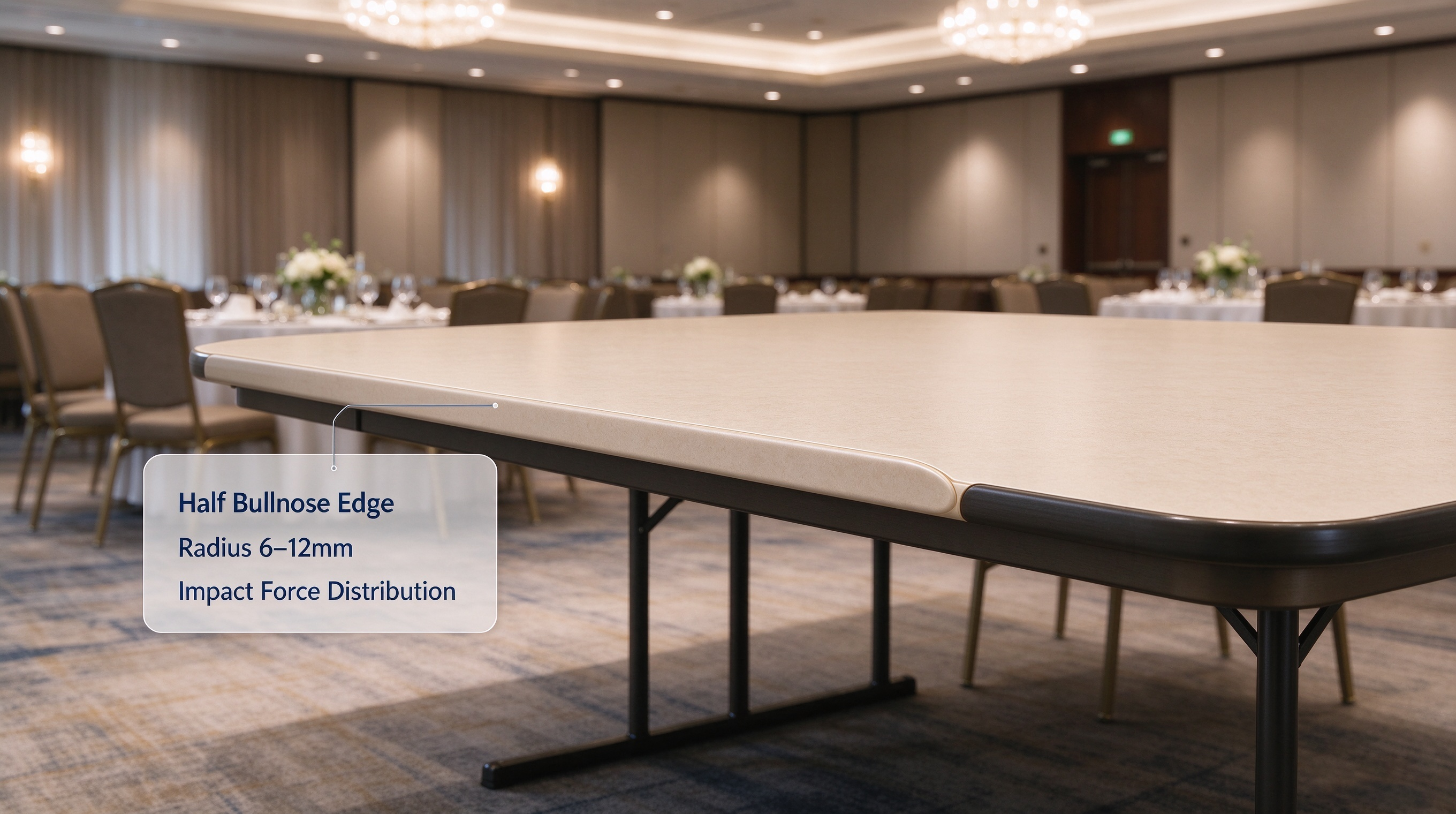
Edge profiles are frequently treated as a minor cosmetic detail when hotel FF&E teams specify banquet tables. Procurement buyers often focus first on tabletop material, load capacity, folding mechanism stability, laminate scratch resistance and overall unit price. But banquet halls operate in uniquely high-risk conditions: crowded foot traffic, fast-moving serving staff, guests stepping between tightly spaced chairs, low lighting during gala dinners and weddings, and constant setup, breakdown, stacking and transport cycles. A square, sharp, minimally eased edge turns an ordinary collision into bruising, cuts, abrasions, and even liability claims for the hotel.
Unlike stationary restaurant tables that stay fixed in place, banquet tables are reconfigured dozens of times monthly. Servers carrying heavy trays, guests shifting chairs to make room for wheelchairs or strollers, and event attendees moving between seating rows all create repeated contact against table edges. A poorly specified edge profile does not only hurt guests; it also injures banquet staff, tears linen, chips laminate surfaces, and accelerates premature edge delamination. This guide breaks down banquet table edge geometry, safety testing standards, zone-by-zone specifications, material choices, and procurement validation steps to help FF&E teams select edge profiles that protect guests, reduce operational risk, and extend table service life.
Operational and Commercial Impact
Safety is not the only benefit of thoughtful banquet edge design; edge profiles carry measurable operational and financial consequences for hotel banquet departments. When guests collide with sharp square edges, the resulting injuries generate negative online reviews, guest compensation requests, and potential liability insurance claims. Even minor bruising incidents damage the reputation of wedding, corporate and social event sales packages, directly reducing repeat bookings and event referral revenue.
A properly radiused or bullnose edge also improves guest comfort during long seated events. During multi-course banquets, guests rest their forearms along the table edge for hours. Hard square edges create localized pressure points on the forearm, leading to numbness and discomfort. Comfortable edge geometry keeps guests seated longer, improves satisfaction scores, and supports higher event feedback ratings.
For banquet operations teams, durable edge profiles lower replacement and maintenance spend. Square knife edges chip instantly during stacking, loading onto dollies, and bumping through doorways. Chipped edges catch linen threads, rip tablecloths, and expose raw substrate to spills and moisture. Over time, moisture penetrates exposed particleboard or MDF cores, causing swelling, bubbling laminate, and early table retirement. Investing in well-designed banquet table edges is therefore a direct investment in risk control, guest satisfaction, linen preservation and long-term FF&E asset value.
Common Banquet Table Edge Profile Types
Before locking in specifications, procurement and design teams need to understand the performance tradeoffs of each standard edge style. No single profile works for every banquet space, event type, or brand aesthetic requirement.
Square / Knife Edge The square knife edge has a clean 90-degree vertical transition between tabletop surface and side panel. It is popular for modern minimalist brand aesthetics and is usually the lowest-cost edge option. This profile carries the highest injury risk. Even low-speed contact delivers concentrated impact force onto a narrow line. Knife edges chip easily, catch linens, and require extra corner protectors that are often lost or forgotten during setup. This profile is generally not recommended for high-volume hotel banquet halls.
Eased Edge / Light Chamfer An eased edge removes the sharp 90-degree corner with a small chamfer or light radius, typically 2mm–4mm. It softens the impact point slightly, reduces immediate cutting risk, and is simple to manufacture. It is a common middle tier for conference tables and low-traffic meeting rooms. While safer than a pure knife edge, an eased edge still creates a hard linear contact zone and does not fully eliminate bruising risk in dense banquet layouts.
Half Bullnose Edge Half bullnose features a continuous rounded curve along the top edge, while the bottom edge remains vertical. This is the most widely specified commercial banquet edge. It distributes impact force across a curved surface instead of concentrating pressure at a sharp line. Forearm resting comfort improves significantly, linen slides smoothly without snagging, and impact damage during transport is reduced. Recommended radius range is 6mm–12mm for standard banquet tables.
Full Bullnose Edge Full bullnose curves both top and bottom edges into a continuous semicircular shape. This offers the highest level of impact absorption and guest safety. It is ideal for family-focused hotels, youth conferences, school events, and venues with very narrow aisle layouts. The tradeoff is higher production cost, and some luxury brand designers may feel the rounded shape looks overly casual for formal galas.
T-Molded Rubber Edge T-molding is a flexible PVC or thermoplastic rubber extrusion locked into a routed groove along the table perimeter. It adds a compressible cushion layer over the substrate edge. T-molding excels for heavy rental programs, convention centers, and tables that are frequently stacked, dragged, and transported. The soft layer absorbs impact, prevents bruising, hides minor substrate chipping, and seals out liquid spills. It can discolor, peel, or delaminate if the groove routing and adhesive quality are poor.
The table below summarizes recommended profiles by banquet zone and risk level:
| Zone | Preferred Edge Profile | Recommended Radius | Primary Purpose |
|---|---|---|---|
| Main Banquet Hall, Wedding & Gala | Half Bullnose | 6–12 mm | Guest safety, forearm comfort, linen compatibility |
| High-Density Aisles, Servers’ Traffic Paths | Full Bullnose / T-Molding | 10–16 mm | Max impact absorption, staff injury reduction |
| Small Conference & Boardroom Tables | Light Eased Chamfer | 2–4 mm | Brand aesthetics, moderate risk control |
| Outdoor Terrace Banquet / Poolside Events | T-Molded Bullnose | 8–12 mm | Waterproof sealing, UV resistance, impact safety |
| Luxury Formal Fine Dining Galas | Precision Half Bullnose | 5–8 mm | Balance safety and refined visual styling |
Edge Substrate, Banding and T-Molding Performance
The geometry of the edge only performs reliably if paired with compatible substrate and edge sealing construction. Most commercial banquet tabletops use plywood, MDF or particleboard cores surfaced with HPL high-pressure laminate or melamine. Raw substrate exposed at edges is the weakest failure point.
Standard thin PVC edge banding adheres to the outer vertical face. It can lift, peel and crack under repeated impact, especially if the table is dropped during handling. T-molding is mechanically locked into a routed groove, making it far more resistant to peeling than glued edge banding. Premium banquet tables combine HPL top surface with continuous bullnose edge wrapping, so the laminate material itself follows the curve without a separate seam. Wrapped HPL edges eliminate a critical failure seam and resist stain penetration better than glued banding.
For humid coastal resort banquet spaces, edge sealing becomes even more critical. Unsealed edges wick moisture, swell, and create uneven surfaces. Any banquet table specified for beachfront or tropical hotels must have fully encapsulated edges, with no exposed porous substrate. T-molding or fully wrapped HPL bullnose is strongly preferred in these environments.
How to Compare Safety and Impact Performance
Evaluating edge safety cannot rely only on visual inspection or subjective “it feels smooth” feedback. FF&E procurement teams must reference standardized impact, sharpness and durability test metrics.
Key Safety and Durability Metrics
Edge sharpness testing follows guidelines from ASTM F2057 and BIFMA X5.9 for non-residential commercial tables. A compliant commercial banquet edge must not present a hazardous sharp point when tested with sharpness probe gauges. The test simulates human skin contact and identifies edges capable of cutting or lacerating tissue.
Impact testing uses a steel ball drop test, commonly 1.2m drop height, to simulate accidental guest collisions. Knife edges show immediate chipping and laminate cracking under this test. Bullnose and T-molded edges spread impact energy, limiting cosmetic damage and injury potential.
Abrasion and peel testing for edge banding and T-molding verifies adhesion strength over thousands of handling cycles. Cheap T-molding will separate after repeated stacking and bumping; commercial-grade extrusion should resist delamination after a minimum of 500 setup and breakdown cycles.
Linen compatibility is another measurable factor. Square edges catch fabric weave, creating runs and tears. Bullnose edges allow table linen to slide freely during setup and cleanup, reducing linen replacement expense for the hotel housekeeping department.
Ergonomics of Forearm Support
Banquet guests often rest their forearms directly on table edges for 2–4 hours during weddings, awards dinners and conferences. Pressure concentration is measured by contact area. A knife edge concentrates load onto a narrow line, creating high localized pressure that leads to discomfort and bruising upon impact. A 10mm half bullnose spreads contact pressure across a wide curved surface, lowering peak pressure and improving comfort.
Table height also interacts with edge safety. Standard banquet table height is 30 inches (76 cm). If edge radius is too large on a 30-inch table, the effective usable surface area shrinks and dinner plates can tip on the curved transition. Procurement teams must balance radius size, safety, and functional tabletop space.
Compliance, Testing and Sourcing
Specifying a safe edge profile is only one part of the workflow. Hotels must verify samples, enforce third-party testing, and include edge requirements clearly within RFQ and tender documents.
Liability and Compliance Risks
Injury incidents on hotel property create premises liability exposure. A documented failure to specify commercially accepted safety edge profiles can increase settlement risk if a guest injury proceeds to a claim or lawsuit. Many large hotel brand FF&E manuals now explicitly restrict sharp knife edges for banquet and event furniture. ADA considerations also intersect with edge design: guests with limited mobility, slower movement, or visual impairment are statistically more likely to collide with furniture in banquet aisles. Radiused edges reduce injury risk for accessible event layouts.
For international shipments, European projects require compliance under EN 15372, the European standard for non-domestic tables, which includes edge sharpness and structural impact requirements. North American projects reference BIFMA X5.9 and ASTM sharpness protocols.
Mock-Ups, Pre-Production Samples and Field Trials
Never approve mass production based on renderings or small photos alone. Always request a full-size pre-production sample table with the exact edge profile, laminate, substrate, edge banding or T-molding specified. Conduct internal impact testing: drop a weighted soft block against the edge, slide linen across it, stack two tables together, and inspect for chipping, snagging or peeling.
A 60-day field trial in an active banquet hall is ideal. Track three metrics: visible edge damage count, linen tear frequency reported by banquet staff, and guest or staff injury reports. If a half bullnose edge develops chipping after regular use, the laminate wrapping or substrate quality is insufficient, even if the profile shape looks correct.
Supplier Evaluation Criteria
When comparing suppliers, unit price should not override edge construction quality. Reliable banquet table manufacturers can provide certified test reports for edge sharpness, impact resistance, T-molding peel strength and laminate adhesion. Ask suppliers to confirm whether edge radius is consistent across all four corners; many low-cost manufacturers only round corners while leaving the long table sides as sharp knife edges, which creates inconsistent safety performance.
Custom edge profiles may increase MOQ and lead time. Standard half bullnose is widely stocked with short lead times. Full bullnose and custom T-mold colors may require minimum order quantities from 20–50 pieces and production lead times of 6–10 weeks, which must be scheduled ahead of hotel renovation or pre-opening timelines.
How to Make the Final Selection
Balancing brand design intent, safety compliance, linen durability, and budget requires a structured, cross-functional decision process. The sales team cares about visual presentation for event photos; banquet operations cares about handling and linen wear; risk management focuses on injury reduction; procurement controls capital spend. A weighted decision matrix helps remove subjective disagreement.
| Selection Criterion | Weighting | Ideal Target Specification | Critical Red Flag |
|---|---|---|---|
| Guest & Staff Safety | 35% | Half / Full Bullnose or T-Molding, radius ≥6mm | Knife edge, no radius, failed sharpness test |
| Edge Durability & Impact Resistance | 30% | Wrapped HPL or locked T-molding, passes ball drop impact | Glued thin PVC banding, easily chips on contact |
| Brand Aesthetic & Event Presentation | 20% | Consistent curve, clean transition matching FF&E standard | Inconsistent radius, visible gaps or uneven routing |
| Total Cost of Ownership | 15% | 7+ year service life, low linen tear rate | Edge fails within 1–2 years, frequent linen replacement |
By assigning the highest weighting to safety and durability, hotel teams avoid selecting visually attractive knife-edge banquet tables that create recurring operational headaches and liability exposure.
Guidance for Design and Procurement
Add edge profile, radius dimension, wrapping method and sharpness testing requirements directly into FF&E schedules and purchase contracts. Many costly post-delivery disputes happen because “rounded edge” is written loosely without a numerical radius requirement. A supplier may interpret “rounded” as a trivial 1mm chamfer, while the design team intended a 10mm bullnose.
Upgrading from knife edge to half bullnose usually adds 8–15% to the per-table unit cost. This upfront premium delivers long-term savings: fewer linen replacements, fewer warranty claims, fewer guest incident reports, and reduced insurance risk. A sharp-edged banquet table can look perfect on day one, but it becomes a liability asset the first time a guest collides with it in a crowded ballroom.
Key Takeaways
- Knife / square 90-degree edges create concentrated impact force and the highest risk of bruising, cuts and linen damage in banquet halls.
- Half bullnose (6–12 mm radius) is the balanced standard for most hotel banquet events, combining safety, forearm comfort and acceptable formal aesthetics.
- Full bullnose and compressible T-molded edges deliver maximum impact absorption for high-traffic aisles, server paths, family events and accessible venues.
- Edge geometry alone is not enough; wrapped HPL edges or mechanically locked T-molding prevent peeling, moisture intrusion and substrate swelling.
- Validate edge safety with ASTM/BIFMA sharpness and ball-drop impact testing, not only visual inspection.
- Clearly define radius measurements in RFQ documents, rather than vague descriptive language such as “soft edge” or “rounded edge.”
- Safe banquet edge profiles reduce guest injury claims, lower linen replacement costs, and protect the hotel’s event sales reputation.
Frequently Asked Questions
What is the safest banquet table edge profile for hotel ballrooms?
Half bullnose with 6–12 mm radius is the most versatile safe standard. For extremely high-density aisles and family-friendly venues, full bullnose or T-molded edge offers superior impact cushioning.
What radius should I specify for banquet table edges?
A minimum 6mm radius is recommended for commercial banquet use. 8–10mm is the sweet spot for most hotels. Radii smaller than 4mm still carry meaningful bruising risk.
Is T-molding better than wrapped laminate bullnose?
T-molding adds a compressible rubber layer, excellent for rental-heavy, frequently transported tables. Wrapped HPL bullnose creates a seamless, premium surface preferred for luxury branded hotels, with no separate plastic extrusion line.
Can a rounded edge fully eliminate guest bruising risk?
No edge design can eliminate all injury risk in crowded banquet spaces, but properly radiused profiles distribute impact force and reduce the severity of injury during accidental collisions. Rounded edges are the single most cost-effective FF&E specification to reduce banquet hall incident rates.
Does edge profile affect table linen lifespan?
Yes. Sharp square edges catch fabric fibers and cause runs, snags and tears. Smooth bullnose edges allow linens to slide freely, cutting down on housekeeping linen replacement costs year over year.
Post time: Oct-15-2026