
 joyce@taisenfurniture.com
 0086 15356090777


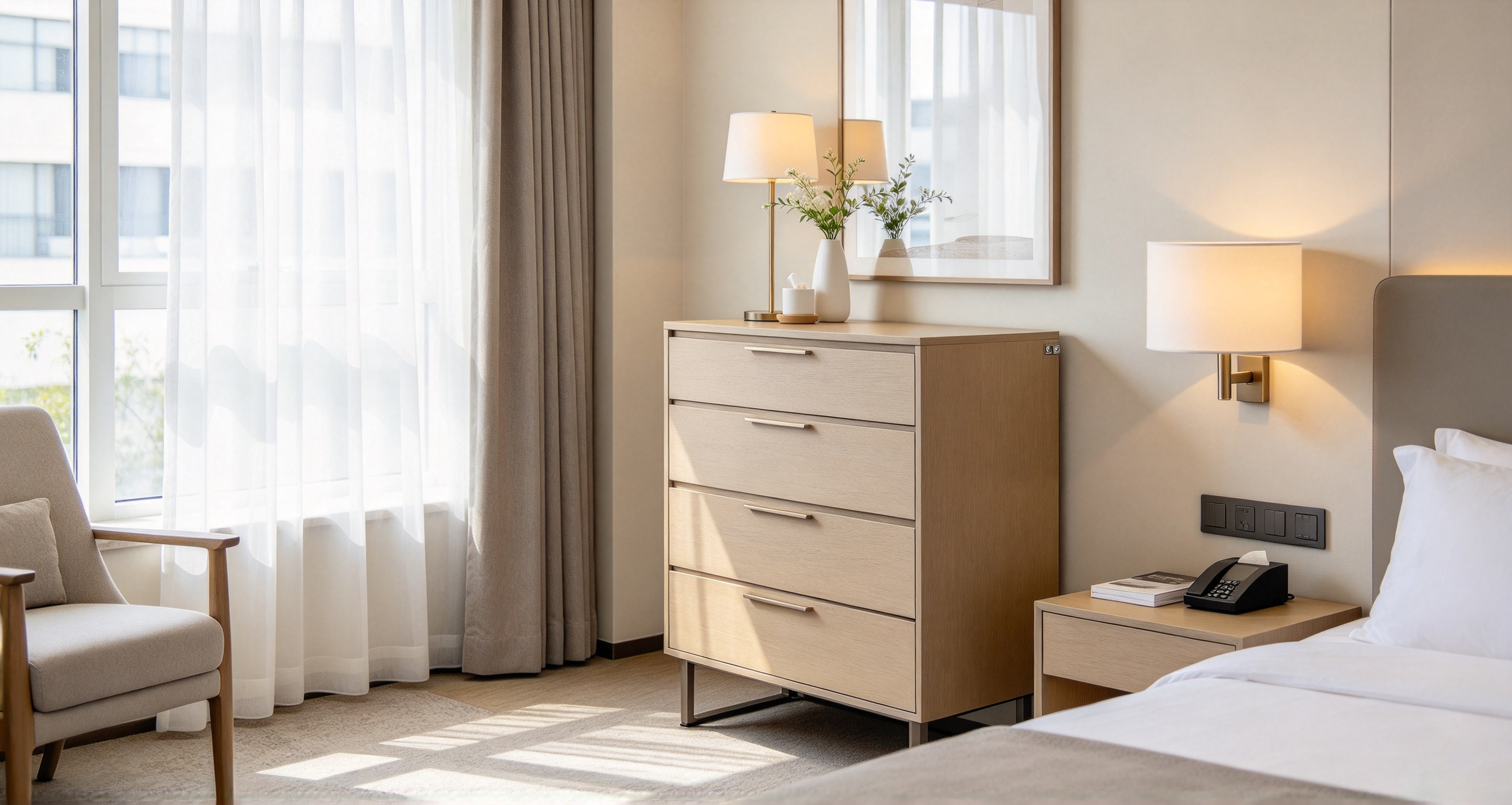
A hotel guestroom is a temporary living space, where guests of all ages, mobility levels, and behavioural patterns interact with furniture without prior safety briefing. Children may climb on open drawers, senior guests may lean against tall cabinets, and housekeeping staff may shift freestanding units during cleaning. Furniture tip-over incidents are not rare isolated accidents; they are a persistent liability risk for hotel operators, FF&E contractors, interior designers, and furniture suppliers. Unlike residential settings, hotel environments involve high turnover, unsupervised use, repeated moving, and diverse guest groups, which makes anti-tip performance a non-negotiable specification rather than an optional add-on.
Anti-tip hotel furniture refers to freestanding storage units, tall cabinets, dressers, wardrobes, open shelving, TV consoles, and high tables engineered to resist overturning under defined test loads and real-world guest behaviours. Compliance with international safety codes creates a shared baseline for manufacturers, buyers, and property insurers. Without documented anti-tip compliance, hotels face potential injury claims, insurance premium increases, brand reputational damage, and mandatory product recalls. This article breaks down the core global standards, test protocols, design strategies, labelling requirements, procurement verification steps, and operational maintenance rules that define compliant anti-tip furniture for hospitality environments.
The Unique Tip-Over Hazards in Hotel Properties
Many procurement teams underestimate how hotel conditions amplify tipping risks compared to ordinary residential use. Residential furniture is often used by a consistent family group, while hotel furniture is exposed to unpredictable guest actions every few nights. The first major hazard comes from drawer and door loading. When a guest pulls out multiple drawers on a tall dresser, the weight shifts forward and creates an overturning moment. In residential markets, this scenario is already heavily regulated, but hotels add extra variables: drawers are frequently left open by guests, housekeeping staff may place heavy guest amenities inside open drawers, and lightweight low-cost cabinet frames are common in budget FF&E packages.
The second hazard is guest interaction. Family hotels attract young children, who naturally climb on open drawers, shelves, and cabinet surfaces. Senior wellness hotels and accessible properties host guests with limited balance, who may grip or lean against tall furniture for support. Even adult guests in standard rooms may lean on a narrow console or push a shelving unit while adjusting luggage. All these actions must be considered in stability testing, because safety codes require furniture to pass the worst-case loading condition, not normal gentle use.
A third hidden risk factor is installation and relocation. Hotel FF&E is often reconfigured during renovations, brand refreshes, or room conversion projects. Anti-tip brackets may be removed, misplaced, or never reinstalled after furniture is moved. Wall anchors can fail when installed into drywall without locating wall studs, or when installers use undersized fasteners. Carpet thickness, uneven floor surfaces, and caster wheels further reduce friction and stability. Wheeled storage cabinets and service carts are especially vulnerable, as casters reduce resistance against tipping forces and allow lateral movement.
Finally, mixed-use zones compound risk. Lobby display shelving, restaurant sideboards, meeting room storage units, and rooftop bar consoles all fall under hospitality anti-tip considerations. These public areas have higher foot traffic, unsupervised children, and frequent staff rearrangement. A single tip-over incident in a public lobby can draw media attention and trigger third-party safety audits across the entire hotel portfolio.
Table 1: Common Hotel Furniture Types and Relative Tip-Over Risk Level
| Furniture Type | Risk Rating | Primary Tipping Trigger |
|---|---|---|
| Tall drawer dressers / chests of drawers | High | Multiple open drawers, child climbing, forward weight shift |
| Freestanding wardrobes and armoires | High | Narrow depth, heavy hanging loads, guest leaning |
| Open display shelving units | High | Uneven top loading, public area access |
| TV consoles and media credenzas | Medium-High | Heavy TV mounted on top, guest pulling on cables |
| Tall sideboards and buffet cabinets | Medium | Asymmetric loading, staff moving items |
| High narrow bar tables | Medium | Lateral push, wind load for outdoor versions |
| Low wide nightstands | Low | Low centre of gravity, large base footprint |
| Low bench seating and storage ottomans | Low | Heavy base, wide stance, low height |
This risk matrix helps procurement teams allocate testing budget and specify mandatory anti-tip hardware. High-risk items should always require third-party stability test certificates and integrated anchoring kits. Medium-risk items need stability verification, while low-risk furniture can rely on basic structural testing unless specified for child-centric or accessible hotel brands.
Core International Safety Codes and Standards for Anti-Tip Furniture
There is no single universal global anti-tip regulation. Instead, different regions operate under harmonised test standards, mandatory national rules, and industry contract specifications. For hotel FF&E suppliers selling internationally, buyers must match the project location to the applicable code set, and document compliance for insurers and building officials.
ISO standards form the global foundation for furniture stability testing. ISO 7171:2019 defines test methods for storage furniture stability, outlining the worst-case loading sequence, test surface conditions, and pass-fail criteria for cabinets, dressers, and shelving units. The standard specifies the sequence of opening drawers and applying static loads to simulate climbing or leaning. ISO 19682:2023 covers stability, strength and durability for tables, which is critical for high-top tables, narrow console tables and bar furniture used in hotel lounges. These ISO test methods are widely referenced in European, Asian, and Australian commercial furniture specifications, even when local national standards exist.
In North America, ASTM F2057-23 is the primary mandatory safety specification for clothing storage units, enforced under the STURDY Act and CPSC rules. This standard sets stability requirements for dressers, chests, armoires and wardrobe units, requiring the furniture to resist tipping when drawers are opened and loaded. ASTM F3096 covers the performance requirements for anti-tip restraint kits, which must be supplied with qualifying storage furniture. A common misconception is that the anti-tip bracket alone satisfies compliance. The furniture unit itself must pass the stability test first; the restraint kit is a secondary backup, not a substitute for basic stable design. BIFMA standards also supplement commercial contract furniture testing for hospitality seating and casegoods, though BIFMA documents do not replace the dedicated anti-tip stability standards for tall storage.
European markets follow EN standards developed by CEN. EN 14749 is the key European standard for domestic and contract storage furniture, including stability and anti-tip testing. It shares many test principles with ISO 7171 but adds regional requirements for labelling, instruction leaflets and warning notices. For outdoor contract furniture in Europe, EN 581 series covers stability for tables and seating, which overlaps with anti-tip requirements for patio and rooftop furniture.
Australia and New Zealand reference AS/NZS 4935 for stability testing of freestanding chests, wardrobes and bookshelves. This standard is widely adopted by hotel groups operating across the Pacific, and it is often required by local commercial property insurers.
It is important to distinguish between voluntary test standards and legally binding rules. Many ISO and EN standards are voluntary by default, but they become mandatory when they are referenced by local building codes, hotel brand FF&E manuals, insurance policies, or project contract documents. For large international hotel chains, brand standards often exceed minimum legal requirements, requiring anti-tip testing even in regions where no local tipping regulation exists.
Table 2: Key Global Anti-Tip Furniture Standards at a Glance
| Standard Code | Region / Scope | Main Application |
|---|---|---|
| ISO 7171:2019 | Global | Storage furniture stability test method |
| ISO 19682:2023 | Global | Table stability, strength and durability |
| ASTM F2057-23 | North America (CPSC mandatory) | Clothing storage units, dressers, chests |
| ASTM F3096 | North America | Anti-tip restraint hardware performance |
| EN 14749 | EU / EEA | Contract and residential storage furniture stability |
| EN 581 | Europe | Outdoor contract tables and seating stability |
| AS/NZS 4935 | Australia, New Zealand | Freestanding storage unit stability |
Anti-Tip Test Protocols: How Laboratories Verify Stability
All recognised anti-tip standards rely on structured laboratory testing, designed to replicate the worst foreseeable guest behaviour. The test sequence is not a casual push test; it follows precise rules for load weight, load placement, test surfaces, and timing.
For drawer storage units, the standard worst-case test condition opens the drawers in the configuration most likely to create forward overturning moment. Typically, the bottom drawer remains closed while upper drawers are opened, and a defined test mass is hung on the front edge of the open drawer. The test load simulates the weight of a child climbing or an adult leaning. The furniture must not lift the rear feet off the floor or overturn for the full test hold duration. Tests are run on both hard flat surfaces and carpeted surfaces, because carpet can reduce friction and change tipping behaviour. Many failed units pass on hard tile but tip when tested on thick hotel carpet with underlay.
For shelving units and sideboards, testers apply offset top loads to simulate uneven loading of guest supplies, display items or minibar stock. The test checks both forward tipping and side-to-side tipping, a requirement that many low-cost suppliers overlook. Narrow, deep shelves often resist forward tipping but fail sideways stability when loaded asymmetrically.
High tables and bar furniture follow separate table stability protocols. Lateral horizontal force is applied at tabletop height, and the table must not slide or tip beyond the standard threshold. For outdoor rooftop furniture, this test is combined with wind load assessment, as covered in our earlier rooftop bar table guide.
Restraint kits are tested separately under ASTM F3096 or equivalent local hardware standards. The bracket, screws, wall plate, cable or strap assembly must withstand defined pull loads without breaking, slipping or pulling out of standard wall substrates. Cheap plastic brackets, thin cable and self-tapping screws into drywall are common non-compliant hardware failures.
A critical point for procurement teams: a test report is only valid if it matches the exact furniture model, dimensions, material thickness and drawer configuration. A test certificate for a 120 cm tall dresser cannot be used to certify a 150 cm tall version of the same design. Suppliers sometimes reuse old test reports for modified products, which creates hidden compliance gaps.
Design Strategies to Build Anti-Tip Performance Into Hotel Furniture
Compliance starts at the design stage, not with a last-minute added bracket. Responsible manufacturers combine passive stability design and active restraint systems to create a layered safety approach. Passive design means the furniture resists tipping even without wall anchoring, while active restraint is the backup anchoring kit.
The first passive design rule is managing the height-to-depth ratio. Tall, shallow units are the highest risk. Increasing base depth lowers the overturning moment. Designers also lower the centre of gravity by adding weighted bases, placing heavy components near the floor, and avoiding heavy solid tops on tall narrow cabinets. Many hotel dressers use lightweight engineered wood tops and integrated weight blocks in the base plinth instead of heavy stone tops.
Wide base footprint and stable leg geometry are the second core strategy. Four-point leg support with a wide spread resists side tipping better than a narrow single pedestal base. Where casters are required for cleaning mobility, manufacturers specify locking casters with high friction locks, and they add anti-tip foot stabilisers that contact the floor once the unit is in its final position. Unlocked casters are a major failure point in hotel operations, as housekeeping staff may leave casters unlocked after moving furniture.
Drawer interlock systems are another effective anti-tip feature. Interlock hardware allows only one drawer to open at a time, preventing multiple drawers from being pulled open simultaneously. This directly eliminates the most common tipping trigger for chests of drawers. Interlock systems are widely specified in family-friendly hotels and child-safe resort brands, and they reduce reliance on guest or staff compliance with anchoring instructions.
When passive design cannot meet stability thresholds, the product must ship with a fully tested anti-tip restraint kit. The kit should include steel brackets, coated steel safety cables or heavy-duty straps, corrosion-resistant screws, wall anchors for drywall and stud mounting, and printed installation instructions. The kit must be packaged with the furniture, and warning labels must clearly state that anchoring is required for safety.
Table 3: Passive and Active Anti-Tip Design Features for Hotel Casegoods
| Feature Type | Design Option | Compliance Benefit |
|---|---|---|
| Passive Stability | Wider base footprint, increased cabinet depth | Reduces overturning moment without hardware |
| Passive Stability | Weighted low-profile base plinth | Lowers centre of gravity |
| Passive Stability | Drawer interlock mechanism | Prevents multiple drawers opening at once |
| Passive Stability | Locking casters plus stabiliser feet | Enables mobility while limiting tipping risk |
| Active Restraint | Steel cable anti-tip bracket kit | Secondary restraint if passive stability is exceeded |
| Active Restraint | Integrated wall anchor mounting points | Pre-drilled positions simplify correct installation |
Labelling, Instruction and Documentation Requirements
Safety codes do not only test physical furniture performance; they also regulate warnings, user instructions and record keeping. Many projects pass laboratory testing but fail compliance audits because of incomplete documentation or missing labels.
Permanent warning labels must be affixed to the rear or side of high-risk storage furniture. The label should use pictograms plus multilingual text, warning of tip-over hazard, prohibiting climbing, and stating that the unit must be anchored to the wall. For international hotel projects, labels commonly include English and other languages matching guest nationalities at the property. Removable stickers are not acceptable; labels must resist cleaning chemicals, UV light and normal wear through the furniture warranty period.
Installation manuals must be included with every unit. The manual should identify required wall substrate types: solid wood studs, concrete block, drywall, or metal stud. It must specify the correct fastener size, torque values and installation sequence. A common installation error is fixing anti-tip brackets only into drywall without a stud, which will pull out under load. The manual should also state that after any furniture relocation, the anti-tip system must be inspected and re-secured.
For procurement records, the supplier must provide a compliance package including: test certificates referencing the relevant standard, test lab accreditation documents, restraint kit performance reports, material specification sheets, warning label artwork, and installation guides. Hotel brand QA teams and insurance auditors routinely request this documentation during pre-opening inspections and periodic safety reviews.
Common Installation and Operational Compliance Failures
Even fully compliant furniture becomes unsafe when installed or maintained incorrectly. Hotel operators and contractors repeatedly encounter the same non-compliance issues.
The most frequent failure is skipped anchoring. Installation teams may view anti-tip brackets as an optional extra, especially when the furniture appears stable at rest. On tight FF&E schedules, installers omit the wall anchors to save time. Some interior designers also dislike visible cables and brackets, so they request that anti-tip hardware be left uninstalled for aesthetic reasons. This decision voids the safety design and removes the supplier’s compliance liability.
The second failure is improper anchor installation. Installers use the wrong wall plugs, undersized screws, or fail to locate studs. On commercial hotel walls with metal studs, regular wood screws will not hold; dedicated metal stud toggle anchors are required. Waterproof exterior walls, concrete panels and tiled surfaces also require special fasteners.
Third, anti-tip hardware is lost during renovation or furniture movement. When rooms are refreshed, staff may remove the cable brackets and store them separately, then misplace them. Replacement kits are not ordered, and the furniture goes back into service without restraints. Hotel operational manuals should create a formal process: any time high-risk furniture is moved, the engineering team must inspect and reattach anti-tip hardware before the room is returned to inventory.
Fourth, warning labels are removed or covered during painting, wallpaper replacement or deep cleaning. Housekeeping and renovation teams often peel off labels or paint over them. Periodic safety walks should check label integrity, and replacement labels should be kept in stock.
Fifth, non-compliant replacement parts are fitted over time. A broken drawer interlock is replaced with a generic non-interlocking runner, or a damaged anti-tip cable is replaced with thin untested cord. The maintenance team may not understand that changing these components breaks the original test compliance.
Procurement Checklist for Anti-Tip Hotel Furniture
Before issuing purchase orders or accepting FF&E deliveries, procurement and project teams should run through this checklist to confirm full compliance.
- Classify each furniture item by tipping risk and identify the applicable standard for the project destination.
- Request third-party test reports from an accredited testing laboratory, not just supplier self-declaration.
- Confirm that the test report matches the exact model, dimensions, weight configuration and drawer layout ordered.
- Verify whether the design relies on passive stability alone or requires mandatory wall anchoring.
- Confirm anti-tip restraint kits are included, with hardware rated to ASTM F3096 or equivalent local standard.
- Review warning label artwork, check for permanent adhesion and appropriate multilingual hazard messaging.
- Review installation instructions for wall substrate guidance, fastener specifications and relocation inspection rules.
- Confirm the supplier provides a certificate package for insurance, brand audit and local building official review.
- Add contract clauses requiring replacement hardware, replacement labels and post-move inspection procedures.
- Schedule site inspection after installation to verify anchors are fitted correctly and labels are intact.
Key Takeaways
Anti-tip compliance for hotel furniture is a layered safety system, combining inherently stable design, validated laboratory testing, tested restraint hardware, clear warning communication, and consistent on-site installation and maintenance. No single component solves the tipping hazard. A well-designed dresser with a weak bracket is unsafe; a strong bracket fitted to a poorly designed shallow cabinet cannot reliably prevent tipping; and fully compliant furniture becomes risky when installers skip anchoring or maintenance teams lose hardware.
International standards provide a shared framework for buyers and suppliers across different regions. ASTM F2057 and ASTM F3096 govern North American mandatory requirements, ISO 7171 and ISO 19682 provide global test methods, EN 14749 applies in European contract markets, and AS/NZS 4935 covers Australia and New Zealand. Procurement teams must map the project location and brand requirements to the correct standard, and reject generic “commercial grade” claims that lack stability test evidence.
For hotel operators, anti-tip compliance is both risk management and brand protection. It reduces the chance of serious guest injury, limits insurance exposure, and satisfies the strict FF&E audit requirements of major hotel groups. For furniture suppliers, documented anti-tip certification is a powerful differentiator in B2B hospitality bidding, separating manufacturers that invest in safety engineering from low-cost suppliers that cut corners on stability testing.
When anti-tip rules are embedded into the specification stage, verified by lab testing, installed correctly, and maintained through the furniture service life, hotels can deliver guest spaces that are aesthetically pleasing, commercially durable, and reliably safe for every guest profile.
FAQ
Q1: Does every hotel cabinet need to be anchored to the wall?
A: Not every unit requires wall anchoring. Low, wide, heavy furniture with a large footprint can pass stability testing through passive design alone. Tall, shallow, high-risk storage units such as dressers and open shelving typically require anchoring as a backup, even if they pass the static stability test. Always follow the requirements stated in the relevant standard and the supplier’s test report.
Q2: Can I use a self-declaration from the manufacturer instead of third-party lab testing?
A: Self-declaration may be accepted in some regions for low-risk items, but most hotel brands, insurers and mandatory regulatory regimes require third-party accredited laboratory test reports. Self-declaration is not sufficient to satisfy CPSC requirements under ASTM F2057-23.
Q3: Are anti-tip brackets visible and will they ruin interior design?
A: Many modern restraint kits use thin steel cables and low-profile brackets mounted at the rear of furniture, so they are hidden from guest view. Design teams can specify recessed mounting points to reduce visual impact. Removing brackets for aesthetics is not a compliant safety trade-off.
Q4: What is the difference between ASTM F2057 and ASTM F3096?
A: ASTM F2057 tests the stability performance of the furniture unit itself. ASTM F3096 tests the strength and reliability of the anti-tip restraint kit hardware. Both may be required for full compliance for clothing storage units sold into North America.
Q5: If furniture passes anti-tip testing on hard flooring, is it automatically safe on carpet?
A: No. Carpet and underlay change friction and tipping behaviour. Most standards require stability tests on both hard surfaces and carpeted surfaces matching typical hospitality flooring. A unit that passes tile testing may fail on thick hotel carpet.
Post time: Nov-06-2026